Saturday, December 21, 2013

New PS4 and Xbox One Game Consoles: A Mixed Bag for Energy Efficiency

 Photo by Javier Domínguez Ferreiro under Creative Commons licensing)The Natural Resources Defense Council has just completed rigorous measurements of the power use of the newly released U.S. versions of the Sony PlayStation 4 (PS4) and Microsoft Xbox One. We found that the new models have made substantial progress on energy efficiency compared to their predecessors, the PS3 and Xbox 360. But despite these power-saving advances, the new consoles' higher performance and new features result in up to three times higher annual energy consumption than their predecessors. 


That adds up to a lot of energy every year. In fact, even if these new video game consoles became 25 percent more energy efficient on average over time – which we believe is possible – they would still use between 10 and 11 billion kilowatt hours of electricity annually once the new consoles have replaced the more than 100 million units currently in use.


This translates to four large power plants and over $1 billion in annual electricity bills. To put this into further perspective, video game consoles in the United States are projected to use more electricity annually than all the households in Houston, America’s fourth-largest city.


Thumbnail image for Projected Video Game Console EConsupmtion.png


Fortunately, a number of relatively simple enhancements can reduce this energy consumption by more than 25 percent. Here’s a summary of some of our findings and key opportunities, in advance of NRDC’s full report scheduled for release early next year.


The Good – To their credit, Sony and Microsoft have done a lot to make sure the energy use of these devices was not even higher. They use very efficient power supplies to minimize energy losses in power conversion, advanced multi-core chips that can throttle down power use when the task at hand does not require full power, and well-designed “auto power down” software so the device automatically drops to a lower power state after an extended period of user inactivity. The new models also allow for charging the USB controller and headset from sleep mode, eliminating the need to keep the console on just to charge accessories. And Sony and Microsoft each came up with an innovative energy efficiency feature: after 10 minutes of inactivity, PS4 reduces console power in Navigation mode while Xbox One dims the TV.  


The Problem – When you add it all up, however, the new consoles may still use up to three times more energy than their most recent predecessors because of a combination of factors: they use more power to play games and watch movies, and use that power over a longer period of time, particularly while in sleep mode (called Connected Standby) when you may not even be in the room or charging accessories, and in TV mode, when you use the Xbox One to control the TV.  


How much power do these new models use? – NRDC measured the power consumed by each model during active game play, streaming a movie, when the menu screen is selected (Navigation mode), and when the console is in connected standby or completely turned off. We found all levels are significantly higher than their predecessors. For example, the Xbox One uses approximately 40 percent more power to play a game than the Xbox 360, and the PS4 consumes almost twice as much as the PS3.  (Note: some of the Xbox One’s incremental power use is because of the Kinect voice and motion recognition device now included by default with the console.)


In all of the active modes, the PS4 requires significantly more power to perform similar tasks as the Xbox One. Although the PS4 delivers higher resolution images and uses a more powerful graphics processor, its power levels should be closer to the Xbox One. However, the Xbox One uses twice as much power as PS4 when in “connected standby” (called “Instant On” on Xbox One), the default mode most U.S. users will experience when they turn their device “off” unless they change settings to the Energy Saving mode. While in connected standby, the Xbox One is consuming all this power waiting for the user to walk into the room and say “Xbox on,” even if nobody is home. Both devices have a more traditional “off” state that uses less than 1 watt of power, but it is unlikely many users will get there given the design of the set-up menu.


PowerInModeChart.jpg


(1) With Kinect and PS4 Camera installed


(2) With USB charging enabled


How much energy do these devices consume annually? – After applying a typical usage pattern to these power measurements, NRDC found the Xbox One uses more energy per year than the PS4 due to its very high connected standby power level, the mode where the boxes reside for most of the day. This “always listening” feature is responsible for almost half of the Xbox One’s annual energy use and consumes more electricity annually than the 50-inch TV to which it might be connected. Given Microsoft’s recent release of its “carbon fee playbook” about its leadership in the area of reducing company-wide carbon emissions, we anticipate the company will make it a priority in future updates for the voice recognition feature to use a lot less power when no one is home or likely to use the console. 


In addition, Microsoft’s business plan that seeks to make the Xbox One the media hub of the living room will likely result in increased hours of operation and console energy use. People who use this feature to watch YouTube videos, cable TV, etc., will have their console on for as long as their TV, which is roughly five hours daily.


EnergyPerModeChart.jpg


(1) Based on active use (playing games, watching movies and TV) of 2.9 hours per day for PS4, and 4.0 hours per day for Xbox One (assuming 30% of people use Xbox One’s TV integration mode)


Over five years, the Xbox One’s 250 kilowatt hours per year usage represents roughly $150 in electricity costs, enough to buy two or three new games!


What improvements are needed?


Launch models are more focused on working well than on efficiency. We expect upcoming hardware and software revisions to bring efficiency enhancements, but the question is how much and how soon. As we enter the holiday season, here’s our efficiency shopping list for Sony and Microsoft:


  1. Sony to reduce active mode power levels of the PS4 closer to those already achieved by the Xbox One. Both use the same AMD “system on a chip” in their consoles so this should be attainable through system software enhancements with little or no hardware changes.

  2. Microsoft should bring down the energy use of its consoles in connected standby. There is no reason they should consume over 100 kWh per year, mostly in the middle of the night waiting to hear someone’s voice asking the console to wake up.

  3. Sony’s PS4 uses 8 watts of power in connected standby when USB charging is enabled. While this is a good feature as users can charge their controller and headset without leaving the console on and fully powered, laptops perform this function for only 1 watt and Sony should strive to achieve similar levels.

  4. Sony and Microsoft both need to work toward bringing down the power needed to stream video or other media content. Standalone devices like Apple TV and Roku need less than 5 watts to stream HD movies – a whopping 15 times lower than PS4 and Xbox 360. This improvement is even more critical for Microsoft’s Xbox One due to its TV integration mode, which may result in the device operating for more hours and consuming more energy.

We are hopeful that Microsoft and Sony will implement these recommendations quickly, game on!

Friday, December 20, 2013

The Hard Truth About Being Addicted to Social Media

I moved to LA for many reasons, one of them being that I wanted to have a more enriched and fulfilling life. My excuse for being addicted to television and internet in Toronto was because of the weather. That during the summer my "addiction" was limited because I could actually go outside and enjoy myself. Fast-forward a year and here I am with hours upon hours a day on various social media platforms and in front of the soul sucking television.

I started to get serious anxiety, knowing that my life's precious moments are being wasted but justifying that it's dark out, there is nothing much to do, saving money, etc. My husband would come home from work and my nose would be in my computer working or stuck to the television getting caught up on the latest drama.

We barely spoke to each other during the week, which was justified by many excuses on both our ends but none of them really being valid. Still in denial I started finding myself feeling more stressed, and even though I was working all day on the computer, communicating with clients, art directing, writing, I was constantly being pulled into the vortex of my Facebook news feed and would often find myself mind numbingly scrolling through posts after posts.

During which, if I were actually paying attention, my emotions would fluctuate within seconds based on what I was looking at. For instance my thoughts would go something like this:

Oh that's a new article on the 80 millionth way I can use coconut oil, oh I shouldn't be eating that meat now it's contaminated, oh no our water is being polluted by radiation!, oh wow I am a spiritual strong being and can't forget that I AM AMAZING! (Insert inspirational quotes for about five status updates) look at the success of those people I wonder what they are doing to get to where they are.

And on and on and on... so I would go from feeling guilty about the food I was eating, then paranoid about the state the world was in, then uplifted by random quotes, then frustrated that I'm not hustling enough, and repeat. Exhausting to go through in a matter of less than 5 minutes!

I didn't realize at the time but I started feeling depressed, I felt like it was so difficult to focus on anything and that I actually had ADD. This went on for a long time and honestly I can't even remember when it started, probably the minute I opened up my Facebook account. Who knows, but I was realizing that the life I thought I was going to have in LA was beginning to mirror the misery I was feeling in Toronto.

It wasn't until I was speaking to one of my best friends Nikki Jumper did I realize what the root to my emotions of defeat and sadness were. We started talking about our careers, what we wanted to do in life, what we were feeling and it didn't take us long to realize that we were both on the same page. How was it that two, talented, intelligent and ambitious women were both feeling stuck, frustrated and uninspired. It finally clicked when I blurted out "You know what, Nikki, I hate Facebook sometimes" and went on a rant about how it has taken over my life and that even though a lot of my work is based on social media communication, there is no reason that I need to be sucked into that vortex when it clearly is not serving me.

"Here we are trying to connect to everyone in the world through social media and yet all we are doing is disconnecting from the people we are with, from ourselves, from the moment, it's complete hypocrisy!" And then the light bulb went off -- insert aha moment.

"Nikki, let's you and I commit to something here and see what happens" -- she was intrigued as always to new and exciting ideas (I love her) let's limit our usage of social media, television and emails. I'm going to write out a schedule as to when I'm allowed to go online and stick to that schedule for two weeks! Then let's document all the stuff we do when we aren't online, when we would have been trolling through our various social network feeds hypnotized by empty words. She was in and needless to say the second we got off the phone I started to schedule.

Now I want to be clear, my intent is not to completely obliterate social media, the goal is to be selective and allow myself short windows throughout the day to participate with the technological world. There is no way I can cut out social media from my life because it is a major part of my career as a marketer. I'm not rebelling, I'm simply taking things in moderation and removing the unnecessary chatter.

The first thing I am committing to is that for the first hour of the morning I am not touching my phone. It is BRUTAL that I wake up every day, say a little prayer thanking the Universe that I'm alive and immediately reach for my phone and go through my emails, Facebook, Instagram what have you, before I even brush my teeth!

Immediately stress levels are elevated from the second I wake up, what an awful way to greet the day. So that was step one, no communication through technology until I've been out of bed for one hour at least. Step two; limit my social media time to three intervals for 30 minutes each. This means if I have any client work I can use that time to communicate and pre-schedule (I also have a team of people working on my client social media stuff so they are not being neglected by any means), I can keep my newsfeed open and talk to people and network during those times. I have set my alarm to go off as to when these social media times begin and then when it's time to shut it down. I have given myself a morning, afternoon and evening window. (Oh and if for any reason I miss that window, it's gone for the day, I cannot make it up during another time)

As a result I have turned off all notifications from my phone. This was the WORST constantly being bombarded with updates on news-feeds and comments and what have you. I felt like I couldn't let go and just get a moment's peace. I have also allowed myself a maximum of 2 hours of TV every day. In addition to that all emails are turned off at 7:30 p.m., there is no world where I want to live that I am at the beck and call of my "job" even if it is my own business. I have created the freedom of being an entrepreneur and I plan on actually using that to be free and not a slave to my own business. (Been there done that and it sucks hard.) The other thing is that I am turning off my phone after 10 p.m. No communication for 1-2 hours before I go to sleep. I am committed to creating a ritual of down time for me to start relaxing and winding down and getting ready to clear my head and be prepared for a new day of clarity.

I'm on day two of this journey and so far I have seen amazing transformation. Yesterday my husband and I spent the whole day off social media (I forgot to mention that Saturday is a complete disconnect day) what I discovered was that using our time to talk and connect and dream was incredible. We spent the entire day and night together and we had so much fun and we didn't need the distraction of television, or movies or internet to fill up the space and time. (What do you know I actually have a great relationship just being with my husband enjoying our time together)

My grandparents, God rest their souls, used to eat dinner at the dinner table (not in front of the TV) and then sit in the living room and chat for a few hours before they retired to the bedroom and only then would they watch TV and fall asleep. This was after 63 years of marriage. It's only been two for us, so we have a long ways to go, but I want to establish a pattern that we can build off of and not bad habits that create major separation for us to repair later down the road.

On day two as I see text messages coming in from Nikki as to how productive she's already been, I have managed to write three pages of this inspired post or series of posts whatever it is going to be. What I would have normally done was sit on Facebook and scroll through feeds and really drove myself nuts again. My alarm went off to tell me I can get on social media this morning, but I ignored it. (Granted, I did go on for like five minutes about half an hour ago, but I'm still keeping disciplined.)

I know it's going to take time but I'm going to do my best without judgment. The irony in all this is that I told Nikki as soon as I wrote out this schedule that I felt like such a fool to even have to do this -- it seems so idiotic that this is what my reality has come to. What did we do without social media? Well we sat on the phone for hours, I remember that.

I will keep writing about the changes I experience, not for anyone else but for myself, to see how I can use my time to be more creative, inspired, and productive. I'm looking forward to seeing the outcome of this challenge and I already feel a HUGE relief just knowing that I have made this commitment so far.

If you want to join me on this journey, I welcome it! We can share our experiences together (possibly on social media but only in our allotted time frames). It's different for everyone, and I have no judgment for people who just love to be online all the time, it's just not for me. So when the alarm bells are ringing, it's time to take action.

2013-12-19-SariSig01.png

www.facebook.com/TrueProsperityMarketing
www.sarigabbay.com
www.u2r1.ws

Thursday, December 19, 2013

Why Barrett Brown's Trial Matters

Before he was arrested and detained, I asked Barrett Brown why he didn't encrypt his communications. He replied, "I don't consider myself a criminal in any shape or form and never have, and refuse to 'hide' from a government I see as illegitimate."

As a journalist who'd been around awhile and witnessed the media's incompetency firsthand, Barrett understood the stakes in the ongoing information war, and that's why he devoted himself with zeal to advocating for Anonymous. Erroneously pegged by the media as a "spokesperson" for the group, he merely served as a colorful character to explain its operations, though he never participated in hacking. Far more near and dear to him than Anonymous was the outfit he'd created, called Project PM.

Project PM is a crowd-sourced investigation focusing on private contractors and their dealings with governments. It was designed to be an actionable resource for anyone interested in learning about the growing surveillance state, the activities of cybersecurity firms, and other threats. Using a combination of open source intelligence, e-mails leaked by hackers, and ordinary research, they released reports and exposed a number of alarming capabilities, particularly showing that activists and journalists were at significant risk from rogue elements of the intel community-even before Snowden blew the whole system wide open.

It's no accident that the DOJ, which has already been implicated in schemes to go after critical journalists and activists (see: Team Themis), has brought its full force down upon Barrett Brown, overreaching quite dramatically in the process. The existence since September of a gag order is telling, as is the earlier subpoena of his website to identify those he worked with. Altogether he's looking at a maximum sentence of 105 years in prison, and the idea that his persecution could be unconnected to his work is absurd.

A few months ago Rolling Stone posited that "Brown's case is a bellwether for press freedoms in the new century, where hacks and leaks provide some of our only glimpses into the technologies and policies of an increasingly privatized national security-and-surveillance state." Indeed. So it's not surprising that the establishment seeks to imprison and silence those intent on using the advances of the information age to expose it. In effect, the FBI has outed itself as ever-so-dutiful servants of the private security companies Brown was researching.

In cases involving information activists who threaten the status quo, the feds stack the deck and disregard the rule of law. It happens frequently nowadays. They twist statutes beyond recognition, overcharge the defendant and misapply due process as a crude mockery of "justice." They exploit vulnerable personalities and prey on a defendant's inability to gain wider support or mount a competent defense. They count on this strategy to succeed, but we can't let them.

There's a small minority of people who'd rather focus on the circumstances of Brown's arrest -- that is, how he reacted to being investigated, raided, and surveilled by the FBI, while being incessantly harassed online by contractors, informants and trolls, and the very real legal threats against his mother-while ignoring the more significant First Amendment issues at stake. These people have already convicted him in their minds, despite the doctrine of "innocent until proven guilty."

His critics focus on a video in which he demanded his stuff back from the feds along with an apology, and vowed to investigate and expose the lead agent on his case -- explicitly disavowing violence -- while pledging to defend himself. He proposed to do to them what had been done to him. We could speculate about what his state of mind was when he made those statements, but what does it matter? Apart from the fact that he didn't hurt anyone, and the very murky, questionable nature of the supposed "threat", along with the obvious free speech implication, when one examines the rest of what he's been charged with, these allegations patently represent the least of what he's facing.

More to the point, the central charges in his case threaten our right to link, and could set a legal precedent for the criminalization of transmitting certain hyperlinks. It's a classic slippery slope. Fundamentally this is about Internet and press freedom, and it affects us all.

The link at issue didn't only contain credit cards -- it was Statfor's customer database, revealing the extensive connections of their clients to the government, private industry, the military and defense world, and think-tanks. One could search for email addresses or names within that list and find all sorts of noteworthy things. There's no allegation that Barrett used this information for financial gain, that he was involved in the breach, or that he hosted it anywhere. Jeremy Hammond pled guilty and was sentenced to 10 years in prison for some of these actions. And yet here we are: multiple counts of identity theft and fraud. It seems like they piled on whatever they could, right?

The question is: what does this mean for people who link to WikiLeaks? Or journalists who use leaked or stolen source material? What does this mean for technology reporters filing stories about hacks of password databases? And what about the average Internet user -- should they also be prosecuted for their curiosity?

Organizations and citizens alike devoted to a free press and digital rights are concerned.

When agents came to his mother's home and asked if he wanted to hand over his laptops (later obtaining a warrant), he was in the middle of writing a book about Anonymous, while still searching through the Stratfor e-mails for stories and directing Project PM. Michael Hastings reported, "They're after his Twitter records, chat logs, IRC conversations, his computer, and apparently everything else." They seized all those things and more. As a result of his case we now understand that the FBI expects investigative journalists to hand over their computers and sources or else they could face obstruction of justice charges.

The search warrant listed HBGary and Endgame Systems, two firms which were written about at Project PM. Brown noted that those searching his belongings would find evidence of wrongdoing by contractors, yet "they will not choose to investigate those sorts of things." Such is our two-tiered justice system, with a revolving door between agencies and firms.

In recent years, many journalists covering the national security beat have been subpoenaed for their sources; although leaks are tolerated when their purpose is to make the current administration look good. The New York Court of Appeals recently held, "There is no principle more fundamental or well-established than the right of a reporter to refuse to divulge a confidential source." Yet the colluding interests of the security apparatus and its federal enforcers don't believe in reporter's privilege, as exemplified here.

If independent journalists like Brown cannot publish the truth without becoming a target of extremely selective and vindictive prosecution, the concept of freedom of the press which is vital for democracy is as good as dead. His continuing pretrial detention on an extremely dubious (and secret) basis has already had chilling effects and occurs contrary to any notion of the public interest. People are now thinking twice before linking to things.

Ultimately it's other voices like Barrett's, without institutional backing or adequate shield law as protection, who are most at risk. Supporting digital security for journalists is one way forward.

Another question raised at his trial could be the false distinction between journalism and activism, or the legitimacy of "advocacy journalism." This is a crucial debate, but most have long recognized that standards of so-called journalistic objectivity are a joke. Before the 20th century, almost all journalists were partisan, and they were expected to be. Embedding oneself inside a worldwide movement for transparency without even the advantage of a mask, Barrett sensed where the action and the story lay, and decided to become a part of it. His experience told him that the Internet combined with a decentralized collective would be a powerful tool for political change, capable of challenging state and corporate concerns and reshaping the media landscape. His treatment, which is indicative of the perceived threat by those in power, shows that he was onto something.

In any case, a memorandum filed by his defense lawyers puts to rest any argument about his role and status as a journalist.

Noam Chomsky states that Barrett Brown is being "punished for the crime of taking citizenship seriously." This is clear: he stands for values of liberty, transparency and privacy; though soon prosecutors in Dallas will try to persuade a jury otherwise. Increasingly, conscious citizens know the true score -- an electronically connected generation that is skeptical of authority after a decade of failed wars and mass spying will not be fooled by their arguments.

If the charges are not dropped or thrown out of court by next spring, and he finally makes it to trial, then we should severely doubt this administration's commitment to the rule of law, free speech, freedom of the press, and one's rights on the Internet. What we may witness next year is nothing other than a landmark case.

Tuesday, December 17, 2013

Year of the Whopper: Top Ten Lies, Hoaxes, and Pranks of 2013

If North Korean Supreme Leader Kim Jong Un had whispered to his uncle, "Looking forward to seeing you over the holidays" it would have taken the cake on this year's Top Ten List... but this year there were even stronger real contenders:

10. The "Diane" Flight Hoax

Diane was an airline passenger on Thanksgiving. Frustrated by holiday delays, her mood arced from agitated to hostile to sinister temptress that represented everything people hate about air travel.

Thanks to in-flight wifi, Diane -- and her temper tantrums -- became Internet celebrities before her plane's wheels hit the runway. A producer for the hit ABC series, The Bachelor, took to Twitter to broadcast the play-by-play, while cheerfully provoking her and egging her on. The Arthurian battle ended in the terminal with Diane slapping him and airport officials threatening to arrest her. By then, social media was on fire with an impracticable display of both empathy and hate for the hapless traveler.

The only problem is that Diane never existed. The following week, the mischievous producer confessed the whole show was theater. Maybe it was a way of passing time on a painful flight; maybe it was a way to spin up an avalanche of new Twitter followers. Regardless, never believe those lying eyes... or those lying tweets.

9. Manti Te'o's Imaginary Girlfriend

Notre Dame linebacker Manti Te'o was having a career season. The Fighting Irish were destined for the National Championship game, and the All-American linebacker was leading the charge. The only catch? His girlfriend Lennay was stricken with leukemia. Manti told his teammates and the media alike the heart-wrenching tale of nights spent holding her hand, trying to pull her out of a deep coma.

On game day, Lennay passed away. Manti met the moment, inspiring his teammates and leading them to a 20-3, "win one for the Gipper" walloping of Michigan State. The following week, she was buried. But she had insisted Manti not miss his game. Another victory followed, and Lennay became a celebrity. Heisman trophy whispers orbiting Manti grew to a chorus. Charities were started, Notre Dame's campus electrified.

If only she existed. Manti's Shakespearean love drama unraveled just in time to distract the team ahead of the National Championship game. They lost to Alabama 42-14.

8. Barack Obama Flirts with his Danish Counterpart

Oh that incorrigible scamp Barack Obama! On a solemn occasion such as Nelson Mandela's funeral, you'd expect some reverence from the Commander-in-Chief. Instead, an Agency France-Presse photographer snapped a few shots of the President giggling and playfully enjoying a coquettish chat with the comely Prime Minister of Denmark.

Bystander Michelle Obama's stern look of disapproval added to the fun. A few moments later, in the seat-change heard round the world, the First Lady plopped herself between the two like the reincarnation of the Berlin Wall.

Social media, as social media is wont to do, blew up. Media outlets, as media outlets are wont to do, followed social media's cues and hungrily ran "the sequel" to President Clinton's noted philandering.

To the world's dismay, the AFP photographer put a stop it all. "Photos can lie," he wrote on the AFP blog. "In reality, just a few seconds earlier the first lady was herself joking with those around her, Cameron and Schmidt included. Her stern look was captured by chance."

7. Jimmy Kimmel's Twerking Prank

Before Miley Cyrus made the fiery booty shake colloquially dubbed "twerking" a household name, one poor young lady introduced the dance to the world in a somewhat more subtle, if not wildly painful, way.

She decided to film herself twerking, maybe for the Internet's enjoyment, maybe for her boyfriend's. But normal twerking simply wouldn't do. That's not the way to get a good video to go viral. Instead, she flipped herself in a handstand and twerked her front door like it was Kanye West. A hapless roommate opens the door, she falls onto some candles, and before you can click back to Amazon, the poor girl is screaming in terror as flames creep up her leg.

It took approximately 6 days for the video to hit 6 million views, or roughly the population of Denmark. It was somewhere in the range of 12 million views when late night host Jimmy Kimmel, known for his pranks, decided to confess the whole thing was nothing more than a spirited hoax.

6. Lance Armstrong Fesses Up

There's nothing more excruciating to watch than a house of cards tumble. But how else can you describe cyclist Lance Armstrong's fall from divinity? Over a decade of astounding cycling victories, coming on the heels of a nasty cancer diagnosis, Armstrong's abilities seemed mythical.

Turns out he was juicing himself up like a reality TV version of the 6 million dollar man. When teammates, staff, competitors or anyone else dared challenge Armstrong's integrity, the Tour de France champ resorted to intimidation, bullying, and the tried-and-true lawsuit.

The U.S. Anti-Doping Agency eventually zeroed in on Armstrong like a cruise missile, and the walls started closing in. So where else to go but Oprah? Armstrong's heartfelt penance in the daytime star's confessional swept the chaff off of years of cheating and scandals. Though it's reasonable to expect he was being truthful under her microscope, the culmination of 10 years of fibbing earns Armstrong the number 6 spot on the list.

5. Google Nose: Smelling is believing.

There are an astounding 12 billion Google searches per month. That type of attention has turned the search engine giant into a quasi public laboratory, where people watch the company do wildly fun and interesting things like build glasses that interact with the world, self-driving cars, and moon maps.

So no one smelled a rat on April 1st 2013, when Google announced its latest creation, Google Nose. Not at first, at least. In an admirably convincing video that was unveiled on the Google homepage, the wily tech wizards from California proudly proclaimed a breakthrough in "photo audio olfactory sensory conversion." In English, it meant you could search for smells.

The date, of course, should have been a dead giveaway. Google was just having some April Fools' fun. But the jig wasn't up until the online and communications world exploded with a cheerful mix of confusion and enthusiasm. Consider it a user-warning for the next time April creeps around.

4. Amy's Bakery

It's no secret that businesses will bend, distort, twist, stretch, and ultimately break their word to lure in consumers. But it's not always the big guys who do the fibbing.

Take the sad saga of Amy's Baking Company. In a reality show where celebrity chef Gordon Ramsay tries to rescue failing eateries, even Lucifer himself of Hell's Kitchen couldn't put the owners on the straight and narrow. After enduring baffling stubbornness and a dismal work ethic, Amy's Bakery was the first and only establishment Ramsay abandoned.

It got worse. Amy, the eponymous owner of the bilious bakery, was later caught reselling a stale old cake that she claimed was hers. Her ensuing Facebook meltdown bordered on madness, as Amy hysterically mapped out a conspiratorial alliance of "haters" and the downright jealous, all out to get her. Naturally, Amy and her bakery quickly found themselves the subject of viral Internet and media fame.

It's more fun to pick on the Fortune 500s and their often-questionable relationship with the truth. But for Amy's cringe-worthy train wreck of paranoia and blatant lying, this small business owner earns the number four spot on the list.

3. Anthony Weiner Comes Clean

After Congressman Anthony Weiner was caught distributing photos of his canoodle to individuals best descried as women other than his wife, he went into full rehab mode. Following the old time-tested political playbook, Weiner went to the media and admitted he lied, took some time off to "be with his family," and reentered politics after the tidal wave of outrage receded.

The New York City Mayor's race was the perfect target for the shameless Representative from Brooklyn. Weiner was justly apologetic. Humbled, he swore up and down that he had seen the error of his ways, insisted that he was whole again, that he learned his lesson. And it was working. As recently as May, some polls had him leading a crowded field of mayoral aspirants.

Then a young woman curiously named Sydney Leathers sank the ship. She blew the whistle on her well-documented online relationship with Weiner. His campaign's following implosion was worthy of the Hindenburg.

Weiner finally confessed to a double-digit number of illicit relationships, including 3 after he was chased out of Congress. On Election Day, he stumbled to an ignominious 5th place finish.

2. Lesbian Waitress' Bigotry Hoax

Americans are empathetic people. So when a struggling young lesbian waitress posted a restaurant recipient with a bigoted, anti-gay note in place of a tip, the sympathy -- and the dollars -- started pouring in.

For a time, Dayna Morales was the talk of the town. You couldn't scroll through a Facebook newsfeed without seeing her story. Thousands of dollars found their way to the former Marine, who gallantly promised to donate the proceeds to the Wounded Warriors Fund.

That's about where her story fell apart. A nice couple that frequented Morales' restaurant spotted their receipt and some suspicious alterations on the tip line. Justifiably interested in clearing their name, the couple took to the evening news with their copy of the receipt, noteworthy for its 20% tip instead of a hateful note. They even dug into the their credit card statement to cement their alibi.

Morales was later caught flatfooted by a local NBC affiliate, wide-eyed and full of denial. Faster than you can say "cry for attention," the restaurant did a short investigation and promptly let her go. And the Wounded Warriors? They're still waiting for that check.


1.President Obama "If you like your insurance, you can keep your insurance."

Nothing defines a presidency like a lie or empty promise that becomes a legend. Nixon fled the White House after Watergate. George H.W. Bush promised "Read my lips. No new taxes". President Clinton will be remembered for "not having sex with that woman" and the impeachment that followed.

President Obama made many promises during his 2012 election run. But perhaps no promise was more punctuated than his insistence that if "you like your health insurance, you can keep your health insurance." In what's certainly one poor speechwriter's regret, that line has replaced the Obama Administration's hopeful clarion's call of 2008 with the glum thumping of a tuba.

Three months after implementation of Obamacare and 15 months after the election, nearly 5 million Americans have lost their health insurance. And another 129 million more are vulnerable to losing their plans. Politifact has already rated it the Lie of the Year.

Whether the President was the victim of poor choice of words, poor policy, or poor politics, his empty assurance wins the title-belt of 2013's sordid gallery of hoaxes, fibs, and whoppers.

Monday, December 16, 2013

Scandiweb: Latvia's Magento Magicians

201ldn't have 2-06-27-techscapelogocolumn1.jpg


Where is Latvia? What is Magento? What is Scandiweb?

Let me handle those questions in their proper order.

1. Latvia is one of the "Baltic countries" located on the northern rim of Europe, across the Baltic Sea from Stockholm and sandwiched in between its Baltic partners Estonia to the north and Lithuania to its south. With a population of about two million, it's capital is Riga, a beautiful old city with superb architecture reminiscent of Paris or Prague in places. Latvia was a country besieged in the 20th century first by Stalin and his Bolshevik murderers, then by Hitler and his Nazi degenerates and finally -- as if that wasn't enough -- Stalin again. Though their official language is Latvian, most Latvians speak Russian and many refer to themselves as "Russian." Latvians, in my experience, are fun-loving, uber-intelligent people who enjoy technology to its fullest. Given their awful dictatorial experiences, they are about as resilient a people as one could find on this planet and are delighted by meeting new people and talking about technology.

2. Magento is an E-commerce web application which has attracted a strong following amongst retailers and online merchandisers with over 180,000 clients from small online shops to big department stores. It is also Open Source, which I just love; and far more importantly, developers also love Open Source platforms. Started in 2007, Magento has been a pioneer in the transitioning of e-commerce on mobile devices. In 2011, eBay bought Magento.

3. Scandiweb is a small company of 50-plus young tech people based in Riga, the capital of Latvia. I have a fascination with Russia and Eastern Europe (EE) and have been to Riga many times. There is a different kind of mind in these regions, one where mathematics and software algorithms rule the day and are embraced not feared as they sometimes are in the West. Riga has some bad-ass programming minds and capabilities as most of the giant EU tech/telecom companies have discovered; they partner with and usually end up acquiring these Petrie-dishes of software coding activity.

Antons Sapriko is the CEO of Scandiweb. He is perhaps one of the foremost examples of how I profile Eastern Europeans above. Sapriko won the Latvian Math Olympiad and possesses one of those highly mathematical minds which can translate to computer programming very easily.

2013-10-11-ScandiwebAntons1.jpg


Having studied at university and been fascinated with early programming classes, Sapriko then went on to study IT at the University of Copenhagen, a top regional business school and there became mesmerized by Magento. Couple this software interest with Sapriko's early entrepreneurial experience washing cars at age 11 and you have one well-rounded tech entrepreneur.

As a 21-year old in Riga, he first worked for an international furniture manufacturer but quickly decided he "wasn't happy with that career. So I decided to travel the world for a while," he told me. "I spent a year or so cleaning beaches in Spain from an oil spill there around 2001," he said making me think giving something back is an imperative ingredient for business success.

And as this quote from Sapriko clearly shows, he's got a clear vision around turning others on to Magento too. "What excites me at Scandiweb is our ability to take programmers from beginners to world-class professionals. I love watching former interns become certified Magento developers and teachers for the next bunch of newcomers. Every year our unique training and development model opens new possibilities we never imagined."

Scandiweb is the type of start-up that could certainly put together your web site -- if that's all you wanted. Like many of these EE tech/programming start-ups, Scandiweb is way into the deep back-end of their technology projects meaning the user interface/experience (UI/UX) are not their main concern but the way the web client connects and works with the entire back-end technology and database is where they really shine. And within those confines, to define them even further, Scandiweb focuses exquisitely on the "E-Commerce enabling" of highly retail-oriented websites ... websites that sell things.

With more than 50 employees based in Riga and one developer in another programming hot-spot, the Ukraine, Scandiweb seems entirely focused on growth but managed growth according to Sapriko. Sporting clients such as Puma, Avis, Diesel, Lego, NASDAQ, Pandora, Qatar Air, Loreal and Metallica, to name a few, Scandiweb has become a crucial specialist in E-Commerce web implementations as opposed to a generalist.

According to Sapriko, "Yes, we are Magento focused company, their associate partner and I guess one of the biggest Magento agencies in the world. Both in terms of Magento developers and more than 200 projects we worked on; across 17 countries; from Brazil to Australia," he told me with aplomb.

When I asked Sapriko about some of the sites that best displayed the uniqueness of Scandiweb's work, he responded quickly, "Let's try this one. Typerings is the only web site that allows you to order a ring with engraving or your custom image online. Usually ring engraving is a cumbersome process: you have to find a man who can do it; go there; select fonts; write text; pay in advance; then come in few days to get it ready. Here you can do it all at once any time of the day, any day of the week," Sapriko said excitedly. Now the Typerings link above is just to their homepage which is not the real specialty of Scandiweb, which is one click away on the "Design your Type Ring Now" page and that is indicative of the highly Magento-based work Scandiweb does.

Spariko continued explaining:
It was not our desiring, We made a technical implementation to make it work fast, to allow the store owner to upload more fonts, more ring models, etc and etc ... many technological details here but the idea itself is great. With Typerings, we did all, minus the graphical design and rendering engine to display all nice shades and rotation of the ring. But we did all-around work there, like getting data from rendering engine, sending the ring 3-D models, fonts, other info and then getting designed ring back and sending it to the machine file ready to process.


Asking for another example, Sapriko didn't hesitate for an instant. "A somewhat cool site optimized for iPad and interesting product is Rossini Shop.com and it was optimized for iPad long before Responsive Web Design became a fashion. It allows the browser to see product detail together with the product list without the need for extensive clicking back and forth, so tiresome in tablets." Yes Antons, that is very tiresome indeed... I'm so sick of it, I could cry.

Now I realize both of the above examples aren't big brands like the other Scandiweb clients listed are and I think this is indicative of a problem I've seen for years where big brands don't let the small, entrepreneurially-driven companies that serve them use their web work as reference material -- to show what they can do for other prospective clients. They often times have it built into their contracts that the vendor cannot use the work they've done for them in any way. This in my un-humble opinion, is patently unfair and must stop.

Scandiweb now has a presence in Riga, Ukraine, London and a new, small office in NYC. "We're a service company right now," Sapriko observed, "but we also have our own product we're developing -- a learning system internally at the company." Hmmm, I wonder what that's all about: Sapriko wouldn't elaborate.

What will the future hold for Sapriko and Scandiweb? "I want to find a U.S.-based partner, so I can create a more interesting future for my colleagues."

I confess I didn't know a lot about Magento when first meeting Sapriko. But now after a complete education by the Latvian, I'm excited about the future of the Open Source' Magento and companies like Scandiweb that specialize in it.

Sunday, December 15, 2013

You're a 21st Century Shopper, Stop Overpaying Online

From augmented reality shopping programs to Bitcon payments, technology is fueling shopping behavior like never before. These advancements are mostly useful -- finding products on Pinterest is fun and next day shipping is convenient -- but do we actively use the Internet and technology to our advantage when shopping? Most of us don't. Instead, we regularly approach online buying from a fairly submissive stance, and that which we are presented with, we gladly accept, even if we would never accept it in-store.

When did we start becoming such passive shoppers? When did the price, product or deal presented to us online become not only accepted as correct but something we seriously considered buying? Did we really just become that lazy? Regardless of the cause, and regardless of how we are used to shopping, if we don't start taking an assertive role as online shoppers, we're going to end up paying a high price -- literally.

When you shop online you're basically on your own as an online customer and you're treated the same as everyone else. Online there are no sales associates to greet you and ask if you have questions throughout your shopping experience; you must actively contact the retailer to ask a question. Nor are told about discounts by a cashier as you checkout that may save you money; you must actively look for discounts on your own.

Being a twenty-first century online shopper isn't about having a rapport with a retailer or being a thrift store connoisseur; it's about keeping up to date with online shopping advancements, and using all that the Internet has to offer to your advantage, in order to find the best prices. If you're tech-savvy enough to send an email on your own, you're tech-savvy enough to not pay full price online. Below are four methods to start paving your own path to getting the best possible online prices.

1. Cheat the System; Buy a Discounted Retail Store Card
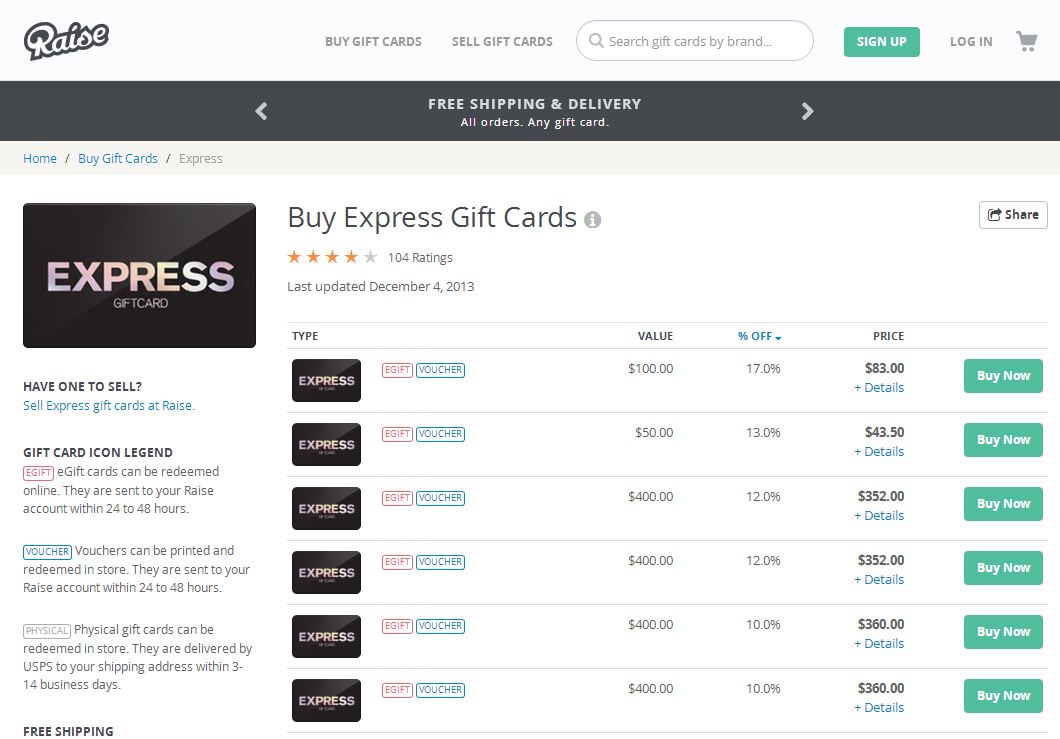
Even with coupon code sites, daily deals, penny auction sites and the works of digital buying platforms the Internet has enabled, it has also, almost ironically, made good-old-fashioned gift cards more valuable to shoppers than ever before. An assortment of gift card buyback sites have emerged allowing you to sell unused and unwanted gift cards online for cash. Along with buying back gift cards, certain sites, such as Raise , Cardpool and Card Rescue flip the used gift cards they receive and allow you to buy these used cards back at a discount. The 'gift card' in this case can be an e-gift card to be used online, voucher to be printed and redeemed in store, or a physical delivered to you by mail.

The loophole is in the re-commerce; the re-selling of a 'used' item online. Because the gift cards are 'used' they are sold at a discount pricing the cards below the value they are actually worth. So yes, they're truly discounted gift cards.

Thus, on gift card re-commerce sites, a $300.00 used gift card will cost you less than $300.00. Or, for example, you could get a $100.00 Express gift card for $83.00 -- a $17.00 or 17 percent off savings. It may not seem worth the hassle, but when we're talking about, say, a $500.00 purchase, that 17 percent off -- or $85.00 off -- I could get from buying a used gift card first, it sure makes the juice look worth the squeeze.

2013-12-05-Raise_express.JPG

Raise.com offers discount e-gift cards, vouchers, and physical gift cards to automatically save you money on your next purchase.


2. Go Where The Curated Discounts Already Are
Everyone loves a coupon, but the endless supply of coupon code sites can be overwhelming and finding the right one can end up becoming more frustrating than productive. Fast-track your search by going directly to aggregated discount sites that are relevant to the product for which you are looking.

There's no harm in using Google to find all possible coupon codes, but if you want to narrow your search you can start with the sites that are already clearly focused on a genre. Genre-specific sites will not only have the largest amounts of coupon codes in the categories you are looking, but will more often than not feature complementary editorial, such as gift guides, to help you shop. Streamlined discount sites also give you a leg up in the online shopping space by doing the searching, and essentially much of the discovery shopping, for you.

If you're on the hunt for tech-related items, check out LogicBuy or Techbargains.com. Techbargains is a deal site and technology forum run by self-called 'Bargainmeisters' who, with a slew of tech backgrounds, curate top computer and electronic deals and coupons. LogicBuy takes a similar approach with 'Deal Experts' each with backgrounds in deal hunting, who act as curators populating the site with top electronic deals. LogicBuy will often feature deals with an additional coupon code pre-applied to the deal total, allowing you to see the best possible price on a product with all applicable discounts applied.

Alternatively, if you are looking for fashion, you can jump straight to The Budget Fashionista or Style For Free. The Budget Fashionista is a one-stop-shop for the latest coupons, promo codes and deals in fashion, run by Kathryn Finney, author of How to Be a Budget Fashionista -- The Ultimate Guide to Looking Fabulous for Less. Style For Free is an over-decade-old site featuring fashion promo codes, for retailers from PUMA to Henri Bendel, stores and lookbooks.

3. Gift Giving? Take Advantage of Free Shipping Day
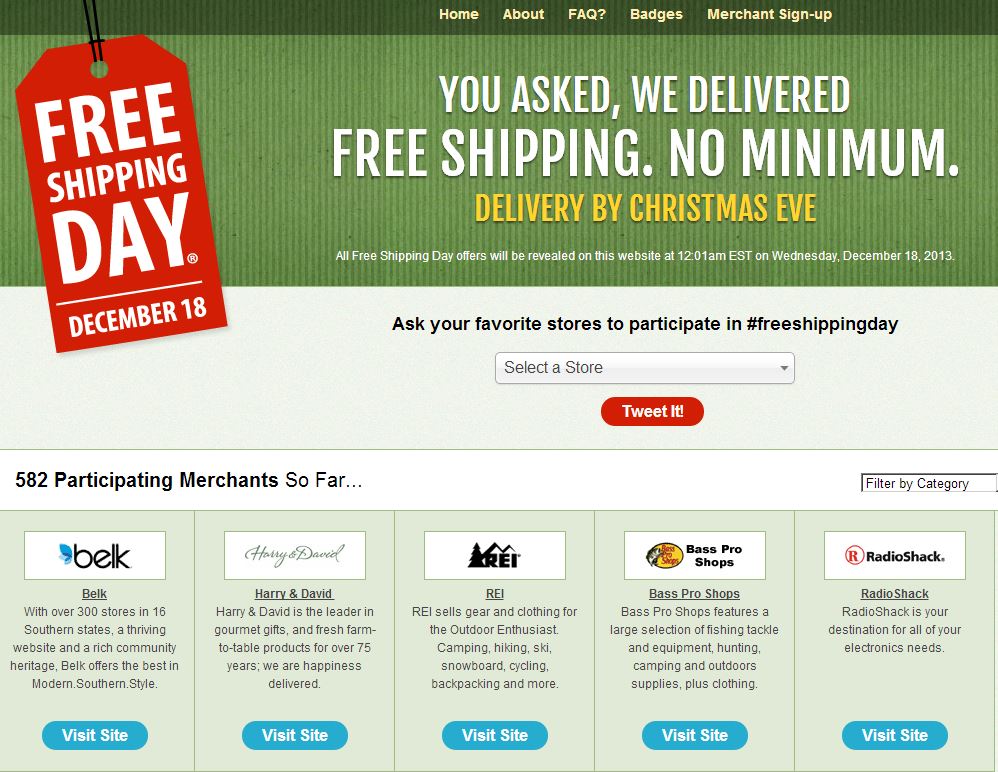
Depending on the size of your items and capacity of the seller, shipping can be a substantial part of an online purchase. To combat the extra fees, there's now a 24-hour holiday that banishes them. The web-originated holiday, Free Shipping Day, is a prime example of the Internet put to good consumer use. First launched in 2008, Free Shipping Day is an annual one-day event held in mid-December when which hundreds of online retailers offer 100 percent free shipping and guaranteed delivery by Christmas Eve at Freeshipping.com.

Since its launch, the shopping-prompting holiday and site have been featured across morning shows, CNN, and The New York Times, among others, consummating the day as a legitimate online event for consumers. Free Shipping Day was the third highest spending day of the 2010 shopping season and by 2012 had recruited over 1,000 participating online merchants. The holiday is US-originated and has branched out to Canada and the UK. This year, Free Shipping Day falls on December 18th 2013, but will land on a different day each year as it is positioned around Christmas.

2013-12-05-freeshippingday.JPG

On Free Shipping Day you can get free shipping with no minimum and delivery before Christmas from a growing list of 500+ retailers.


Be Assertive, Just Ask
When we shop in stores, we expect to hear the discounts as we walk in or read them off a sign in the doorway and we expect store employees to assist with the buying process. Expect online stores to show you the same courtesy, and if you don't see a discount you want, simply ask. Don't be afraid to email the retailer directly and ask for a price match on a product you have found elsewhere for less. Email or chat with the retailer and include the URL to an alternative price if possible. In most cases, the retailer will value your consumer loyalty and offer you a similar price or other buying incentive.

Remember you are giving the retailer your business, therefore even without a lower price found elsewhere or what you think is a 'good reason' to deserve a discount, it doesn't hurt to ask the retailer for one anyways. Worst case scenario, you don't get a discount, and instead use another method to find one.

As a tip, it's especially useful to turn to social platforms to ask your inquiry. Write on the retailer's Facebook wall, send a tweet on Twitter or tag them in a picture. You'll usually receive a much more prompt and positive response on social platforms where the conversation is made visible to the public.

Saturday, December 14, 2013

eReader vs Tablet -- Kindle Fire HDX vs. iPad mini with Retina vs. Kindle Paperwhite -- Which to Buy?

iPad mini vs Kindle Fire HDX vs Kindle Paperwhite

Should you purchase a full-featured tablet or a select-features tablet or an e-reader? That may be a better way to ask the question. Do you want to spend the money on an iPad? If so, nothing else will do. If you're invested in the Apple ecosystem, there is no way that any other device is going to make you happy. That said, there are excellent reasons, such as price and performance, to consider purchasing a Kindle Fire HDX. And, there are very good reasons to prefer an good, old-fashioned eReader. Let's have a look.

Apple iPad mini

Apple's iPad mini 2 with Retina Display


The iPad mini is everything you've come to know and love from the full-sized iPad, shrunk down to a 7" form factor. Apple's newest iPad improves in every way over its predecessor. Where the first iPad mini was good (actually it was a miniaturized iPad 2), this one is great. The new iPad mini packs a Retina display that features the same resolution as the full-sized iPad Air. Also, like the iPad Air and iPhone 5s, the new iPad mini also features an A7 processor, which Apple touts as "desktop class." It's a whole lot of power in a really small package.

The mobile landscape has been built around Apple, and the iPad Mini's biggest strength is its expansive app catalog. Like every other iPad, the mini can run every app in the App Store, which is far and away the number one reason to buy an Apple tablet over any other brand. For productivity, games or anything in between, the best apps almost always go to Apple first, and then make their way to Android, Amazon and Windows.

Chances are, you've used Apple products before. This is the same comfortable experience you've come to know and love from the company. Even if you haven't, you'll feel right at home in iOS.

Amazon Kindle Fire HDX

Amazon's Kindle Fire HDX 7"


Amazon's newest Kindle Fire tablets are the best the company has ever made. While slightly more expensive than the previous model, the 7" Kindle Fire HDX is more affordable than the new iPad mini. The HDX starts at $229, and even maxing out the storage capabilities and removing Amazon's "Special Offers" will only set you back $324, a full $75 less than the cheapest iPad mini.

The new Kindle Fires have a few awesome features found nowhere else in the tablet world. Aside from the expected processor and RAM bump, the newest Kindle Fires have a Mayday feature that helps you connect with an Amazon tech-support employee directly on the tablet. The tech support agent shows up on your screen in a tiny video box while they help you. If you're having any trouble navigating or troubleshooting your device, Mayday is here to help, and that's awesome. Amazon's staff won't be able to see your passwords, and you can ask them to disable screen mirroring at any time. The feature also doesn't use the Fire's front-facing camera, so no worries there.

The Kindle Fire HDX won't blow the competition away with specs - though they are impressive - but it will when it comes to support. Amazon has made its tablet friendlier and less intimidating, and wants to deliver a world-class experience. Mission accomplished!

Like all of Amazon's tablets, the experience revolves around Amazon's media. If you're an Amazon Prime customer, or just a fanatic for Kindle books, Amazon Instant Video and Amazon mp3, the whole ecosystem will be a multimedia wonderland for you. Amazon has also expanded features tested in earlier products, like X-Ray, which lets you dive deeper into movies you watch by showing you information such as actor bios and trivia. The feature now works for music too, and you can use it to follow along to the lyrics (or sing along) as a song plays.

The new Kindle Fires are also awesome if you have kids. A feature called Kindle FreeTime lets you create a personalized experience for each of your children based on the content you've purchased. You're also able to use this to limit the amount of time your children spend watching videos in a day. It offers a level of customization and parental control not found in many - if any - other major tablets today.

Kindle Paperwhite

Amazon's Kindle Paperwhite


The Paperwhite is the best e-reader on the market today, and offers great value. It's "just" an e-reader, which means you can't use it to watch movies or play (real) games, or listen to music. The Paperwhite is a device dedicated to reading and it is priced accordingly. Paperwhites start at $119 with Special Offers (or $139 without).

The battery life in these things is killer - it's measured in weeks, not hours - and each generation sees an improvement in screen quality, clarity and glare reduction. You can use the Paperwhite anywhere you go. Its processor is 25 percent faster than the Kindle it replaced and it features better touch technology that makes it respond more accurately than any other e-reader on the market. It even has a "next-gen, built-in light" that lets you read without eyestrain, even in the dark.

The Paperwhite has awesome features built in that make reading a great experience. Kindle Page Flip lets you skim through your books by page, chapter or all the way to the end, without losing where you're at. It features Smart Lookup, which integrates a full dictionary with X-Ray and Wikipedia. It also has a built in vocabulary builder, so any time you look up what a word means on your Kindle, that word is added to an easy-to-access list, where you can quiz yourself with flashcards. And, like the Kindle Fire, it has Kindle FreeTime, which is aimed at young readers and tracks their progress and awards achievements as they reach their goals. Awesome.

Price vs. Performance


When it comes to the iPad mini, the real drawback is cost. It's more expensive than the original model - the base model costs $399, $70 more than the first-gen iPad mini's original price point - and hundreds of dollars more than the two Kindles on this list. (By the way, the original iPad mini is still around, and now starts at $299. But if you're looking for a top-tier tablet, and one to compete with the new Kindle Fires, you've got to go with the latest and greatest mini.) But if you're willing to saddle up and pay the hefty sticker price, you'll get access to the best App Store in the world.

The Kindle Fire packs a lot of value, but it doesn't come with the App Store ... or even Google Play. It's getting better every day, but Amazon has a way to go.

The Kindle Paperwhite isn't a tablet, but that's not why you're buying it. A Paperwhite will never replace a Kindle Fire or iPad mini, but it's not supposed to. If you have a big phone (Galaxy S4 or HTC One, etc.) you may not need a tablet, but an eReader may make you very happy. Especially if you like to read in direct sunlight - eReaders are perfect when you have lots of natural light. I can think of several reasons to own a dedicated eReader, including that fact that I'm willing to throw them in my briefcase or backpack and not care too much about what happens to them.

Which is Right For You?


If You Own an iPhone: You've entrenched yourself in the world of iOS and nothing but an iPad mini will do. Buying a Kindle Fire means starting from scratch when it comes to apps, which isn't something anyone wants to go through. The iPad mini is still a fashion accessory, and if you're toting around an iPhone loaded with apps and content, you'll want the mini to match.

If You Own an Android or Windows Phone: Either will suit you just fine. But by using either of these devices, you're asserting that you've broken free of the iOS atmosphere and want something a little more customizable, and a little more tech-y. The Kindle Fire is probably the better choice for you. Plus, you'll save money!

If You Plan to Use it Primarily for Games: No question: go with the iPad mini. The best mobile games are always on iOS and maybe... possibly... eventually make their way to other platforms. Not even Android can compare in this field, let alone Fire OS.

If You're a Media Hound: The Kindle Fire is built around Amazon's media. From Kindle to Instant Video to Amazon mp3, Amazon's media is built into the core experience of the Fire. iTunes offers third-party apps, but many of the most popular ones - like Netflix - are also on the Fire. If you lovelovelove media, the Kindle Fire is for you.

If You Just Want to Read: Paperwhite! That's the ticket. You'll save hundreds of dollars and have the best reader of all three.