Monday, April 7, 2014

The Internet of Things: Monopoly Capitalism vs. Collaborative Commons

This post is excerpted from Jeremy Rifkin's new book, The Zero Marginal Cost Society: The Internet of Things, the Collaborative Commons, and the Eclipse of Capitalism, published today by Palgrave Macmillan.

If I had told you 25 years ago that, in a quarter century's time, one-third of the human race would be communicating with one another in huge global networks of hundreds of millions of people -- exchanging audio, video, and text -- and that the combined knowledge of the world would be accessible from a cellphone, that any single individual could post a new idea, introduce a product, or pass a thought to a billion people simultaneously, and that the cost of doing so would be nearly free, you would have shaken your head in disbelief. All are now reality.

But what if I were to say to you that 25 years from now, the bulk of the energy you use to heat your home and run your appliances, power your business, drive your vehicle, and operate every part of the global economy will likewise be nearly free? That's already the case for several million early adopters who have transformed their homes and businesses into micropower plants to harvest renewable energy on site. Even before any of the fixed costs for installation of solar and wind are paid back -- often in as little as two to eight years -- the marginal cost of the harvested energy is nearly free. Unlike fossil fuels and uranium for nuclear power, in which the commodity itself always costs something, the sun collected on your rooftop, the wind traveling up the side of your building, the heat coming up from the ground under your office, and the garbage anaerobically decomposing into biomass energy in your kitchen are all nearly free.

And what if prosumers everywhere were able to connect, produce and share their own energy, physical products, and services on a global Collaborative Commons, at low or near zero marginal cost? That too is beginning to evolve on a small scale as thousands of start-up businesses and hobbyists establish 3D-printing operations, infofacture products at near zero marginal cost, power their Fab Labs with green electricity, market their goods for nearly free on hundreds of global websites, and deliver their products in electric and fuel-cell vehicles powered by their own green energy.

A powerful new technology revolution is emerging that is going to fundamentally alter our economic life. The Communication Internet is converging with an embryonic Energy Internet and Logistics Internet to create a new technology platform -- the Internet of Things (IoT) -- that connects everything and everyone. Billions of sensors are being attached to natural resources, production lines, the electricity grid, logistics networks, recycling flows, and implanted in homes, offices, stores, and vehicles, feeding Big Data into the IoT global neural network. Small and medium sized enterprises and Prosumers will be able to connect to the network and use Big Data, analytics, and algorithms to accelerate efficiency, dramatically increase productivity, and lower the marginal cost of producing and sharing a wide range of physical products and services to near zero, making them nearly free, just like we now do with information goods.

The plummeting of marginal costs is spawning a hybrid economy -- part capitalist market and part Collaborative Commons -- with far reaching implications for society. Millions of people are already transferring parts of their economic lives to the global Collaborative Commons. Prosumers are plugging into the fledgling IoT and making and sharing their own information, entertainment, green energy, and 3D-printed products at near zero marginal cost. They are also sharing cars, homes, clothes and other items via social media sites, rentals, redistribution clubs, and cooperatives at low or near zero marginal cost. Meanwhile, students are enrolling in free massive open online courses (MOOCs) that operate at near zero marginal cost. Social entrepreneurs are even bypassing the banking establishment and using crowdfunding to finance socially responsible startup businesses as well as creating alternative currencies in the incipient sharing economy. In this new world, social capital is as important as financial capital, access trumps ownership, sustainability supersedes consumerism, cooperation ousts competition, and "exchange value" in the capitalist marketplace is increasingly replaced by "sharable value" on the Collaborative Commons.

The critical policy question now raging around the world is who will control the new IoT infrastructure and reap the vast benefits brought on by the unleashing of "extreme productivity"? The struggle to capture the IoT platform is being aggressively waged among governments, capitalist enterprises, and champions of an emerging Collaborative Commons, in courtrooms, legislatures and in the public arena. The outcome of this epic struggle will largely define the political landscape and the nature of economic activity as we move further into the twenty-first century.

Network Neutrality

Until the present, the Internet, and now the more expansive Internet of Things, has been managed as a global Commons with three primary stakeholders playing a collaborative role in its governance -- the government, private sector, and civil society. Now, however, the private sector is beginning to stray from the three-party stakeholder alliance, seeking increased income and profits by way of price discrimination -- a move that threatens to undermine one of the guiding principles of the Internet: network neutrality, a principle that assures a nondiscriminatory, open, universal Communications Commons in which every participant enjoys equal access and inclusion.
The concept of network neutrality grew out of the end-to-end design structure of the Internet, which favors the users rather than the network providers. While users pay for Internet connection, and the price they pay can depend on the speed or quality provided by their Internet service provider, once they're connected, their transmitted packets are treated the same way as everyone else's by the network providers.

Network providers -- the major telecom and cable companies -- would now like to change the rules of the game and secure control of information exchanged over the Internet of Things for commercial gain. That control would allow them to charge different prices for access to specific information or to prioritize transmissions, putting time-sensitive packets at the front of the line for a higher price, or charge application fees, or block specific applications from their networks in favor of others, again based on exacting discriminatory payments.

In January 2014, the U.S. Court of Appeals¸ the nation's second highest court, knocked down the Federal Communication Commission's (FCC) long-standing regulation requiring "network neutrality," arguing that the commission had overstepped its regulatory authority (the FCC is currently reviewing its policy of network neutrality with the goal of maintaining the principle of open access to the Internet of Things without running afoul of its mandate).

Proponents of network neutrality argue that the network should remain "stupid," thereby allowing millions of end users to collaborate and innovate by developing their own applications. It's this kind of "distributed intelligence" that makes the Internet such a unique communications medium. If network providers were to gain centralized control over access to content and how it is delivered, it would disempower end users and undermine the creativity that comes with distributed collaboration and laterally scaled intelligence.

The struggle over network neutrality is, at its core, a battle of paradigms. The Second Industrial Revolution telecom and cable companies would like to control the content and the traffic on the IoT, in order to boost their margins, and secure a monopoly by dint of their ownership of the "pipes." Prosumers are equally determined to keep the Internet of Things an open Commons and find new apps that will advance network collaboration and a push to near zero marginal costs and near free goods and services.

The Internet Monopolists

And it's not just the telecom and cable companies that are muscling in from the outside, attempting to enclose the IoT. It's coming from the inside as well. Some of the best-known social media sites on the Web are revving up to find new ways to enclose, commercialize, and monopolize the new communications medium. And their bite is potentially far bigger than the companies managing the pipes.

Unfortunately, some of the biggest Internet companies like Google, Facebook, and Twitter, are cashing in on the very rules of engagement that made them so successful and selling the masses of transmitted Big Data that comes their way to commercial bidders and businesses that use it for targeted advertising and marketing campaigns, research efforts, the development of new goods and services, and a host of other commercial propositions. They are, in effect, exploiting the Commons for commercial ends.

Should we worry about social media sites sharing everything they know about us with third-party commercial interests? Of course, no one wants to be pestered by targeted advertising. More sinister, however, is the prospect of health insurance companies learning whether you had been Googling research on specific illnesses or prospective employers prying into your personal social history by analyzing your data trail on the Web to spot potential quirks, idiosyncrasies, or even possible antisocial behavior.

Worse, is this newest form of commercial exploitation creating corporate monopolies in virtual space that are every bit as centralizing and proprietary as the Second Industrial Revolution companies they are dislodging from power? By 2013, Google was fielding almost 6 billion searches a day, and enjoyed a market share of 67 percent among search engines in the United States, 93 percent in Germany, 89 percent in the United Kingdom, and 95 percent in France.

Facebook has gobbled up 72.4 percent of the global market share of social networks, and as of January 2014, boasted over 1.3 billion active users--that's nearly one out of every six human beings living on Earth. Its visitors spend an average of 405 minutes a month on the site: that's the number of minutes of the next six most popular sites combined -- Tumblr (89), Pinterest (89), Twitter (21), LinkedIn (21), Myspace (8), and Google+ (3). Facebook's revenue in 2013 was $7.8 billion.

Twitter now has over 600 million registered users, of which 200 million are active tweeters. The rest prefer to be listeners. The company is expected to make more than $1 billion in revenue in 2014.

The overtly commercial sites, like Amazon and eBay, that include Collaborative Commons features, are also quickly becoming online monopolies. According to a study conducted by Forrester Research, one out of every three online users starts their product searches on Amazon.com, "compared to 13 percent who started their search from a traditional search site." Amazon has "over 152 million active Amazon customer accounts," "over 2 million active seller accounts," a worldwide logistical network that serves 178 countries, and enjoyed revenues in excess of $74 billion in 2013. By 2008, eBay had grabbed 99 percent of the market for online auctions in the United States, with a similar track record in most other industrialized countries. EBay's revenue in 2012 was $14.1 billion.

Tim Wu, a professor of law at Colombia University and a senior adviser to the U.S. Federal Trade Commission, raises an interesting question about the new corporate giants that are colonizing large swaths of virtual space. He asks, "how hard would it be to go a week without Google? Or, to up the ante, without Facebook, Amazon, Skype, Twitter, Apple, eBay, and Google?" Wu is putting his finger on a disquieting new reality -- that the new communication medium a younger generation gravitated to because of its promise of openness, transparency, and deep social collaboration masks another persona more concerned with ringing up profit by advancing a networked Commons. Wu writes:

Most of the major sectors [on the Internet] today are controlled by one dominant company or an oligopoly. Google "owns" search; Facebook, social networking; eBay rules auctions; Apple dominates online content delivery; Amazon, retail; and so on.


Wu asks why the Internet looks "increasingly like a Monopoly board."

A growing number of communications-industry analysts and antitrust attorneys are asking whether these new heavyweights in virtual space are really "natural monopolies" like AT&T and the power and utility companies of the twentieth century and therefore either legitimate candidates for antitrust action or for regulation as public utilities. They argue that if one or both of these courses is not rigorously pursued, the great promise of the IoT as a shared global Commons is going to be irretrievably lost and, with it, the hopes and aspirations of a generation that has put such store on a peer-to-peer collaboratist ethos.

Empowering The Energy Internet

The telecommunication and cable companies, and the profit-making online enterprises are not the only commercial players attempting to thwart an open, transparent, and democratically managed Internet of Things infrastructure.

Already, the creation of an Internet of Things across locales, regions, countries, and continents is coming up against powerful, entrenched energy and electricity transmission companies with commercial interests every bit as formidable as the telecommunication companies, cable companies, and profit-making online enterprises.

Global energy companies and power and utility companies are, in some cases, blocking the creation of an Energy Internet altogether. In other instances, they are attempting to force a centralized architecture on the smart grid, to enable the commercial enclosure of the new energies.

The European Union, the world's largest economy, has taken steps to keep the Energy Internet an open architecture by requiring that conventional power and utility companies unbundle their power generation from their transmission of electricity. The unbundling regulations came about because of growing complaints by millions of small, new renewable energy producers that the big power and utility companies were making it difficult for them to connect their local micropower plants to the main transmission grid. The companies were also accused of discriminatory practices that favored speedy connectivity for green electricity generated by affiliated business partners and of imposing bureaucratic delays and even refusing to accept green electricity from others.

Electric utilities are also fighting on a second front, with behind-the-scenes maneuvers to design a smart grid that is centralized, proprietary, and closed, and in which all transmission data flows only in one direction, from prosumers to headquarters. The objective is to withhold vital information from the millions of new prosumers on moment-to-moment changes in the price of electricity as well as to prevent them from controlling when to upload their electricity onto the grid to take advantage of peak electricity prices at various times of the day.

These efforts by the electricity transmission companies appear to be losing steam as countries all over the world introduce green feed-in tariffs to encourage millions of end users to produce their own green electricity and share it across an Energy Internet.

The generation that grew up on the Communication Internet and that takes for granted its right to create value in distributed, collaborative, peer-to-peer virtual commons has little hesitation about generating their own green electricity and sharing it on an Energy Internet. They find themselves living through a deepening global economic crisis and an even more terrifying shift in Earth's climate, caused by an economic system reliant on fossil fuel energy and managed by centralized, top-down command and control systems. If they fault the giant telecommunications, media, and entertainment companies for blocking their right to collaborate freely with their peers in an open Information Commons, they are no less critical of the world's giant energy, power, and utility companies, which they blame, in part, for the high price of energy, a declining economy, and looming environmental crisis.

For a growing number of young people, the conventional energy and utility companies represent the very archetype of centralized power and all the ills that it has forced on the world. The prospect that those ills can be cured by joining together in open, collaborative, and democratically managed green electricity cooperatives to produce and share clean energy is empowering. It is inspiring a generation to rally under the banner of sustainability. The call for free access to communication is now being joined by the demands for near zero marginal cost green energy.

It's highly unlikely that the global companies attempting to capture the Internet of Things will escape some kind of regulatory restriction by way of either antitrust action or treating them as global social utilities with appropriate regulatory oversight. The nature and extent of the oversight is still very much an open question. What's not in question is the need to address the worrisome commercial enclosure of a technology platform whose very existence is predicated on the premise of providing a universal Commons in which all of humanity can collaborate and create value across every sector of social life at near zero marginal cost.

0 0 0 0 0 0 0 0 0

2014-03-31-FinalZMCSCoverArt.jpg
The struggle between investor capitalists and prosumer collaboratists over control of the Internet of Things, while still embryonic, is shaping up to be the critical economic battle of the first half of the twenty-first century. Global telecom, cable, Internet, energy and electricity companies are determined to enclose the IoT and monopolize the flow of communication, power generation, and logistics, keeping the price of producing and distributing goods and services far above their marginal cost, to optimize their profits. The new prosumers, on the other hand, are increasingly banding together in lateral networks, producing and sharing information goods, renewable energy, 3D printed products, and an array of services on a global Collaborative Commons at near zero marginal costs, disrupting the workings of capitalist markets. The unfolding economic clash between the capitalists and collaboratists is a manifestation of a cultural conflict that will likely redefine the nature of the human journey in the years ahead. If there is an underlying theme to the emerging cultural conflict, it is the "monopolization vs. democratization of everything."

Jeremy Rifkin is the author of The Zero Marginal Cost Society: The Internet of Things, the Collaborative Commons, and the Eclipse of Capitalism. Rifkin is an advisor to the European Union and to heads of state around the world, and is the president of the Foundation on Economic Trends in Washington, DC. For more information, please go to www.thezeromarginalcostsociety.com.

Sunday, April 6, 2014

How We Research: A Look Inside the Buffer Blog Process

I often get asked about my research process for the Buffer blog. For my science and life hacking posts in particular, I rely heavily on scientific research to back up my points, so there's a lot of research to be done.

Unfortunately there's no secret sauce or magic bullet when it comes to this process. It's mostly just a matter of time and practice. I do have a few tips to share about where and how I find the sources for my research, though, so hopefully you'll find these useful.

Finding the research you need


The first thing I do when I start a research-heavy post is start digging into the topic to learn everything I can. Here are a few ways I find studies and research papers for my posts.

Google Alerts


I have a few different Google Alerts set up to send me new research papers. Thanks to some advice from Leo, I usually get interesting scientific studies in my inbox once a week from these alerts.

google alerts email

Most of my alerts include the words "study OR research." Using Google's search operators like OR make my results more useful.

google alerts email 2

Here are some of the alerts I have running currently:

  • study OR research + sleep

  • harvard OR stanford OR columbia AND "new research"

  • study OR research + exercise


Just head to google.com/alerts to set up a new alert, and choose to have it delivered immediately, daily or once per week. I get mine once per week so my inbox isn't overloaded, and I usually run through the list and save any interesting links to my reading list.

reading list

Read a lot


The other way I collect research material is to simply read a lot. I follow authors and blogs I like reading on Twitter--you might prefer to use RSS, Facebook or Google+ for this. Whenever I come across something that seems interesting, I save it to my read later list.


I end up reading a lot of material that I never use, because I always keep track of things that might be relevant some day, rather than only what I need right now. I try to keep track of ideas and topics I read about, however, so that I can come back to them later on when they are relevant.


For instance, I use Day One to save quotes from blog posts or books I read, and tag them with whatever topics they touch on. This makes it easy to go back through all of my saved quotes to see what's relevant to the blog post I'm writing today.

day one quotes

I also drop ideas and notes into Day One, and tag them with topics they relate to. I used to use a Moleskine notebook for the same purpose, but I like being able to search by tags in a digital journal.

dayone notes

I also like reading related stuff, to expand my knowledge of particular areas. I often end up saving five or six books to my Amazon wishlist at a time, because I find a lot of the related books to be quite interesting. Here's an example of what my wishlist tends to look like:

amazon wishlist

Bloggers often make this easy for you as well, by including links to related posts at the bottom of each one, or by including inline links to other, related posts they've written. Here's an example of how we do this on the Buffer blog:

buffer inline links

Save all the research you find


I save everything I read that might come in handy one day. I use Pinboard for this, but there are lots of free options you could try, such as Delicious, Kippt, Diigo or Saved.io.

pinboard

I use multiple tags for each item. For studies, for instance, I'll add the tag "research" and then tags like "sleep," "naps" or "running" to help me find it again later.

pinboard tags

Google searches


Once I have a good idea for a blog post I usually need a lot more research to fill it out. This is when I'll turn to Google and start hunting for related studies. I usually start with a Google Scholar search:

google scholar

I usually start with a fairly basic phrase to start uncovering related studies:

google scholar search

After a few tries of different keyword combinations, I'll start to work out which keywords researchers use in the kind of studies I'm after. This process isn't usually much fun, but it's important if I want to find the right studies for my topic.

The other useful thing about Google Scholar results is that they often show the number of citations a paper has received. This isn't necessarily proof that it's a high-quality paper, but it's a clue that it's at least popular and worth taking a look at. It's a bit like when you see someone on Twitter with a high follower count: It doesn't prove that they're the best, but you'd probably give them a try, at least.

google scholar citations

Bringing it all together


When I have some research ready for each point I want to make, it's time to start bringing it all together into a draft.

Start with the basics


Usually I'll find that I need some background about the basics of a topic I'm looking into---both for my own understanding and to add context for readers. A good example is this recent post I wrote: 6 Research-Tested Ways to Improve Your Memory.


I started out with a basic break down of how memory works before moving into the main topic of the post, which was how to improve your memory.


I get this basic information from a few places. One of my favorites is this book which covers each section and function of the brain in just a few pages. It's a great way to get a really basic understanding of how something like memory works and where to start looking when I dive further into the research process.

I also use Wikipedia for this. I don't use Wikipedia as a research source, since it's not reliable enough, but for my own understanding it's a really helpful place to start.


citogenesis


Read studies carefully


From reading a lot of research studies, I've discovered a few important things that I try to keep in mind. Whenever I can, I read the full study rather than just an abstract. I usually find that any statistics and mathematics sections are beyond my understanding, but I find the introduction, results and discussion sections to be really helpful.


The discussion section of a study paper usually talks about suggested causes of the results found, caveats to what the study has shown (such as a small sample size or results that apply to a specific group of people only), and related research areas.

Reading full studies can be quite expensive, so a lot of the time I'm stuck with only an abstract or a preview to go on. In these cases, I try not to draw conclusions from the abstract that may not be true--an abstract usually doesn't include any caveats about the study, or a detailed analysis of what the results mean.

Link to original sources


Studies often get covered by multiple news sites which simplify the results of the research for a non-scientific audience. This can sometimes lead to inaccuracies and misunderstandings. For that reason, I try to always link back to an original study or source, rather than linking to someone who has interpreted the information. That's almost like relying on other people to do your research for you.


Doing the work myself to fully understand the research I'm using helps me to feel more confident about backing up the points I make, and sharing information that isn't misleading.

Don't include everything


One of the most important things I've learned recently about research-heavy posts is that I don't need to include every single bit of research I can find. A good example is this post I wrote about junk food cravings: Why we crave junk food and how to turn down the cravings.


I first got the idea for that post when I read about a study that showed eating avocado at lunchtime can stave off food cravings in the afternoon. Once I'd written the piece, I struggled to find a place to squeeze in that fact about avocados. No matter where I put it, it just didn't fit in with the rest of the post. Eventually I realized it just wasn't necessary.

Sometimes knowing what to cut is just as important as knowing what to write.

What research methods do you have? Let us know in the comments.

If you liked this post, you might also like From Ideas to Traffic Results: How We Run a Blog with 700,000 Readers Per Month and El Bibliomata; xkcd

Saturday, April 5, 2014

The 11 Most Annoying Kinds of Parents on Facebook

You know them. You've seen them. You might even be one. Well, not you, of course. You're cool. I'm totally talking about that annoying friend you have. Yeah... that's the ticket.

So even though I am a parent and I love parents, the fact of the matter is we can be an infuriating bunch. The know-it-all mentality, the one-upmanship, the showboating -- it can all be a little much at times. Unfortunately, social media -- and Facebook especially -- serves as a virtual bullhorn that broadcasts that obnoxiousness across the Internet and beams all the bullshit directly to your laptop, tablet or phone.

Well, it's time to call these perpetrators out by shining the spotlight of truth on them.

I have used every bit of scientific methodology and cutting-edge research available to mankind (or simply looked in the mirror while also observing many of you) to put this list together. So read this list of annoying kinds of Facebook parents to find your friends, see a little bit of yourself and tell me which ones I've missed.

11. The Gratuitous Picture Poster.
We start with an old fan non-favorite -- the mom or dad who posts WAY too many pictures of kids. Look, I get that becoming a parent is life-changing and you want to record and share your precious new addition with everyone. I, myself, have flooded your poor social media streams with roughly 27,487,302 pictures of Will and Sam in the six years I've been a parent, so I've got no ground to stand on here. But at some point you've gotta say enough with the "LOOK AT THE BABY LOOK AT THE BABY!" stuff. The only problem is if you stop them from posting pictures of kids they'll just turn to something else. Sunrises, sunsets, landscapes, pets or -- God forbid -- food. Because the Internet needs more cat pictures and food portraiture.

10. Your Actual Parents.
The good news is your parents have learned to work the computer. The bad news is the first thing they did was sign up for a Facebook account and friend you. You stared at that friend request for four entire days before you grudgingly accepted, all the while knowing full well the hell that would follow. Your mom likes EVERYTHING you do and feels the need to comment on every single status update. Your dad won't stop sending you Farmville requests. You want to contain your Facebook life, but they take each of your status updates involving the kids and tag Aunt Millie and Uncle Rob, who then want to know why you haven't accepted their friend requests. Mark my words, this will be the eventual downfall of Facebook!

9. The Misinformer.
There's always an alarmist in every group, but give overprotective parents individual media platforms and you have a recipe for disaster when it comes to spreading misinformation about parenting topics. How many times have you seen a headline or meme that says something like "WARNING!!!!!!!! FACEBOOK CAN STEAL YOUR PICTURES IF YOU DON'T POST THIS LEGAL COPYRIGHT!" or the complete lie that was pedophiles being able to get to your kids via the Talking Angela app? Nope. Sorry. It was just a talking cat. I'm not sure when grown men and women lost the ability to perform a cursory Google search or take 30 seconds to look things up on Snopes, but we need to ignore the Misinformers or, at the very least, verify before we spread incorrect information. However, that Nigerian prince who wants to give you a cut of his millions? Totally true.

8. The Humblebragger.
Regular braggarts are not on this list, because it's social media and part of the deal is to brag. I'm a reasonable guy. But the Humblebragger is a horse of a different, and far more obnoxious, color. It's douchebaggery masquerading as self-deprecatory humor, and it drives me bonkers. Things like "I honestly envy the parents with kids who aren't in the Gifted & Talented Program. Junior has so much extra work, and traveling to the local university for college level classes is really cutting into his all-star equestrian practices. But hey, #yolo right?" At least a run-of-the-mill braggart is an asshole out in the open, and doesn't feel the need to be a passive aggressive dillweed about everything. But then again, we shouldn't be too hard on him. After all, he's SO stressed helping his kid choose between Yale, Princeton and Stanford (with Harvard as the safety school, naturally).

7. The One-Upper.
Anything you or your kid can do, the One-Upper and his/her progeny can do better. I understand you wanted to celebrate your 1-year-old taking his first steps, but that's just not how Facebook parenting rolls. Instead of "Congrats, that's awesome!" you get something like "Hey, he finally did it huh? Isn't he almost a year? My daughter walked at 8.5 months, but I guess all kids are different." Because parenting on Facebook means feeling like you're never doing a good enough job, and everyone else is doing it better.

6. The Know-It-All/Unsolicited Advice Giver.
Being overwhelmed is a rite of passage for all parents, as is dealing with the monotonous, insane, gut-wrenching, overpowering, bring-you-to-your-knees emotional roller coaster that is raising kids. And the one really great thing about Facebook is it's a safe place to vent your frustration virtually, so you don't lob your kids over your neighbor's fence and run away. Except the Know-It-All won't let you vent. Instead, he tries to fix everything by offering you advice you didn't ask for, don't want and probably already knew in the first place. Screw this jackass. Punch him right in the dickhole.

5. The "Too Cool For Parenting" Parent.
I almost named this one the Hipster Parent, because it seems there's always one parent on your friend list who think s/he is too cool for the rat race that is parenthood. While most of the parents you know (yourself included) are mired down in explosive diapers, babies who never sleep and a Chicago Cubs-level drought when it comes to sex, this clown seems to be doing everything BUT taking care of kids. There were the pictures of that kidless vacation to Cabo, the dinners at the fancy restaurants every weekend (who's watching the kid??), and somehow managing to train for and complete an Ironman (seriously, where are the children?!?). There's a name for this phenomenon, but you've probably never heard of it.

4. The Complainer.
On one hand, parenting is a goddamned grind and a half. Truly, it is. If you have a newborn, you're up every few hours; women have to breastfeed until their nipples bleed; toddlers watch the same shitty TV shows over and over until your adult brain turns to mush and you find yourself drooling oatmeal and humming the Mickey Mouse Clubhouse song. And some parents (myself definitely included) have a tendency to wallow in the negative and post update after update complaining about EVERYTHING kid-related. But at a certain point, it's just too much. There are more positives than negatives when it comes to being a parent, and the years are too short to overlook the terrific things parenting brings with it by spending time dwelling on all the crap.

3. The Crafty Parents.
I consider myself a success if I've slapped some peanut butter and jelly on a couple of slices of bread, and filled my son's lunchbox with a bag of Goldfish and a cheese stick. But then I jump on Facebook, look at what the Crafters have made their kids, and want to jump off a bridge. Seriously, who does this?? Suddenly I'm dealing with culinary savants who are making Yertle the Turtle out of broccoli and snap peas. There's no way to compete with that kind of awesomeness! And God forbid your kid sees even one picture of this artistic wizardry, and then it's "WHY DON'T YOU MAKE MY LUNCH LIKE THAT?!" You creative bastards have ruined it for us commoners.

2. The TMI (Too Much Information) Parents.
Yes, before any of you bring it up, let me be the first to admit I'm king of this group. My name is Aaron, and I share. A lot. Fine, I overshare on a regular basis and may have written a post specifically about my wife's cervix. I don't know why, but parenthood is the end of boundaries. Suddenly it's fine to talk about poop (color, consistency, frequency), vomit, rectal thermometers, how long it's been since we've had sex, how sex has changed post kids, post-pregnancy hair in the shower drain and even pictures of the time you ripped your pants wide open while curling. Moms routinely talk about tearing during delivery, bloody nipples from breastfeeding and stretchmarks. All of this to say, if you have parents in your timeline, you're setting yourself up for one long, seemingly continuous stream of bodily updates complete with pictures of the first time Junior dropped a deuce in the potty. My apologies.

1. The Perfectionists.
Here they are. Numero uno on the hated list. They're rich and they have a nice house with an eco-friendly luxury car parked in the garage. There's a picture of the mom seconds after giving birth (naturally, of course, and at home) -- with no makeup -- looking like a supermodel. The dad is uber successful, routinely runs marathons for charity, was once used as a movie double for Brad Pitt and had his personal friend Morgan Freeman narrate their DVD birth announcement. Their children are all flawless and their family pictures are so perfect they look like they were plucked out of an Abercrombie & Fitch ad. They make their own wheatgrass tofu baby food that's been blessed by the Dalai Lama, and no one has ever seen them fight about anything. They are one of the FFFs (Flawless Facebook Families), and their existence irks you for reasons you can't even fully comprehend. The only way to combat the Perfectionists is to take solace in the fact that they must be fake, since manufacturing happiness and the perfect image is easy to do on Facebook. They're almost definitely fake. Probably. Dear Christ let them be fake...

So, which annoying Facebook parents did I miss?

This piece originally appeared on www.daddyfiles.com. You can also follow The Daddy Files on Facebook.


Like Us On Facebook |
Follow Us On Twitter |
Contact HuffPost Parents


Also on HuffPost:


via STFU, Parents

Friday, April 4, 2014

Want A Strikingly New Web Site That You Develop Yourself?

201ldn't have 2-06-27-techscapelogocolumn1.jpg


If you're anything like me, you might have a website for your small business that was once state-of-the-art but is now tired and looking a bit frayed around the edges. My own website was really slick and ahead of its time when I first unveiled it in 1995; I had it done by a professional web developer at great expense.

As the years went by ... 1999 ... 2002 ... all the way to 2005, I procrastinated my website redesign. "Ughhh," I thought, "do I really need this headache right now?" And that's what I kept thinking until it became a drag on my reputation with prospective clients and it became critical to update it.

So in 2005, I undertook my "little" (subtext: gigantic and time consuming) project. This time it was Dreamweaver I used to do it and while it involved a massive allocation of my time and a real immersion process--lots of learning--into the Dreamweaver world, my site turned out well and ahead of the curve again for 2005.

Now again, nine years later, it's looking a little green around the gills. So, I've been bracing myself for the next-generation website and dreading what it's going to take this time.

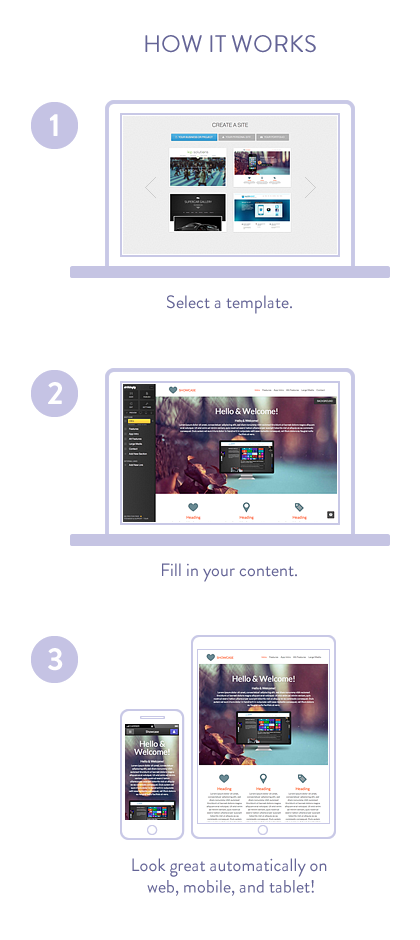
Enter Strikingly. This online website development platform/app makes the excruciating headache of creating your new website easy and most importantly, fun.

There are four central things that are ... well ... striking about Strikingly:

1) It's user interface is really smooth, clean and sharp-looking. This makes it easy on the eyes of the entrepreneur/developer and adds to the feeling of accomplishment. The ease with which a site comes alive, truly makes the process fun, keeps the user moving forward and that's what differentiates Strikingly.

2) It's self-contained, meaning that there are not a lot of clicks necessary or page-shifts to distract and confuse the novice website developer. Like Amazon's patented 'one-click buy' button, Strikingly's web development environment is easy to navigate with an on-screen editor sidebar that slides out smoothly and doesn't annoyingly refresh, taking you somewhere else or hanging up your browser. It's upload capability for images and video is streamlined and you can edit the images in-screen which is very convenient. And, you put in your own 'content' like graphics, photos, videos so there's not the constant need to go to and quiz a graphic design expert.

3) The "Preview" function is state-of-the-art and another thing that sets Strikingly apart. An editor button quickly opens up a new browser tab and takes you to a clean, fresh view of where you are on Desktop, Tablet and Phone format previews. For the busy entrepreneur, this is worth its weight in gold because you can literally check and double-check each small change you make and see immediately how it affects your overall website. This empowers the novice, non-HTML programmer and, it's not just previewing it that's great but also that Strikingly builds the websites simultaneously in all three formats.

2014-02-28-strikinglyscreens.png


4) And fascinatingly, for any career-oriented job searchers out there, Strikingly has a super new app which automatically, and I mean automatically, converts your LinkedIn profile into a great job search-enhancing website in seconds. From 'piece of paper' to website; I didn't think such a snap-transformation was possible. David Chen, Strikingly CEO and co-founder said, "I created this (his own website resume directly from his LinkedIn account) in literally one second with one click." (Try this new idea by clicking here--it's free. For those creative-types less interested in career, there's also a link here to turn your Facebook profile right into a website.)

Like the vast preponderance of web services, Strikingly is offered "free" or to be real, in a "freemium" pricing model which involves the user/customer prospect trying the service for free to develop their website and then, if they like what they've created, pay Strikingly to host it or pay to just allow the user to publish it to their own domain. A free user can also build and publish their website entirely for free on Strikingly's domain on a "www.strikingly.com/yourbusinessname here" basis.

There are a multitude of established tech giants and legions of start-ups in the Strikingly world. Though Intuit's Web.com is nothing to underestimate, perhaps Strikingly's strongest competitor is Wix. Wix alludes to having more than "43,000,000 users," in a tip of the hat to McDonald's. I tried Wix and found it clunky and hard to navigate. Strikingly is nothing of the sort.

If you think like I do, you might want to zero in on the customer service infrastructure upstart companies like Strikingly can provide--must provide. Customer service and response times are an important competitive advantage. Microsoft is famous for terrible customer service; yet they made it to the top of the heap. Google, Facebook, Oracle, SAP, IBM and so on, ditto. Yet companies with extraordinary service like Amazon also made it to the top, so why go to all that extra trouble and expense to provide great rather than mediocre or non-existent customer help? Answer: Because it's not enough anymore to have a great technology; you need both sides of the customer equation and the service side seals the deal. The customer service and support function of any high-tech service company is crucial. Get it right, and it is the 'secret sauce' which grows the company exponentially. Strikingly is off to a great start.

At the top, CEO Chen sends a "Meet for Coffee?" email to all new customers (once they've had a chance to begin setting up their new sites) and he means it; he will meet them to hear their feedback. When asked, Chen tells me of one of his first employees, Angela Ognev who's based in Singapore created her own title, "Chief Happiness Officer" which made Chen visibly proud.

To test out this higher-level of commitment of service, I asked long, complicated questions via email which were always responded to promptly by Ms. Ognev or one of her colleagues and though Striking has tutorial videos covering virtually every aspect a user could be unclear about, they always answered my questions directly without reflexively referring me to their video catalog. I loathe when in that moment, your vendors refer you to get rid of you and your questions about their technology, to an automated service area. So far, so good, Strikingly does not do this, while their bigger competitors surely do.

For several years now, clients of expensive web development shops have had a terrible decision to make: develop a 'desktop' type website and then pay to have it 'ported' over to a mobile phone format (which is fundamentally different in how it is coded and displayed through the browser) or develop in the phone form-factor first and then backtrack to see what the desktop browsers would see. This has not only created a real productivity and risk problem on the client side but also conveniently, a strong revenue opportunity for web developers. Software that allows 'normal' people to develop their own website (and update their site themselves without incurring third-party expense on a regular ongoing basis) is not only liberating and empowering for us 'do-it-yourself-ers' but also represent a real threat to the little club of geeks that has been keeping the golden keys to web development to themselves and using it as a bludgeon against us clients for decades.

Strikingly's website development platform is entirely HTML5 and CSS3 in order to satisfy the mobile website creation first. This is key, in my estimation, for Strikingly to compete against the entrenched competitors it faces. None of them that I could determine have taken this 'mobile first' approach.

And it's not inconceivable that our current economic woes could evaporate with the help of technologies like Strikingly. As a strong supporter of Entrepreneurship as the economic engine of the American economy, it's crucially important that government not overtax nor over-regulate small businesses but make it easy to start, incorporate and grow a small enterprise. Our government is not doing a good job of this now and without this, our economy will not improve. With website technologies like Strikingly, budding entrepreneurs who have just been laid off; perhaps been unemployed for an extended period; or just quit their mundane jobs to pursue their dreams, can have an easy way to focus themselves and start building their business online with a website and see where it takes them from there. Think of this first website as an online business plan for a new enterprise. Getting started is the most important thing. Just like writing the great American novel, entrepreneurs need to sit right down and just do it ... just start typing ... just start 'imagineering.'

Started by David Chen and co-founders Teng Bao and Dafeng Gou, Strikingly has offices in Shanghai, San Francisco and Singapore. Chen was a Chinese national coming to the US alone and Strikingly quickly became a Y Combinator company. Russian billionaire Yuri Milner started this incubator/accelerator/institute and Y Combinator only picks the highest-potential tech start-ups to invest seed money in and put through its residency program. Chen is in many ways a prime example of the 'Great American Success Story,' having come to the USA all alone to start an American high school; this couldn't have been easy.

2014-02-08-DavidChen178x178.jpg

Photo Credit: Xin He


"I grew up in Guangzhou and my parents are still there," Chen said wistfully, missing home. "I grew up in a traditional Chinese family and went to the public primary and middle school. Like other Chinese students, I studied very hard and was fortunate to be one of the best students in my city. I came to the U.S. for a trip during my middle school and for the first time, I realized that the world was different than what I thought it was and it is so much bigger and more diverse. That's when I developed the strong urge to leave home and go study abroad to really see the world. Also, ever since I was very young, I learned that Harvard was the best university in the world and I always wanted to study there one day. With all of those wishes, I came to the U.S by myself."

Making the big move, Chen said, "I came over to the U.S at 15 to start high school, near Buffalo, for my sophomore year. Then I transferred to another high school in Massachusetts for my junior and senior year. After that I went to the University of Chicago for college."

"How strong was your English when you first arrived?" I asked. "My English was good compared to other people of my age in China; we started our English education in 4th grade," Chen told me. "However, it was far from communication level. So it took me quite some time--3 months-ish--to pick up English; in the U.S. I stayed with a host family when I first got to the U.S and that helped me a lot in improving my English communication skills."

"With Strikingly, we wanted to create a place to develop a website that would be easy-to-use and then our customers could have fun quicker," Chen observed. "The perceived notion that it's so complicated to make your own website is wrong. It's not. The whole experience should be fun and we tried to create a 'habit-change' for people. We get a lot of feedback from users on Twitter and have heard a lot that the average time, we call it the 'magic time,' for our users to make a functional website is 10 minutes. Of course, to really fine-tune their content takes about one hour, we've heard, but the format and basic structure of their website is done very quickly."

Then, Chen tells me something I thought magical about strikingly's development, "Strikingly' users can use it for free, forever if you don't mind the 'strikingly.com-backslash' domain and 'Powered by Strikingly' at the bottom." In fact Chen tells me, many people use his site for one-off pitches, presentations or to simply wish their girlfriend Happy Valentine's Day ... could these utilitarian usages be the early power of Strikingly and its graphical communications platform?

I tested Strikingly, just as I've dug deep on Intuit's Web.com, Wix and a number of other technologies which empower website creation. I made two sites, one my own firm's which as stated before badly needed updating and also a client's website which sells a consumer product. At first, my heart was filled with dread. But then and interesting transformation occurred. The more I built and the more I uploaded images; the more fun I started to have. This would seem to me to be the 'Holy Grail' of personal website creation. It's the 'having fun' part that can make it so productive.

From the very first screen the Strikingly user sees, the process is simple. To "Get Started" doesn't mean the headache is about to start, but that it is about to end.

2014-03-20-strikinglyscreens2.png


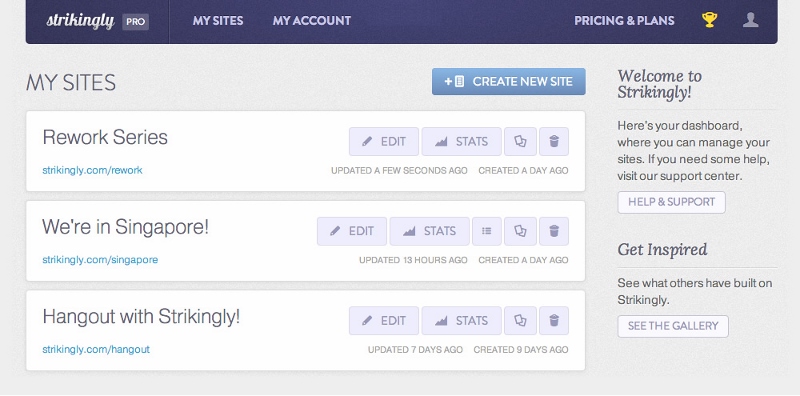
There's a convenient "dashboard" where you can manage your development of multiple websites simultaneously.

2014-02-08-Strikingly2800x396.jpg


The Editor sidebar is straightforward and easy to figure out. Why in the world most technology is so complicated and hard to use for the novice has long been a subject of my wonderment. Tech companies who make it less so are undoubtedly on a fast-track to success.

2014-02-08-editor2.jpg

The Editor sidebar (on the left) opens and closes with ease


The desktop/tablet/smartphone "preview" function loads quickly, while you're in mid-edit and loads the preview image in a different tab from your website in development. This is a strong advancement from the clunky previous options where the user has to wait and wait for the preview to load or experiences 'browser-lock' as a result.

2014-02-08-Strikingly1.jpg


With respect to the pricing of Strikingly, it's simple. As mentioned above, a Strikingly user can use the service for as long as they like for free and have it online through Strikingly's website, provided they don't mind being limited to one website at a time and the Strikingly branding. The"Limited" service plan is $12/month (or $8/month if you pay one year up front) and the "Pro" service is $20/month ($16/month for a yearly payment) and both eliminate the Strikingly branding and allow you to move your website to your own domain but also offer an increased level of functionality.

Add-ons include buying your own 'shopping cart' for your site which calculates shipping and taxes automatically; access to an 'app store' where you can embed apps such as Wufoo (online forms, surveys and needs analyses for prospective customers), SoundCloud (important for musicians especially) and Google Maps, which is vitally important for customers beating a path to your door. The grand finale is helping Strikingly' users integrate payment systems and the ability to take credit cards and PayPal on their sites. Chen told me, "We are working on a partner for and presence in the payment systems area. Right now, we get you online with a beautiful presence that you develop yourself and nobody else has done that."

A prime example of a real, differentiating, super-convenient development for Strikingly users is that when you disconnect from the Internet and go offline, you don't have to sign-in all over again when you reconnect. You just carry on your editing where you left off. This nasty sign-off/resign-in process has been a dreadful byproduct of similar systems which don't consider their user as they should.

To cap off my long, hard look at Strikingly, I'd say that because of the way it empowers and emboldens small businesses, entrepreneurs and start-ups to trumpet themselves with a new web/mobile presence, I believe it's one of a coming crop of high-tech start-ups that will lead the way to the new, fully e-commerce enabled Internet.

Thursday, April 3, 2014

Jaron Lanier Interview: Maximum Openness = Maximum Closedness

Hopefully -- and it's hard for man to make that jump -- hopefully at the end [of Insect Gods] you don't care about the fate of the few. You don't care about the fate of man. You see that civilization has advanced in another way. That it's the roaches that have inherited the Earth. That have become the gods. ( Saturday Night Live comic Michael O'Donoghue in conversation with me in 1979)


Great minds think alike -- at least the minds of late Saturday Night Live comedic genius Michael O'Donoghue and Jaron Lanier, the "father of virtual reality" and the author of the book Who Owns the Future?

In the late '70s O'Donoghue was in pre-production on an end-of-the-world film about the ascendancy of the New York cockroach into a diaphanous creature that would replace humans. The film was an homage to Roger Corman, and O'Donoghue told me it had to be shot in black-and-white and had rejected funding for a color production. Sadly, we lost Michael, and Insect Gods never got made.

Two decades later futurist Jaron Lanier et al. wrote to The New York Times that they had a way to preserve archives for 1,000 years that would survive various disaster scenarios, claiming that with a budget of $75,000 they could implant the robust New York cockroach with a "time capsule" of back copies of the New York Times Magazine and then release a certain volume of the archival insects (eight cubic feet) to breed all over Manhattan. Unlike O'Donoghue's scheme, Lanier's was not intended as black humor.

However, more recent experimenters have demonstrated that commands can be successfully sent from a mobile phone or a PC to live cockroaches. So descendants of the Lanier-implanted roaches could have been sabotaged, posing an even greater challenge to New York City and beyond, possibly unleashing O'Donoghue's vision.

The rest is history. Lanier, a vulnerable man with a Hitchcock-like profile, Rasta hair and generous eyes, has become an international media darling as virtual-reality pioneer, musician and visual artist. Once a goatherd, and with no formal college education, only honorary Ph.D.s, he is cited as one of the most interesting thinkers alive. He is not a physicist, yet his is the lead endorsement on physicist Lee Smolin's recent, provocative book, Time Reborn. (Curiously, the other lead endorsement on the book is not from a physicist either. Brockman-book-agent common thread here?)

In Who Owns the Future? Lanier describes himself as a "humanist softie," and he seems to really enjoy being a father. As we spoke by phone, for instance, Lanier playfully cautioned his young daughter, just back from outdoors, that the pollen in her hair might sprout. In fact, Lanier has dedicated the book to his daughter, and "[t]o everyone my daughter will know as she grows up," saying further, "I hope she will be able to invent her place in a world in which it's normal to find success and fulfillment."

Indeed, Lanier's concerns and pronouncements in Who Owns the Future?, now in paperback, are chilling regarding the consolidation of power enabled by the digital world. In our recent phone conversation he told me that "maximum openness actually turns out to be maximum closedness," referring to the five big tightly controlled platforms.

We also discussed my interest in who owns the origin of life, touching on the secretive, privately funded world of protocell development.

I find the most compelling part of Lanier's book his hopeful exploration of the idea of people being financially compensated for their online contribution instead of being "exploited" (the caveat being ramped-up tracking):

The existence of advanced networking creates the option of directly compensating people for the value they bring to the information space instead of having a giant bureaucracy in the middle, which could only implement an extremely crude and distorting approximation of fairness.


I also adore Lanier's attention to the real nitty-gritty, "the end of laundry and never having to wear the same dress twice" -- something I once discussed with fashion designer Betsey Johnson. Lanier predicts a countertrend to this technology, as well (i.e., greater reverence for vintage and handmade clothing). Bill Blass would have agreed.

Excerpts of my conversation with Jaron Lanier about the future and who owns it follow:

Suzan Mazur: You've written a book titled Who Owns the Future?. Do you have concerns about a few people, privately funded, acting as intelligent designers of more or less a second genesis on Earth? Also, do you have concerns about what they will create?

Jaron Lanier: I have what I hope is a somewhat nuanced position on that. I know some of the people in the protocell world and think for the most part they're good eggs. That world is somewhat more ethically aware than the computer-science world, for instance, which is spying on people, taking advantage of people, doing damage to the economy.

I am, of course, concerned -- as you are -- with the small number of people making protocells, the extreme control, and that it's being facilitated by a few rich people instead of being publicly funded.

Suzan Mazur: Have you been inside some of the protocell labs?

Jaron Lanier: Sure.

Suzan Mazur: Of these half-dozen protocell labs, you've been to one or two of them? You've been to Szostak's lab and to Gerry Joyce's?

Jaron Lanier: I've been to three labs.

Suzan Mazur: Did you have to sign a confidentiality agreement?

Jaron Lanier: I have not signed confidentiality agreements. There might be some that are implied. I'm of the tech and science world.

Suzan Mazur: They trust you.

Jaron Lanier: This notion of very tight control and a very narrow super-elite at work is not exclusive to the protocell labs. The whole world is like that right now. The computer cloud that works with artificial intelligence and works with machine learning with giant databases is also restricted to the five big platforms, which are pretty tightly controlled, ultimately. The whole world has become one of tiny elites and the rest who are kind of left out. It's a negative trend all around, with this being one good example.

It blows my mind that, in a very twisted way, what seems to people like maximum openness actually turns out to be maximum closedness.

Suzan Mazur: How soon do you think we'll have a protocell?

Jaron Lanier: I don't really know. I'm kind of more interested in trying to figure out some way to develop a better empirical technique so we can really know what we've done. I think there's a tremendous fallacy in the field to think that you can see finality, like in computer programming, that you think you know what can happen.

Suzan Mazur: Thinking that computer chemistry can replace bench chemistry, for instance?

Jaron Lanier: Using simulations for virtual possibilities is perfectly worthwhile ... [b]ut we can't pretend that the simulation is reliable before really doing the very, very hard work.

We're all familiar with weather prediction. It has gotten better over time. And biology's surely going to be harder than weather to predict. But because it's so much harder to gather data on microbiology, we're free to fantasize that we have more predictive power than we really do. That illusion is the one that really scares me.

Suzan Mazur: Do you see life as algorithmic or nonalgorithmic?

Jaron Lanier: I think it's a misleading question because it depends on
what you mean by algorithmic. In terms of formal algorithms we study in computer science or mathematics, these things do not ever really exist in physical reality at all. The very idea of a computer that can be described by an algorithm is a bit of a fantasy. What we do is we create an artificial zone where entropy [information] is suspended, and where there's this perfect determinism for a period of time.

It can't last forever. That's what we think of as a computer. And algorithms very quickly correspond to what we can achieve if we do that, but even then it's not perfect. Things will always break down, after a while a cosmic ray will zap them, etc.

Suzan Mazur: And so you don't see life as algorithmic.

Jaron Lanier: If by "algorithmic" you mean the thing that we study in computer science, it doesn't even exist in reality. ... If by "algorithmic" you just mean causal, then of course everything is algorithmic. The problem is you're caught between two extreme definitions of "algorithmic," and I don't think there's any middle one.

Suzan Mazur: You describe yourself in your book as a "humanist softie" and have also said that we humans may have taken a wrong turn -- implying our turn into the digital world -- but that we did it for the right reasons. Other thinkers -- Piet Hut, an astrophysicist at the Institute for Advanced Study, for instance -- have said that we may have taken a wrong turn to the objective pole with our very focus on science, which Hut thinks can't be purely objective anyway. Hut says there are other ways of knowing, that science has been only 1 percent of our human history, and that the other 99 percent -- the subjective pole -- needs further exploration. Would you comment?

Jaron Lanier: I don't think you can really do experiments with consciousness unless you do experiments with aspects of reality. I mean, I understand where Piet Hut's coming from, certainly. I'm sympathetic with it, but as a practical matter, I don't know what more you do with consciousness other than enjoy it.

Suzan Mazur: David Orban, founder and director of Singularity's Institute for Artificial Intelligence Europe, told me at a robotics conference in Bergamo a few months ago that people who don't embrace robotics in the future will not be able to survive. Do you agree?

Jaron Lanier: First of all, I think it's the stupidest institute ever. It's purely about this religious fantasy of superiority. The whole basis of it is repulsive. Yet the people there are great friends of mine. I admire them. We have fun together. And I tell them all this to their faces. I've also given talks at Singularity about how ridiculous I think it is.

Here's the problem. They say people won't be able to survive if we don't have robotics. Well, how is that different from saying, "Oh, if we don't like the way people are, we'll kill them." What is the difference, ultimately?

There's a way in which the new sort of vaguely Asperger-like digital technocrat is absolutely lacking in any self-awareness of ethics or morality. It astounds me, again and again. They're my friends, and we like each other, but I do think it's astonishing.

Suzan Mazur: The European Union is heavily investing in industrial robotics and will retrain workers for jobs lost to robotics. But can it work in the U.S., which is not a social democracy, where job retraining will be left to the unemployed to shoulder the cost?

Jaron Lanier: I don't even know if it can work in Europe. It can work in the early phase in Europe, perhaps, but you can't have a situation where you pretend that all the people aren't needed for anything and robots do the work. This gets to the illusion of Big Data. The truth is the only way to make machine learning algorithms work is robotics or autonomous systems. And it all depends on what we call Big Data, which means massive contributions from massive numbers of people. Without people creating examples, modifying them and reacting to them and all that, the machines can't work. We're pretending that people are less needed.

Now, in the early phase you can train people to work with the robots. If you adhere to the artificial intelligence ideology, then gradually you'll find a way to convince yourself that people aren't needed. But you can't have a 100-percent welfare state. So even Europe will break eventually. But the U.S. will break first certainly, as we'll find out.

Suzan Mazur: Is job application via computer one of the reasons so many people in the U.S. are unemployed? Do we need to go back to more human human-resources departments? Are the robots looking for catch phrases in CVs and failing to recognize human ability and capability at the other end of the computer? Do we need to return to a more human system of hiring?

Jaron Lanier: It's absolutely true that mechanization of human resources has been cruel and ridiculous. That's very, very true. A lot of that was driven by liability avoidance, where if the machine did it, then a company couldn't be sued for discrimination. We're pretending that we're doing things that are really needed but aren't actually needed. It's a giant illusion. I think the reason there are so few jobs for qualified people is that we're exploiting those people online.

Suzan Mazur: How far along are we in the digital world with the concept of rewarding people for their real contribution?

Jaron Lanier: The problem still is that online there's a way for you to pay for stuff but no way for you to earn your real value. People are adding value to all the cloud algorithms that allow artificial intelligence to operate, but there is as yet no way for those same people to benefit.

Wednesday, April 2, 2014

Beware! A Majority of Job References Don't Say Good Things

For most job seekers, providing a list of references is an afterthought. The toughest part of the job search is over -- landing the interview and performing well enough to get to the "final four" (or five or...). Whew -- it's almost over!

Not so fast!

References may be the soft (not "sweet"!) spot in most efforts to land a new job. This step near the end of the hiring process sabotages many job seekers, just short of the job offer/finish line.

According to a CareerBuilder survey:

  • "Three in five employers (62 percent) said that when they contacted a reference listed on an application, the reference didn't have good things to say about the candidate."


  • "Sixty-nine percent of employers said they have changed their minds about a candidate after speaking with a reference, with 47 percent reporting they had a less favorable opinion and only 23 percent reporting that they had a more favorable opinion."


Yikes!

7 Tips for Avoiding Job Reference Disasters

Since references can make or break opportunities for you, manage your references carefully.

1. Be sure you have each person's permission in advance.

Sure, you can add names to your list of references without notifying the people involved, but that's a risky thing to do.

Perhaps they are on vacation or on business travel somewhere and unavailable for a few days. Knowing this in advance will help you. If the perfect reference for a specific opportunity is out of the office for several days, you can share that information with the employer and also line up a substitute or supplemental reference if the employer doesn't want to wait.

2. Make sure each will provide you with a good reference.

Don't ask if they would be a reference for you! That's too simple a question.

As part of number one, above, pointedly ask them if they would be comfortable recommending you to another employer. Obviously, if they say "no" to that question, don't use them as a reference.

Some people may give you permission to use their name, but, unless you ask, you won't know if they will actually provide you with a good reference, as the CareerBuilder numbers show. Asking the pointed question should help.

3. Prepare your references.

You shouldn't normally need to provide your list of references until you are at a job interview. So, preferably before you go to the interview, tell the people on your reference list that you will be giving their names to an employer. Let them know the employer's name, and the names and job titles of the people who will be interviewing you, as well as the location, and other relevant details.

If you can't reach them before the interview, be sure to do it immediately following the interview.

Help them to help you by reminding them of your accomplishments that are relevant to the opportunity you are seeking. If possible, draw parallels between what they know you have done and what the job opportunity requires.

4. Confirm contact information.

Being unable to contact one of your references because the contact information is wrong or out-of-date will NOT impress a potential employer. So, be sure, when you hand over that list of references, that the information on the list is correct and uses the preferred contact information for each reference.

I don't like having my cell phone number shared, but it's fine to share my office phone number. Other people have quite the opposite preference. Re-confirm information and preferences periodically. Maybe someone has a new or better phone number or email address. Keep what you hand to employers in sync with your references' current information.

5. Protect your references.

Your references are a very important asset to your job search, an asset you should protect. You don't want to exhaust them with inappropriate or less than serious contacts. So, don't put their names and contact information on your resume, your Facebook page, or your LinkedIn and Google Plus Profiles.

Making their names and contact information too public risks inappropriate use (spammy phone calls and email) and badly timed contacts by employers. If possible, you don't want your references called before you have prepared them (see #2 above), and you don't want them bothered by everyone who sees your list.

6. Customize your reference lists.

To avoid over-use of any two or three references, maintain a master list of, preferably, ten or twelve people who can act as references for you. Then, from that list, prepare a short list of three or four references to take to each interview.

If possible, customize that short list so that some people are not "used" so often that they become annoyed or less than enthusiastic about you and also so that the references you do use are as appropriate as possible for the opportunity.

For example, if the opportunity is in a new industry for you, and one of your references currently works in that industry -- or has worked in that industry in the past -- add that person to the list you hand to that employer.

7. Don't abuse your references.

These people are doing you a big favor, and, clearly, they can do considerable damage to your opportunities if they choose.

Ask them their preferences on timing and method for an employer to contact them, and share that information with the employer -- perhaps in a note on the reference list ("Best time to contact: afternoons, preferably not Mondays or Fridays. Best method: personal cell phone or office email").

Do your best to avoid bugging them by contacting them too often or having too many employers contacting them. By staying in reasonable touch with your references (monthly, in most cases), you can judge how well they are doing.

After-Action Reporting

Once the interviews are over and the references have been given to the employer, ask the employer their plans and their process for contacting references. If your references have indicated a preference for time and method of contact, be sure to point it out to the employer.

Then, contact your references to let them know what the employer plans to do, and ask them to contact you when (if) they hear from the employer. This gives you another opportunity to do some reference coaching, if necessary, and to simply touch base with these people.

Thank them, regardless of the outcome.

If you do get the job, take them out for a very nice dinner or buy them a nice bottle of their favorite wine (maybe champagne!) or a gift card for their favorite store.

Even if you don't get the job, your references have tried to help you, so they deserve your thanks -- maybe a fancy cup of coffee at Starbucks or a nice lunch, whatever you can afford that they would like. At a minimum, send them a thank you note.

When "Current Supervisor's Name" Is Required

Perhaps you are completing an online application that requires you to provide the name of your current or most recent supervisor. Particularly if you are currently employed, providing your supervisor's name can be risky -- the reference check could "out" your job search, and cost you your job.

In those cases, it's a judgment call whether or not you provide the name of an earlier supervisor who works for a different employer, leave the field blank, or indicate that you will provide the information at the job interview or later in the process.

Not providing your current supervisor's name on the application may cost you an opportunity, if it is a "required field." But losing that opportunity is probably much better than losing your job. Your call.

If you were fired from your last job, or left because you didn't get along with that supervisor, consider providing the name of your supervisor from a previous job or some other reference - hopefully prepared, in advance, using the tips above.

For the Future

Stay in touch with the people you have worked with, particularly those former bosses who have a good opinion of your work. LinkedIn can be very helpful for this, and so can Facebook (carefully!).

Susan P. Joyce is president of NETability, Inc. and the editor and chief technology writer for Job - Hunt.org and WorkCoachCafe.com.

Follow Susan on Google+ for more job search tips.

Tuesday, April 1, 2014

How Tipping Is Changing in the Digital Age

by Michael Y. Park

2014-03-21-CafeGrumpytipping620x928.jpeg
Your smartphone has staged a coup on your social life, invaded your mealtimes, and probably gobbles up more of your free time than your best friend (unless her name is Siri).

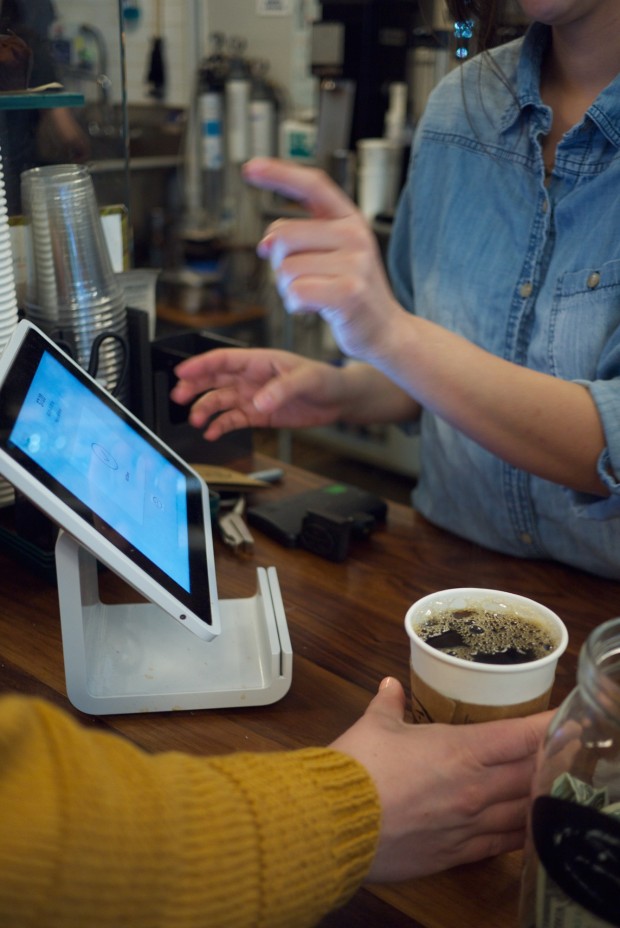
And now it's changing how much you tip -- and you may not even be aware of it. Mobile-phone apps, Square, the new Starbucks digital-tipping service, and similar 21st-century doohickeys are beginning to render our wallets superfluous, and the digital age is establishing new standards for how much gratuities for eating out should be.

"Fifteen percent is old school," said Manny Pena, owner of Astor Row Cafe in New York City. "Twenty percent is the new 15 percent."

Pena, whose restaurant uses Square, has seen tips increase noticeably in the past couple of years, and said it's more than the expected tip creep that's associated with generally rising prices. At Molly Moon's Ice Cream in Seattle, owner Molly Moon Neitzel said that her scoopers went from making about $8 an hour in tips to $12 an hour since her stores embraced digital tipping. Adam Mesnick, owner of the Deli Board in San Francisco, said tips used to make up from 5 to 10 percent of total daily sales. Now? Tips range from 7 to 16 percent of sales.

For Pena, the explanation is that the act of tipping has become a lot more abstract: Even the stingiest customer doesn't feel quite the same punch in the wallet when he scribbles a couple of numbers onto an iPad instead of counting out and handing over a wad of cash.

"I think there's some kind of a casino effect," he said. "You don't comprehend that it's real money."

But credit cards have been around a long time, so the increases can't be explained merely by the fact that the U.S. is transitioning to a cashless society.

It's all about what's really valuable to people who eat out, said Mark Egerman. He's a co-founder of Cover, a service that could be described as the restaurant version of the taxicab app Uber -- Cover users who go to one of the hundreds of Cover-affiliated restaurants in New York City don't even have to wait for a check when they're done eating -- the bill (and the tip) are taken care of through their Cover account via their smartphone app. The average New York City diner tips 18.8 percent, but the average Cover user tips 21.7 percent. Though he acknowledges that his clients are a self-selecting group that makes more money than the average New Yorker, Egerman is convinced digital services like his are primarily making people tip more because of simple psychology.

SEE MORE: 23 Spring Recipes For Warmer Weather

"Tipping down is rare," he said. "But the No. 1 reason people do tip down is waiting for the check. One of the reasons for that is that waiters spend too much time swiping cards. By removing that, waiters spend more time with guests."

And pampered guests are happier guests, and happier guests are bigger tippers. So in a sense, customers who use apps or digital tipping services are tipping more because they're willing to shell out a couple extra bucks for something more precious to them: their time.

Still, payment apps and digital services don't shy away from nudging customers toward generosity.

When the Big Apple's taxis began adopting credit-card readers, many lifelong New Yorkers were shocked to discover that they'd apparently been undertipping their cabbies for years--at the checkout screen, they were presented with their tip choices, with 20 percent being the smallest option. (A small, easily missed button in the corner allows riders to enter other amounts.) Of course, they hadn't really been undertipping before, but thanks to the way the screens were laid out, 20 percent became the new norm overnight. It's a strategy known as anchoring, subtly or not so subtly establishing a new standard by shifting the choices you present. If you want Team Big Tippers to score more touchdowns, you're going to help them immensely by moving the 50-yard line toward the goal.

The same goes for most digital-payment services that include a tipping option. Most offer restaurateurs and shop owners the choice of letting customers tip by percentage or flat-dollar amount, or whether to switch from flat dollars to a percentage-based tip if the total bill comes to, say, $10 or more. Some allow them to set the default percentage as the tip -- customers can adjust the percentage at checkout. Unsurprisingly, most customers pay the default. Cover's standard default, for example, is 20 percent. Square customers have a feature called Smart Tips that allows customers to either leave no tip or one of three tip percentages on bills of $10 or more -- the lowest percentage is 15 percent, the highest 25 percent. Clearly, the implication is that the "generous" 15 percent tip your dad used to give is no longer considered quite so generous.

Even something as seemingly mundane as deciding to have a two-part payment screen with a tip screen that comes before the signature screen, instead of a single screen with both, can make a tremendous difference. Neitzel found that out when a glitch in the Square service turned her two-screen payment into a one-screen for a few hours one day.

"The employees noticed immediately that they were making way less tips," she said.

That extra line asking whether you want to leave a tip makes a big difference to how much a server takes home at the end of the shift, it turns out. Now, when it comes to baristas, ice-cream scoopers, and sandwich-shop counter guys, tipping is no longer just an afterthought. Customers have to consciously click "no tip" before completing their transaction.

SEE MORE: 22 Recipes Everyone Should Know How to Cook

"I wouldn't use the term 'tip-shaming,'" Neitzel said. "I would say, as a citizen of the world, every decision we make that impacts other people should be made with consciousness. If you do not tip someone for a tip they provided, it should be a conscious choice, not one a machine makes for you."

"It's a nice friendly reminder," Mesnick said.

Both restaurateurs and digital-payment providers said people shouldn't get the impression they're designing their products to favor servers or fleece money out of customers. Instead, it's about giving customers more flexibility when it comes to gratuities.

For example, the Starbucks digital-tipping app offers four options: no tip, 50 cents, $1, and $2. When the average coffeeshop customer makes small purchases but is increasingly likely to pay for them with a credit card, leaving any tip at all can prove a hassle. Digital tipping solves that problem.

"No more, 'How do I tip my barista without going to an ATM to get cash?'" said Starbucks spokeswoman Linda Mills.

And Egerman said companies like his are well aware that you're not going win over many customers if you sap all the fun from going out.

"We considered adding a feature where the tip screen could say, 'You just chose to tip 16 percent. In New York City, the average is 18 percent.'" he said. "But we decided the last thing people want on a night out is their phone shaming them."

Still, some servers aren't convinced that they're really sharing in the bounty of the digital age at all.

"I think people are tipping probably more precisely because there are so many apps out there to figure out what your tip is, but I haven't seen a big change," said Darren Cardosa, a New York waiter who blogs under the alias The Bitchy Waiter. "I think it's a wash -- people are rounding up or rounding down. And I don't know many waiters who appreciate Groupon groups or those social-media deals."

But Chase McCown, who writes about his Los Angeles restaurant travails on his Bitter Waiter blog, said he's happy that his tips will soon be coming to him in the form of abstract ones and zeros instead of cold, hard cash -- with one caveat.

"I'd just tell people to keep taking into account service that went above and beyond," he said.

Prefer cash? Here are the 10 best tip jars we've ever seen

See more from Bon Appetit:

25 Ways to Use Sriracha

10 Snacks You Thought Were Healthy But Aren't

10 Restaurants from Books and Movies That Became Real

You'll Never Guess What These Grammy Outfits Remind Us Of