Friday, March 7, 2014

Transhumanism and All My Mortal Friends

We were afraid to think much about spring during the month of March up in Michigan. Too many days gave us false hope of warmth, a Chinook wind might melt the ice and show frozen green from the previous summer, and then a heavy snow could fall and cover our dreams of sun. In college, if we found money, a trip to Florida made us think that by going away for a week we would come back to a vigorous spring and a state in bloom.

I was working in the dormitory cafeteria and had met a farm girl who was taking up my time. Murph suggested I try to save a few hundred dollars and ask her if she wanted to travel to Florida for spring break, and he would ask his girlfriend. Florida was a location where I thought people with money visited and I had no concept of myself on a beach but he convinced me to take the trip, and to take chances. Murph had a car and in the house where he grew up there was a dry sauna. I saw it on a weekend when he invited a group of us from Abbott Hall to South Bend for a hockey game between Michigan State and Notre Dame. The sauna was bigger than my bedroom at our house south of Flint but Murph was not amazed by his circumstances. There was also a pool table upstairs and his parents had left for Florida so we were able to have a party after the hockey games.

We drove his nice car down Interstate 75 and the old Dixie Highway, the road that had led homesick southern boys north from the farms to the car factories and the steel plants that had jobs after World War II. Cold rain splattered against the windshield as we dreamed of the beach in Ft. Lauderdale and finding a motel that was no more than $25 a night. When the Atlantic came into view along A1A, I was as breathless as I was tired but the sun was suddenly warm and the farm girl smiled beside me as Murph sipped coffee and his friend Patty chattered in the front seat.

We were young and our lives were endless and the road was smooth and flat.

* * *


A few weeks ago, there was a demonstration on the campus of Google in California that few people noticed. A small group of individuals stood outside the Googleplex and held signs that said, "Google, please solve death," and, "Immortality now." The modest gathering was in response to Google's announcement of a new initiative called Calico, which is designed to focus on health and well being, but also senescence and the ravages of time and its affects on the human body. A number of people are hopeful that the planet's most powerful technology company has begun to concentrate science and research on transhumanism.
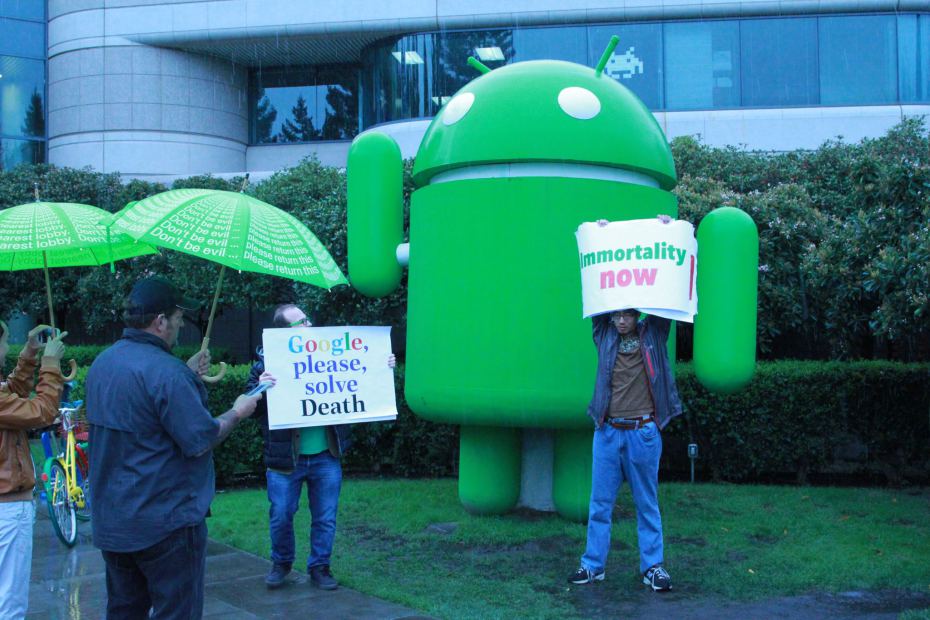
2014-03-06-googleimmort.jpg

A Demand for the Ages


Transhumanism is an idea that we can transcend mortal definitions of our lives. There are already discussions about uploading consciousness and memory to computer networks to enable the human experience to continue even if only in an incorporeal form. Science is presently giving us robotics that move artificial limbs with only thought and there is research to stop the cellular decay that leads to senescence and the failure of organs and biological functionality.

British researcher Aubrey de Grey believes that age is simply a disease that can be cured. He has identified seven ways that human bodies fall into decay and believes they can all be fixed with science and medicine. He is developing what he calls viable Strategies for Engineered Negligible Senescence (SENS), which he is convinced can end aging and our acceptance of death after a traditional life span. De Grey is working to prove that the metabolic and cellular processes that cause aging can be reversed and humanity can eventually approach mortality. The science to save us, de Grey insists, already exists, and the only challenges are money and continuing research.


De Grey, in an interview with German television, said that the first human to live 1000 years is alive today and may even be as much as 60 years of age.

* * *


The sun turned us pink that week on the beach in Ft. Lauderdale but we told ourselves we would be brown and Michigan would be warm when we went back north. Nothing could hurt us and we swam and ran and ate and drank and danced with improbable energy. There was not a moment when Murph was not smiling the entire week and he believed more than me that everything was green and warm up north of the Mason-Dixon.

Murph eventually took off on a career that made him an executive in major corporations and when the farm girl and I were living in a broken down adobe down on the border he already had airline privileges and flew down to sleep on our porch and listen to the shuffle of palm fronds in the wind. Murph and I hung out together for a while in Denver and over the decades our lives intersected often enough that we were able to keep alive a friendship that had survived beyond all others from my university days. Everything, to him, was funny, and for me, mostly serious and demanding of intellectual rigor. Our perspectives mutually leavened our lives and sustained our friendship.

As Murph's career ended, he made plans to move to Austin with his wife Judy. A diagnosis of Parkinson's set him back but he was optimistic about his condition's slow progress and was getting the most advanced treatment possible when he was living near Houston. I had not seen him for a few years until we met him in a restaurant during a road trip to New Orleans and he walked past a window so slowly and stiffly I thought it was a little old widower come for the lunch special and to be around people.

Murph was making his slow exit.

* * *


Gennady Stolyarov II and his wife Wendy Stolyarov do not believe in death. They think science and technology can solve it and, until it does, we need to begin thinking that our end is not a foregone conclusion. They are preaching this gospel of eternity to children in a new book they have written called, "Death is Wrong." First, they think, the cultural perception of mortality has to be changed, and the best method to achieve that goal is to begin with teaching children. Ages eight and up are asked to consider the notion that they can be immortal.

The Stolyarovs have begun an online fundraiser to publish 5000 copies of their book and begin distributing them to families. Believers in dramatic life extension have been invigorated by Google's moon shot project Calico and the hiring of Ray Kurzweil, an artificial intelligence expert and futurist, to direct engineering operations. Kurzweil has argued that indefinite biological life spans can be achieved by 2030. Stolyarov, interviewed by Wired magazine, acknowledged that he fears death and that has prompted his defiance of its cultural acceptance. "I don't see any shame in saying that I am afraid," he said. "For me as a person who relies on reason and understanding and anticipation of the future, this is the only condition that's truly unknowable. If you cease existing, what's that really like?"

It's not like anything, probably.

There is now, however, no reason to be afraid. Nanobots and drug therapies and various other scientific advances promise a possible reverse to the damage caused to human bodies over the course of time. Cells will be revivified instead of decaying. Why not believe this is possible, Stolyarov asks, because the first part of accomplishing immortality is to believe it is possible and dying is not required. Teach that to the young and the world will change. Death, he insists, is wrong.

* * *


Murph did not hang out much after he got to Austin. He began to focus on his condition. As his dementia increased, he sought alternative therapies like deep brain stimulation but learned he was too far advanced to be considered for the treatment. He kept asking me to take him around to assisted living centers because his marriage of twenty-five years was in trouble. I drove and talked to him and listened as he asked me the same questions several times over the course of a few hours. When we drove past a facility we had visited a few hours earlier he liked what he saw and wanted to go inside for a tour and had no memory of having previously spent a half hour asking the manager questions.
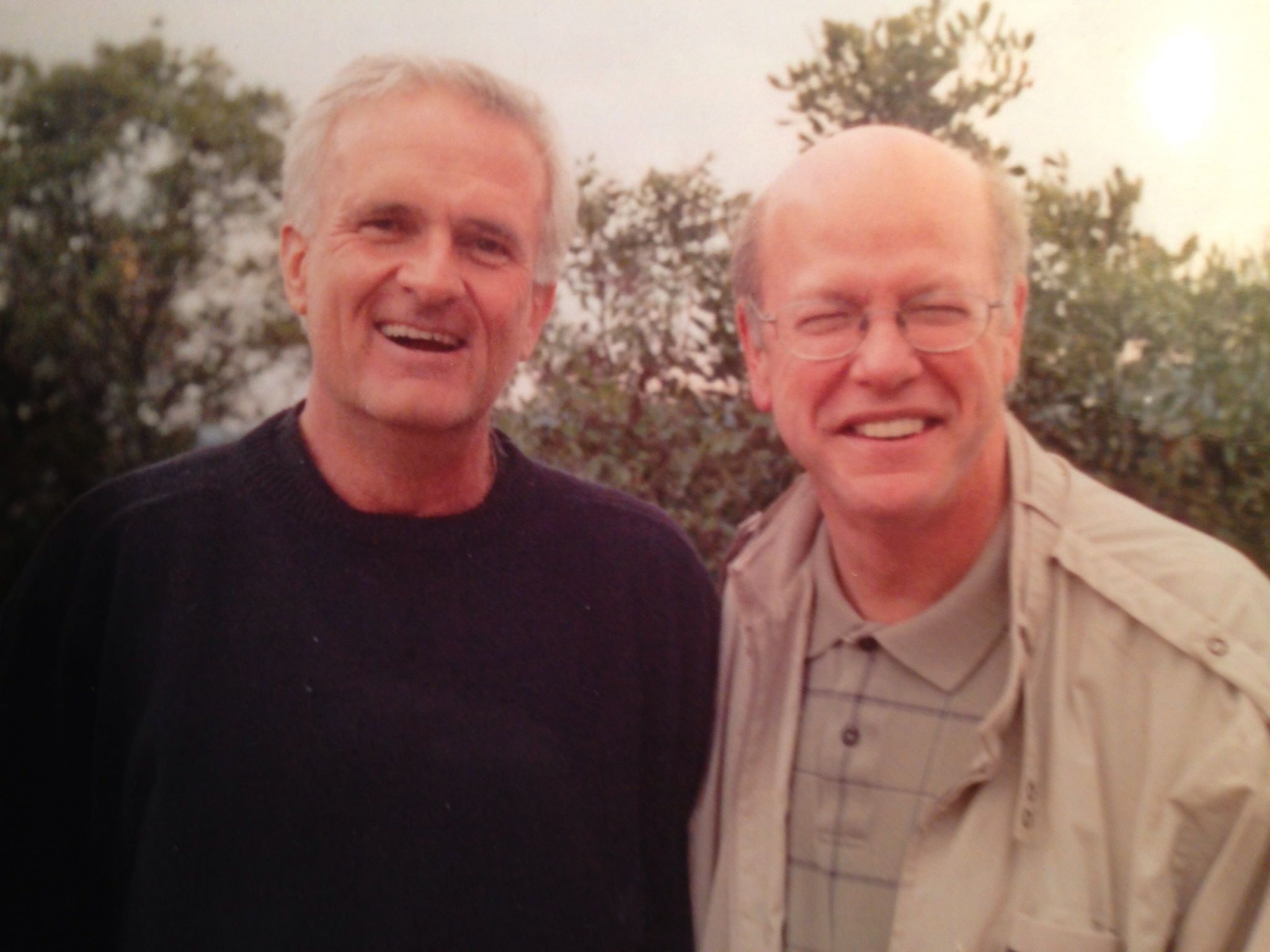
2014-03-06-murphandme.jpg

Old Friends


We went to get Mexican food one bright afternoon and as he was getting out of my car he began to bounce and lose balance and started running to regain stability. I caught him before he had reached the creek. Murph ate slowly like my father near the end of his life and he could not speak loudly enough to be heard in the noisy restaurant. We were late for an appointment to have a chiropractor "adjust" his back and Murph left most of his food on the plate. I opened the door for him and held it for a group of women walking up behind us.

When I turned around Murph had begun bouncing and teetering forward and ran to get his feet under him and he fell hard on his face across the concrete. There was no time for me to reach him before he had busted his lip open and scraped his cheek. The women helped me get him to his feet and Murph cracked one of his disarming jokes but he wiped the blood from his mouth eagerly when one of the women handed him a tissue from her purse.

"Still going to extremes to meet girls," he said. "You can see it works."

I laughed and got him into the car and as we pulled out of the parking lot I saw the tears on his face.

* * *


Murph was too smart for his affliction. He knew what was coming. There were more falls and less memory. The MSU memorabilia he collected and that lined his walls would lose meaning. He would forget the autumn afternoons waking beneath the orange and yellow trees filled with anticipation and talking with friends on the way to the football stadium. Who he was, what he knew, what he could do, was going away. And he did not want anything to do with what he was about to become.

A Saturday night in February, Murph took several bottles of muscle relaxers and maybe some ecstasy and went to sleep. When he did not awake the next morning, Judy, his wife, had him transported to an emergency room. Tubes were inserted; he was stabilized, and taken to intensive care.

Over the course of the next few weeks, he opened his eyes a couple of times. Murph heard my voice and awoke and looked at me, unable to speak because he was intubated, and tears trailed down his cheeks. I asked him if he wanted to stay around or go and that he if chose to stay around to blink his eyes. I did not know if he lacked the power to blink but there was no response. He went back into his coma. Judy wanted to sign a DNR, do not resuscitate order, in the event Murph went into cardiac or respiratory arrest but the hospital ran background checks and discovered that they had filed preliminary divorce papers. Hospital ethics no longer allowed her authority over her husband and a committee authorized me to disconnect my college roommate from life support. I only wondered about the possibility of Murph regaining enough cognitive perception to tell us what he wanted but his doctors assured his wife and me there was very little possibility of such a development and I knew what his desire was based on the behavior that had led him to that ICU.

I thought about the yellow house we lived in on Cedar Street with three college buddies and how we sat on the porch and drank beer and dreamed up our futures and I envied Murph's musical talent and the way everyone in a room stopped when he started to play the piano. I do not think he liked the attention but I know he loved the music. His life was full but he would have been a funny old man and a good friend to laugh at mutual frailties and our naïveté's as the light faded. Murph was self-effacing and always good at giving others reassurance and comfort.

He only lived three days after he was disconnected and died on his birthday. I know he did not want to go and enjoyed living but he felt he was given no choice by his genetics. Nobody wants to lose control. And nobody really wants to die. I want to live a million years and see what happens and if we ever figure out how to exist together and responsibly manage our resources and technology and how far we will reach into space. I know Murph wanted that, too, but he could not have it.

In the fall, when our old campus is alive with people cooking outdoors and throwing footballs and the band is marching proudly along the Red Cedar River, I intend to return and find a spot for Murph's ashes. He never really left Michigan State University and he deserves to be a part of it for all of its remaining springs and autumns as students gather to learn and dream and live.

That way, he, too, might live a thousand years.

Also at: Don't Grow Texas

Thursday, March 6, 2014

Analyzing Your Media History

Each spring semester for the past eighteen years, I've taught a course at Tufts University called Children and Mass Media. And each January I've chosen to begin the class the same way. On the first day of class, I give my students their first assignment: analyze your personal media history.


Years ago I asked them to write about their personal television history, but with the dominance of the Internet, the growing importance of social media and the multiple uses of different types of mobile platforms in the lives of young people, I've had to revise the assignment. Even though the prompt has morphed a bit, I find that the results are always the same: it's a great way to get students to start thinking about how their media preferences and consumption as children colors their media preferences and consumption as young adults. I don't grade this assignment, but I do use it to get conversation going. And I learn a lot about my students, because it turns out that media use is intricately and intimately connected to a lot of personal issues.


Over the years I've had students write this paper, I've seen some fascinating trends emerge. One pattern is an inverse relationship between the amount of control parents or caregivers exert over a child's media intake and the amount of media that child -- now grown into a young adult -- freely admits she or he consumes. When parents greatly limit a child's media use, the child-cum-adult uses a lot of media; when parents do not set enormous barriers to a child's media use, she or he tends to view and use media far more moderately as a young adult. There are exceptions to this rule and I have to admit I have not tracked this very systematically, but there's no doubt the overall pattern exists.


For instance, one student this year wrote, "Ten or so years of extreme parental control over my media use were followed by a few years of absolute media saturation. I'm sure that my parents' stringent media rules during my childhood strongly influenced my desire to over-consume media when I first got to college." And conversely, a student whose parents "truly set no limits as to what my brothers and I could watch or listen to or surf" found that "today I actually spend very little time with media. I watch practically no TV and am a much lighter consumer of most social media than many of my peers. I have to think that because my parents never forbade us from media and had such a laissez-faire attitude about it influenced my siblings and I to have pretty moderate and balanced views and use of media today."


Increasing numbers of my students are writing about how they have made very deliberate decisions to take a break from social media. I've written a column previously about how students are taking a holiday from Facebook, but this year I've found even more students who not only opt out of Facebook, but also are disabling their Pinterest, Instagram or Twitter accounts. "When I realized how much time I was wasting reading everyone's tweets, I realized it was time to get off that social media merry-go-round" wrote one young man.


As Tufts has become ever more diverse in terms of the racial, ethnic, global and economic backgrounds of our students, some of these socioeconomic factors have also found their ways into this assignment. This year a student who had grown up in both Seoul and New York wrote about how her confusion over whether she was Korean or Korean American translated into the television shows she selected as a child. A student who hails from Turkey wrote of how she learned to speak English primarily from watching Disney films and how this created a disconnect with her parents, who did not know a word of English. A student who grew up in a single parent household in South Central Los Angeles wrote of how her mom was determined to do what she could "to protect me and my four siblings from the negative influences of the world all around us, and that included prohibiting us from seeing the glitzy world on television and in advertising that was so different from the reality of our lives." A student who was raised in multicultural Hawaii stated that she "never saw the kind of people I was surrounded with in any of the media I saw as a child." And a student from Ghana wrote about how the dominance of American media in his life as a child meant ""I often dreamed of spending a whole day just watching American programming."


Some students wrote prescient essays about how different forms of media had held social significance for them at different points in their childhood. Writing about his presence on AOL growing up, one young man admitted that, "I could create an AOL profile through which the whole world could see me the way I wanted to be seen, and talk to the girls I was too socially awkward to talk to at school. I literally could not summon the courage to ask a girl for her help on homework at school, but I was flawless in the placement of a coy smiley face and spelling cool 'kool,' or 'kewl' -- whatever the coolest way to spell it was that week."


Another student discussed her thoughts on some of the ways in which memories of childhood media use had proved a bonding mechanism, a form of social indoctrination, during her first days at Tufts: "In the confusion and excitement of the first week of college orientation, some particular conversations seem to be repeated constantly with various groups of fellow freshmen. Few topics come up as continuously as television and other media consumption beyond names, dorms and dining hall food. Possibly in a show of solidarity as a generation, reminiscing on children's television from "the good old-days" of the mid- to late-nineties is a common practice of college students, both in person and on the Internet. Discussing the ninja-turtles' obsession with pizza or playing the Rugrats theme song on a piano would probably considered valid and relatable conversation-starters for many Tufts students and current undergraduates in general. These types of interactions are representative of the sentiment that certain media consumption is considered ubiquitous for my demographic."


Finally, I have found that students often link their media use to other issues that affected them in childhood. Sometimes these issues are intense and profound: The student who wrote about how her parents' addictions to alcohol and drugs shaped her own "addictive personality, which at times has included an addiction to media." There are always students who write about how media use figured into figuring out relationships with parents who had split up. This year, I read about one student whose divorced parents had very different rules about media use in their homes which made my student and her siblings acutely conscious of how media use at respective parents' homes led them to periodically favor one parent over another, and about another student who obsessively watched The Sound of Music because the film was the only positive memory she had to hold onto from the father from whom she'd become estranged.


There are always stories like the one from the young man who wrote that he loved playing video games as a child because "feelings of triumph, sadness and anxiety got funneled through a fictional world to the point where I realized that I was using all my emotional energies there and had little to spare for the real world in which I sometimes lived." And then there are the young women who write poignantly and movingly about their obsession with teen magazines or unhealthy and unobtainable body images of television models. "I truly thought that the runway models and the girls in acne commercials were typical. I never saw anyone overweight on TV. I couldn't change my eyes, my nose or freckles, but the one thing I could change was my weight. Overcoming anorexia recast my relationship with TV."


I don't think I knew when I first came up with this assignment just how revealing it would turn out to be. I asked my students for permission to quote from their papers anonymously in this piece, and without exception, they gave it to me. They realized, as I have, that this assignment says a lot about the relationship between media use and cultural issues. It's proven to be one of the best assignments I've ever given.

Wednesday, March 5, 2014

The Road to Superintelligence

2014-02-10-0610globalintelligence.jpg
(Image credit: mindcontrol.se)

In the 21st century, we are walking an important road. Our species is alone on this road and it has one destination: super-intelligence.

The most forward-thinking visionaries of our species were able to get a vague glimpse of this destination in the early 20th century. Paleontologist Pierre Teilhard de Chardin called this destination Omega Point. Mathematician Stanislaw Ulam called it "singularity":

One conversation on the ever accelerating progress of technology and changes in the mode of human life, which gives the appearance some essential singularity in the history of the race beyond which human affairs, as we know them, could not continue.


For thinkers like Chardin, this vision was spiritual and religious; God using evolution to pull our species closer to our destiny. For others, this vision was a fiercely secular and naturalistic technological utopia designed on scientific principles alone. The rapture for the nerds.

Today the philosophical debates of this vision have become more varied, but also more focused on model building and scientific prediction. The closer we get to our destination, the clearer we can see this world. In the early 20th century Chardin could only generalize about its features. In The Phenomenon of Man he described the Omega Point as "super-personalized" and "infinitely enriched".

It's hard to make real sense of what this means.

In contrast, today we can define the specific mechanisms that could realize a new world. We can actually see the singularity. We can actually touch it in laboratories around the world. Sometimes, we actually experience it in the real world of 2014. Modern theorists can describe it so well that it becomes real to the mind, making our present world seem hopelessly barbaric and painfully primitive. Even embarrassing.

One of the best descriptors of our potential future world was explored in a recent paper by cyberneticist Francis Heylighen titled: Return to Eden? Promises and Perils on the Road to Superintelligence.

Here I summarize the main technological mechanisms as described by Heylighen. I hope you will quickly realize the point of this exercise. In 2014, we live in a world with global brain technology. We live in a world where the consequences of our technological actions demonstrate that the possibilities of utopia come dangerously close to the possibilities of destruction. For example, drones can give us an automated distributed network with the ability to give anyone, anything they want, in a negligible amount of time and for negligible cost. Or... drones could be used to kill children in the developing world.

So far we've chosen the peril first, and planned for the promises second. With the technology yet to come, we must do better. We must prudently walk this road towards the promises, while avoiding the perils in their entirety.

Promise #1: Omniscience

Important Mechanisms:

  • Semantic web

  • Artificial intelligence (AI)

  • Massively Online Open Courses (MOOCs)


Global brain technologies give us the possibility to have the entirety of humanity interacting with omniscient knowledge bases. We are building computers to learn and communicate with humans in a personalized way. The more stored data we have to play with, the better we can design technologies to harness these data. Every single individual, from birth-to-death, can interact with a system that knows what they know, and knows what they need to know. Every individual can have a omniscient personal assistant to guide them through life and help direct them towards their desired goals. The omniscient knowledge base may even be able to recognize an individual's desired goals better than the individual, and make suggestions for future contemplation.

Promise #2: Omnipresence

Important mechanisms:

  • Internet of things (IoT)

  • Wearable/Internal computing

  • Cloud computing


We have a whole host of emerging technology to enable practical omnipresence. As we start the construction of a planet with *everything* connected to the internet, we take steps towards turning humanity into a *single-information-processing-unit*. This is the essence of global brain. Wirelessly communicating smart-technology should be able to immediately recognize any perturbation within our system, whether that be a fire, a murder, a transportation disaster and deploy the necessary mechanisms to resolve the situation or prevent it from ever happening in the first place. This grid should also allow for the efficient regulation of our entire transportation and energy grids, eliminating any physical friction so common within industrial transportation and energy grids.

Promise 3: Omnipotence

Important mechanisms:

  • Robotics

  • Nano-assemblers (3D/4D printing)

  • Internet of things (IoT)


Our present-level of abundance has almost everything to do with industry. Today, we are building the industrial internet, and this will transform production in ways that should give us practical omnipotence. We should be able to manufacture anything we want, for negligible cost, right from our own homes, within a negligible amount of time. This will transform production and consumption of all physical objects (e.g., food, organs, homes, vehicles) in a similar way to how digital technologies have transformed books, movies, and music in the past 20 years. In the global brain, anyone can be Henry Ford.

Promise 4: Omnibenevolence

Important mechanisms:

  • Higher education

  • Abundance

  • Increased connectivity


This is the hardest to justify with mechanisms. We need extrapolated trends, correlations, and natural philosophy to help us justify the assertion that practical omnibenevolence is achievable in the global brain. From what we can tell, the better educated people are, the greater their collective wealth, and the more they know about other peoples and cultures, the less violent and competitive they become. In a world of abundant education, resources, and hyper-connectivity, we should see a system emerge that is built on cooperation and abundance, as opposed to zero-sum competition and scarcity. Global brain should be the end of murder, war, slavery, prejudice, suppression, dictatorship, corruption. We should see a flourishing of human potential and justice.

This Road has Perils

This is not an easy road to walk. Super-intelligence is within our grasp. Temporally speaking, we're closer than most realize. The last few metaphorical kilometers may be the most difficult, or they may be surprisingly easy. No one really knows. But we do know that emergent technology can theoretically be used for global horrors, just as they can be used for global paradise. From my perspective the road can't be avoided, as evolution can't be stopped. But there is no way of knowing with 100% certainty whether we will successfully make the journey. It will take intelligent decision-making from our most powerful institutions. That takes evidence-based distributed decision-making, as opposed to ideology-driven centralized decision-making. They must be willing to make this change now. And yet I fear they won't. Maybe technology will re-structure them for us, or maybe we must actively change them ourselves. Maybe a combination of both approaches is the key. We do see signs of hope.

Whatever happens, the global brain is coming. The technology to build a global brain will come whether our institutions change or not. The problem then morphs into something a little more interesting: technology can build the global brain, but its up to us to build the global village.

For more read: Return to Eden? Promises and Perils on the Road to Superintelligence

For further discussion or contact me.

Tuesday, March 4, 2014

Why I Just Quit My Job at Apple

2014-02-11-Jprice123.jpg


About a month ago, after years of designing in various industries, making websites for small-time clients, working at failed and debatably successful startups, and fiddling with random side projects, I had been offered an interview at Apple. I couldn't believe it. I had just totally revamped my portfolio, and I was now actually good enough to be considered as a candidate at Apple. In my eyes, Apple is, hands down, the most highly-regarded company a designer could work for.


They set an interview date, and I started to brace myself for a bunch of gotcha questions and hard design problems that I would have to whiteboard in front of a design team. I had also assumed such a big company would take many rounds of interviews to make a final decision. I was pleasantly surprised when I only had to interview with three people for less than an hour, and the interview was pretty standard. I drove back to SF from Cupertino, and I replayed the interview in my head. It seemed like it went well, but I didn't want to get ahead of myself. I didn't want to be disappointed if they rejected me.


It turned out it did go well. I received a call the same day, and they told me I knocked it out of the park. They offered me a contract position as a mobile designer. Wow! I was so ecstatic that I had screamed when I got off the phone. My parents and family were super excited when I told them the news. I had posted the news to Facebook, and I had never gotten so many likes and congratulations on anything before. I got more likes when I announced that I got a job at Apple than when my daughter was born. People that I friended years ago and never talked to since were sending me messages. I changed my title on Twitter, and suddenly people started following me that probably never would have a week before. People were so excited for me that I decided to celebrate with drinks one night, and the turnout was amazing. It felt so great to have people want to celebrate this achievement with me.


I couldn't sleep the on the nights leading up to my start date. I was nervous and excited. I felt like getting an offer from Apple had validated my talent as a designer. I thought about the long, unorthodox journey that lead me to Apple. I wondered, "What does this mean for my career? What will I be working on? Where will this take me? Will I ever finish the iPhone app I've been working on on the side?" I had so many questions.


Then I started. I immediately was uneasy about the rigid hours and long commute, but at least I could be one of those notorious tech people whizzing to and from San Francisco on a private bus with Wi-Fi. (I'm especially intrigued by the bus thing because I grew up in San Francisco and have seen the cultural and economic shift that's resulted from this tech boom and the last. Now ironically I was one of the techies who some people think is ruining the city.) I hardly (hardly meaning never) saw my daughter during the week because the hours were so inflexible. I had also taken a substantial pay cut, but I figured I was making a long-term career investment by working for such a prestigious company. On-boarding was super bumpy, and they had so many passwords, accounts, and logins that it took nearly a month just for me to get on the server. There were meetings all the time which were disruptive to everyone's productivity, but they seemed to be a necessary evil in a company that's so large with such high-quality products. It was all a bit bothersome, but nothing that would be a big problem in the long-term I thought.


Then my immediate boss (known at Apple as a producer), who had a habit of making personal insults shrouded as jokes to anyone below him, started making direct and indirect insults to me. He started reminding me that my contract wouldn't be renewed if I did or didn't do certain things. He would hover over my back (literally) like a boss out of Dilbert and press me to finish some mundane design task that he felt urgently needed to be examined. He was democratic about his patronizing and rude comments, but it didn't make me feel any better when he directed them towards my team members. I felt more like I was a teenager working at a crappy retail job than a professional working at one of the greatest tech companies in the world.


I tried to tough it out and look at the bright side of things. I was working at Apple with world-class designers on a world-class product. My coworkers had super sharp eyes for design, better than I had ever encountered before. I loved the attention to detail that Apple put into its design process. Every single pixel, screen, feature, and interaction is considered and then reconsidered. The food in the cafe was great, and I liked my new iPad Air. But the jokes, insults, and negativity from my boss started distracting me from getting work done. My coworkers that stood their ground and set boundaries seemed to end up on a shit list of sorts and were out of the inner circle of people that kissed the producer's ass. I started to become one of those people that desperately wanted Friday evening to arrive, and I dreaded Sunday nights. Few of my friends or family wanted to hear that working at Apple actually wasn't so great. They loved to say, "Just do it for your resume." Or "You have to be the bigger man." Or "You just started. You can't leave yet."


This morning I got up a bit later than usual, and I missed the one Apple bus that stops by my house. I ended up driving to work in slow traffic. I was thankful I didn't have to drive every day. But I was still thinking that I'd rather be taking my daughter to her preschool like I did on some mornings before I started at Apple. I got into work and immediately had to go to another meeting. It went fine, and then I got back to my desk. Without so much as a hello, my boss hit me with another weird low-blow insult wrapped up nicely as a joke. I tried to ignore it and get back to work, and I realized I just couldn't focus at all on my job. I was too caught up thinking about how I should deal with the situation. Should I put in my notice? Could I make it to the end of my contract? Could I switch to a different team? How could I find a new job if I was always stuck in Cupertino? Maybe I should bop my punk boss in his nose? No don't do that, Jordan.


Then at lunch time I wiped the iPad data clean, put the files I had been working on neatly on the server, left all their belongings on my desk, and I got in my car and drove home. I left a message for my boss and told him he's the worst boss I had ever encountered in my entire professional career and that I could no longer work under him no matter how good Apple might look on my resume. The third party company that contracted me is furious because I've jeopardized their relationship with Apple, and of course they feel that I've acted highly unprofessionally by walking out. I'm not really proud of myself for doing that, and I do feel terrible for destroying the long relationship I had with the recruiter who helped me land the interview. This is all an especially difficult pill to swallow because I was so excited to work for Apple. I'm not sure if this will haunt me or not, but all I know is that I wanted to work at Apple really bad -- and now not so much.


p.s. I'm currently looking for a new design job. Please contact me if you have one that's cool.

Monday, March 3, 2014

Message to CIOs, Stop Hogging Innovation: It's the Business of Everyone in the C-Suite

2014-01-16-iStock_000012681402Small.jpg


"There's no 'I' in team," goes the old saying, but many seem to think there's a "1" in innovation. Maybe it's a side effect of the rise of savior entrepreneurs like Tesla Motors co-founder and CEO Elon Musk, but far too many seem to believe that innovation is the responsibility of one person within an organization, rather than something that's distributed throughout the leadership within an organization.

A perfect example of this can be found in "The New CIO: Chief Innovation Officer" a recent article in the the Wall Street Journal's CIO Journal blog. The piece highlights how CIOs can transition into a new role that puts them in the position to lead and drive change within their organizations.

The points made in the WSJ article are valuable insights for any CIO to absorb, but the idea that a CIO alone can enact sweeping, organization-wide change is a pipe dream.

Innovation Comes in Many Flavors


Innovation is not a monolith. Different types of innovation require different ingredients, but all innovation requires a set of correlated, systemic and deliberate structural organizational changes.

These changes go beyond conventional innovation tactics, such as employees having experimental free time (a la Google) for two hours on Fridays or innovation jams.

True innovation is difficult to define, test, perfect and install.

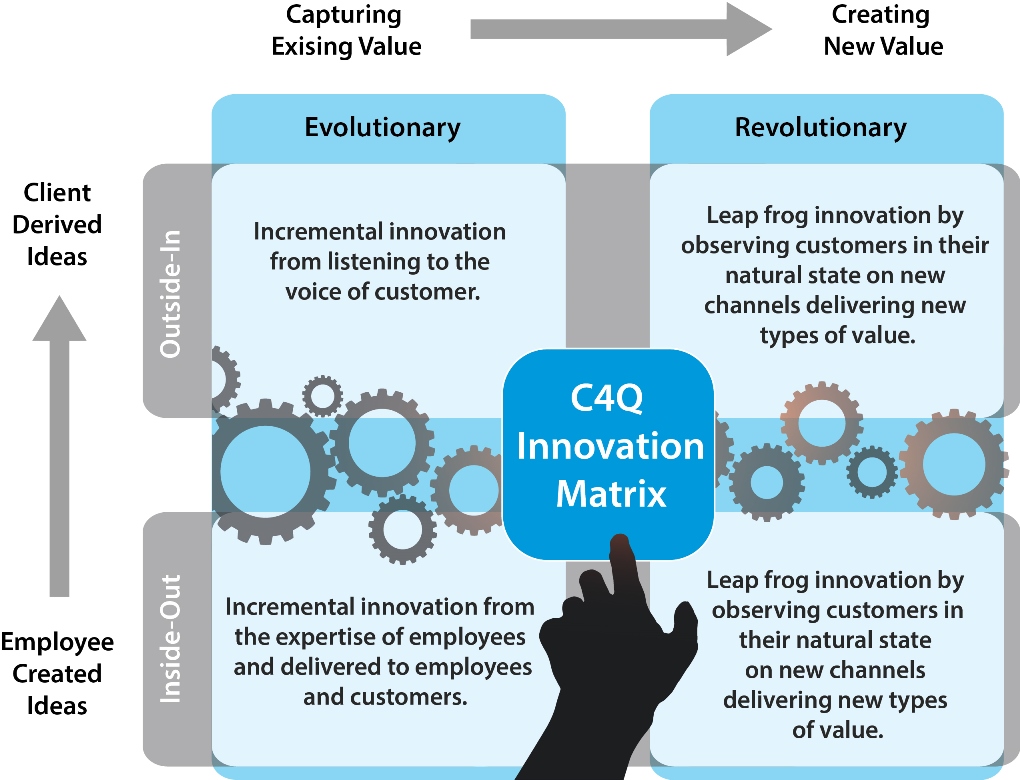
One easy way to think about innovation types is in the construct of a 2x2 matrix mapping outside-in, versus inside-out innovations, and evolutionary versus revolutionary innovations. Let's call it the c-level, four-quadrant innovation matrix.

2014-01-16-C4QInnovationMatrix.jpg


Mapping innovation types triggers thinking about the processes needed to capture and cultivate each innovation type.

What changes may be needed? Which new partnerships may be needed to cultivate each innovation type? The C4Q Innovation Matrix helps illustrate that innovation not only is the job of the CIO or CTO, but also requires the CEO, COO and CMO to make material contributions.

Innovation at the CEO Level


Inside-out innovations are stifled by traditional command-and-control organizational designs, and suffocated by incentive-model designs, where the larger a leader's proverbial ship, the larger said leader's compensation. CEOs must commit to an organization redesign in which the structure is informed by the strategy, rather than one in which the strategy is dictated by the structure.

The hard reality is that inside-out innovations drive efficiencies (especially revolutionary ones), potentially collapsing entire departments and product lines and eliminating career paths.

But the dividends of such innovation can pay off. Steve Jobs ax'ed more than 70 percent of the products [4] at Apple when he was reinstated as CEO in 1996. Jobs' belief that a focused product line-up was key to any business's success was something he shared with Nike CEO Mark Parker.

Jobs told Parker, "Nike makes some of the best products in the world. Products that you lust after. But you also make a lot of crap. Just get rid of the crappy stuff and focus on the good stuff."

Companies that succeed with organizational transformations encourage leaders to cannibalize their roles through innovation, which redirects their value to the company, away from a specific title. This shifts the conventional thinking from, "If I don't have anything to do, what is my value?" to "I can't wait to innovate away everything I do so I can deliver new value."

Innovation at the COO Level


Traditionally, project demand originates from business lines, and investment governance is ROI driven. From an operating-model perspective, a portion of the project spend must be earmarked for innovation beyond the research and development stages. In order for innovation to thrive, the investment-governance process must be deliberately designed to fund innovation projects past the ideation phase into championing and the execution phases; this is specifically a COO responsibility.

One key example of COO-led operational change is to design and install an innovation chargeback model similar to the line of business chargeback model for shared services such as network, storage and human resources. This allows lines of businesses close to the voice of the customer (VOC) to take innovation seriously as a shared service and better identify, prioritize and install VOC outside-in innovations.

These types of operating models and investment-governance changes are often best executed by a COO instead of a CIO or a CTO. Reorienting innovation funding via the operating model and investment-governance process also stops "un-innovation" via prioritization. Stopping un-innovation is an important element of innovating.

Facebook COO Sheryl Sandberg exemplifies innovation at the COO level, with the company's laser-focus on building a viable mobile business.

"Mobile is the top goal right now," Sandberg said at the All Things D Conference. "Every product team is focused on mobile," indicating horizontal buy-in, from ideation to execution.

Innovation at the CMO Level


As many management-consulting companies predicted, the CMO is spending more on technology and is many times closer to the customer than other c-level officers. In many industries, listening to customers is not new. However, where we listen and the veracity of the information we obtain, the new vocabularies we listen to and the speed by which we convert data sourced from listening to value have changed.

While this is very much a Big Data and social conversation, it is hardly a CIO -- or CTO -- only topic. CMOs are consistently pressed to listen to new types of customers, on new types of channels, for new data, with new vocabularies, driving new insight and helping deliver outside-in innovations.

Technology enchants consumers by serving everything they want, when they want it and how they want it. In some sectors, it's common to include these "emotional requirements" in the project lifecycle.

Traditionally, business requirements are written and converted to functional requirements and, eventually, to technical requirements. Emotional requirements are described as emotions an organization intends the consumer to feel when engaging with a product or a service, whether digital or physical.

The practice here is to add emotional requirements as a precursor to the business requirements in an effort to satisfy the consumer's new emotional thirst/outcome. CMOs are charged to innovate by listening more and in new ways and by catering to the consumer emotionally.

Tapping into the power of customers' emotions to develop game-changing marketing is exactly what Chipotle CMO Mark Crumpacker did with the fast-growing, fast-casual chain. Fast Company named Chipotle one of The World's 50 Most Innovative Companies last year, and in its profile of Crumpacker, they recounted one of his moments of epiphany:


[W]hen he hosted a series of screenings of the investigative documentary Food, Inc., Crumpacker understood that the only way to differentiate Chipotle was to replace traditional advertising with more emotionally engaging stories.

That's when Crumpacker turned to CAA Marketing, the arm of the Hollywood talent agency plugged in to the best storytellers in the world. Crumpacker told CAA he had seen a heart-tugging two-and-a-half-minute commercial for Chevron called "Human Energy." He wanted a Chipotle version.

'If a company like that can make you cry, imagine if we had something comparable for Chipotle,' Crumpacker says.


Innovation Requires All Hands on Deck


The examples of innovation at various levels of the c-suite should serve as a valuable lesson to any organization. Anyone, given the right tools, resources and smarts, can be a change agent within an organization.

While it's become a trend for companies to develop roles specifically for innovation, the real power of innovation comes through the integration of innovation throughout the entire c-suite.

Real innovation isn't in a job description or new title, it's a way of life.

Sunday, March 2, 2014

Rulers Who Use the Social Media They Ban

by Cyrus Rassool
Program Associate, Internet Freedom


Iran's rulers have actively used social media for international diplomacy and even for messages aimed primarily at a domestic audience. The latter is surprising, given that the government officially blocks access to such online platforms for its citizens. Jack Dorsey, founder and chairman of Twitter, publicly called out President Hassan Rouhani for using the popular microblogging service despite the fact that it is banned inside Iran.


However, Iran isn't the only country that has drawn criticism for such hypocrisy. Here are five other countries--rated Partly Free or Not Free in Freedom House's 2013 Freedom on the Net report--whose leaders contradict their own policies and practices on restricting social media.


Cuba—Not Free


Since coming to power in 2008, President Raúl Castro has continued his brother Fidel’s record of restricting freedom of expression. Social media applications, such as Twitter and Facebook, are largely inaccessible for everyday internet users in Cuba due to keyword filtering and blocking. However, Raul Castro, his daughter Mariela, and the government of Cuba have all made use of Twitter to promote the authorities’ interests. Mariela has even engaged in Twitter arguments with Cuban dissidents such as Yoani Sánchez, a well-known blogger and outspoken critic of the Castro regime.


United Arab Emirates—Not Free

2014-02-24-sheikhmohammedbinrashialmakhtoumyoutubepage.jpg

Sheikh Mohammed bin Rashid al-Maktoum, the ruler of Dubai and the Emirates’ prime minister and vice president, is an active Twitter, Facebook, and YouTube user. The freedom to use social media, however, does not extend to all Emiratis. Under a 2012 cybercrime law that features vaguely defined offenses and harsh penalties, 29-year-old U.S. citizen Shezanne Cassim and a group of his friends were arrested last year and sent to a maximum-security prison for creating and posting a mockumentary video about wealthy Dubai teenagers trying to adopt gangster personas. Cassim and his friends were sentenced for endangering national security and defaming the country’s image abroad. Cassim eventually was allowed to return to the United States after serving nine months in prison and paying a fine of approximately $2,700.

Azerbaijan—Partly Free


President Ilham Aliyev has actively used Twitter to rant against neighboring Armenia. “Our main enemy is the Armenian lobby … Armenia as a country is of no value. It is actually a colony, an outpost run from abroad, a territory artificially created on ancient Azerbaijani lands,” Aliyev wrote in a series of tweets. Yet the Azerbaijani government, especially in the wake of the Arab Spring, has grown skeptical of its citizens’ use of social media. Officials instituted a campaign to dissuade Azerbaijanis from using such services by linking them to mental illness and treason. At the same time, the government has coerced students into “liking” government policies on Facebook, and has not so subtly urged them to cease support for antigovernment movements online.


India—Partly Free

2014-02-24-singh.jpg
Photo Credit: http://shunalishroff.com


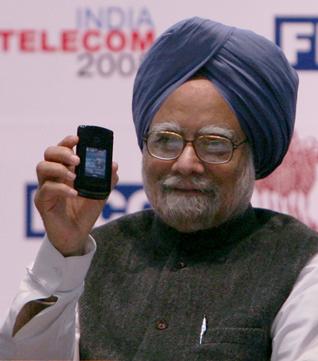
Prime Minister Manmohan Singh is an active Twitter user, but in India, the largest democracy in the world, speaking out on social media can lead to imprisonment. The country’s Information Technology Act, originally passed in 2000, was amended in 2008 to include Section 66A, which allows punitive measures to be taken against anyone who posts “offensive” messages on online communication services. At least a dozen people have been charged under the statute, including 21-year-old Shaheen Dhada, who used Facebook in 2012 to criticize a municipal shutdown marking the death of a controversial politician, and her friend Rinu Srinivasan, who was arrested simply for “liking” Shaheen’s status update. Charges against the two young women were eventually dropped following a public outcry.


Turkey—Partly Free

2014-02-24-ErdoganwithTablet.jpg
Photo Credit: http://www.aktifhaber.com/ilk-tableti-basbakan-verecek-556558h.htm
Despite his active presence on Twitter, Prime Minister Recep Tayyip ErdoÄŸan has been a driving force behind the parliament’s efforts to silence opposition voices on the internet. This past month, lawmakers passed a bill allowing Turkey’s telecommunication authority to block any website without a court order. According to Google’s 2013 transparency report, the Turkish government made the most takedown requests of any country, with over 1,673 requests for the removal of over 12,000 items. ErdoÄŸan has expressed his displeasure with social media, calling Twitter a “menace” and blaming it and other online platforms for stoking antigovernment protests. The Turkish authorities not only censor the internet, but have also punished those who express themselves online. Last April, a court sentenced Fazıl Say, an outspoken atheist and world-renowned pianist, to a suspended 10-month jail term for insulting Islam on Twitter. And earlier this month, Mahir Zeynalov, an Azerbaijani correspondent and blogger for Today’s Zaman in Turkey, was deported for tweets that were deemed critical of the government.

As internet penetration rates continue to grow around the world, so too do the misgivings of political leaders who would prefer to do all the talking and force citizens to do all the listening. Social media are important tools for democratization because they allow ordinary people and civil society to talk back. The international community cannot allow hypocritical bans on these platforms to continue. Business leaders in particular must take a stand on the issue. Facebook, Google, and other web-based services working in countries where free expression is under threat should follow Jack Dorsey’s lead in pressing governments to respect their citizens’ fundamental freedoms online.


This piece originally appeared on Freedom House's blog, Freedom at Issue. Read the original here.

Saturday, March 1, 2014

DIY Rainbow: How Australia Showed Its Support for Gay Rights with Chalk and Facebook

This story was produced in partnership with Facebook Stories. Submit your own Facebook story here.

Facebook launched 10 years ago on Feb. 4, 2004. This is one of 10 stories celebrating a decade of connections made possible through the platform. See the rest at FacebookStories.com/10.


-----

To celebrate the 35th anniversary of the Sydney Gay and Lesbian Mardi Gras, our local council installed a rainbow crossing in the heart of Taylor Square in February last year. Six bold stripes of colour were painted across Oxford Street to represent pride.

I thought the symbolism of the crossing was fantastic. Mardi Gras was born out of a gay rights protest on Oxford Street in 1978 where many arrests were made. To see our community's flag proudly painted on that road just a few decades later demonstrates how far we have come in Australia. History aside, the crossing was a fabulous colourful addition to our city. I thought it would be fantastic for tourism and local businesses.

james and dad

I even took my dad to visit the crossing, and he loved it. I came out to my dad when I was 23, and he's been the most supportive father and friend a guy could ask for. It meant a lot to show him this great bit of public art.

The rainbow crossing was meant to be temporary just for Mardi Gras, but the community really started to feel attached to it. Some of our city officials had had spoken in favour of it, and there was an online petition to let it stay. Despite a groundswell of support to make the crossing permanent, it became increasingly clear that our state government was intent on removing it on the grounds of road safety. So many people who loved the display would stop and take photographs that the roads minister said it had to go.

I sell BBQs by day and host community radio by night. In between that, I try to do a lot of creative stuff in the city. When I heard that the crossing was going to be torn up, I dressed up as a pot of gold to signify the "end of the rainbow." I spent a day with a mate sourcing a garden pot and gold facepaint, and we took some fun shots at the crossing. I thought it might raise awareness to get more signatures on the petition, but mostly I just thought this was hilarious. When I shared the photos on Facebook, they got quite a few likes and some news organisations used the pictures when reporting on the possible removal of the crossing, but I hadn't saved it in any way.

pot of gold

On April 10, the night the state government ordered workers to swoop in and remove the crossing, I was broadcasting from a local radio station. A dear friend of mine, Denton, called in and described the scene. People watched as tractors and men with shovels tore up the short-lived installation and covered it with plain black bitumen. It was such a shame.

The next night is when the magic began. On my way home, I thought about making my own rainbow crossing in a laneway behind where I live. It was basically a joke for my friends on Facebook. I figured chalk would be the easiest and cheapest way to do it, so I picked some up on the way home, along with a bottle of wine. At the time I was living with my sister and we had a third housemate Vladi, a german backpacker. Once I had outlined my six stripes in chalk I convinced them both to colour in this DIY rainbow in exchange for a glass of white wine each.

original

We started taking photos of our ad hoc crossing and the images quickly spread on Facebook. Our quiet night of what I like to call "whimsical activism" really resonated with heaps of people who were also disappointed with the rainbow crossing removal. As the night progressed, there was a lot of chatter from people saying they'd love to make their own rainbow. At this point I wasn't really convinced this would happen. It's one thing to get people to like a photo, it's another to get them outside making something.

I remember the next day, which was a Friday, really well. Some fine ladies a few suburbs away made a DIY rainbow chalk crossing in Paddington. Their photos were also extremely popular. At this stage I started the Facebook Page, DIY Rainbow, to share any other crossings that might come in. Quickly, chalk rainbows started popping up all over Sydney. It was one of the most exciting things to see. With a sunny weekend on the way and the page growing quickly, it was a perfect storm for a complete chalk rainbow explosion.

submission

That weekend was the most exhilarating time I've had in front of a computer screen. Chalk rainbows started coming in, along with various tales of people meeting their neighbours and making new friends from nearly every corner of Australia. Television crews had arrived at my house to get me to "recreate" my original chalk moment. For someone who spent a lot of time and money dressing up as a pot of gold just a week earlier, it was fairly hilarious that just $7 of chalk is what grabbed people's attention.

recreation

With pictures flooding in, Sydney actually had a chalk shortage that weekend, particularly for the colour red. People were posting to the page about stores that still had chalk available. Others were posting to connect with strangers who wanted to join them to make a crossing in their local area. It was incredible. Our first international rainbow was from a lesbian couple in France. Everyone loved their photo and quickly we started receiving photos from all over the world. In that month of April we received rainbows from Cambodia, New York, Zurich, Vietnam, Singapore, the U.K., and many more places. So many places that I struggled to keep up with it all.

collage

By the end of the month I had organised a "chalk off" around the Sydney Harbour Bridge and Opera House for a mass chalking. Although the authorities weren't too happy about a large crowd with chalk, over 300 people coalesced in Sydney's Circular Quay for one of the best moments of my life.

Clearly the movement, although born from the removal of the Sydney Rainbow Crossing, meant more to people than just a single government decision. The page morphed into a vehicle for gay rights across the world and for marriage equality in Australia, which we have yet to receive.

logo

It's been 10 months now and DIY Rainbow has become my part time job that I love. We don't get the same volume of submissions that we did when the whole thing exploded, but a beautiful community has developed. One of the lovely things that has struck me is how few homophobic or negative comments there are towards the LGBTQI community on the page. It's just a really fun place for everyone. Rainbows sent to us are from families, straight people and gay people -- a total mix across the population.

We've chalked outside the Russian Consulate here in Sydney in support of our gay brothers and sisters in that country. We have even recreated the rainbow crossing at its original site on Oxford Street during a number of marriage equality rallies. One nearby council, with fierce lobbying from its citizens, has implemented a permanent rainbow installation in Summer Hill, which was born from a DIY chalk rainbow.

As we approach the 36th annual Mardi Gras this year, I've got a team together making a float for DIY Rainbow, which will drive over the original crossing location, and pay homage to the rainbow that started it all.

Chalk your own rainbow and submit a photo to the DIY Rainbow page.

Check out the slideshow below for more stories celebrating Facebook's 10 year anniversary.