Saturday, May 17, 2014

53+ Free Image Sources For Your Blog and Social Media Posts

In social media, we're all increasingly thinking about visual content.

At Buffer, we've shared our own study on the importance of images in Twitter posts for more social sharing. We've explored tools that help anyone create visual content.

But there's one question we get asked quite often: Where can you find free, good quality images that are cleared to use for your blog posts or social media content?

It's a question with a lot of different answers and caveats. Nearly every image created in the last 30 years is still protected by copyright -- a protection that gives virtually every author the exclusive right to use or reproduce their work. But you can find a public domain photo, use a Creative Commons image that might need attribution or even create your own image from scratch.

We'll explore all of these and then some in this post about free image sources. A few things to know before we get started:

What is Creative Commons?
Creative Commons is a nonprofit organization that enables the sharing and use of creativity and knowledge through free legal tools.

There are various types of Creative Commons licenses that range from allowing any type of use with no attribution to allowing only certain uses and no changes.

What is public domain?
Works in the public domain are those whose copyrights have expired, have been forfeited, or are inapplicable. Finding something on the internet does not mean it is in the public domain.

These terms will come up often as we discuss free photo sources. Read over the terms and conditions of each site you try so you know exactly when and what type of attribution is required.

In this post, we'll break down more than 50 different sources and tools for visual content. We'll cover the following (click on any section to be taken to that area directly):


Searchable photo databases


If you want a photo or image on a specific topic, you'll want a site that's searchable. Here are a few to check out. (To better help you evaluate these sites, I performed the same search on each using the word"coffee.")

1.) Dreamstime


Dreamstime offers a free section that's searchable and frequently updated. It requires you to create a (free) account.

dreamstime

2.) Free Digital Photos


Free Digital Photos houses a wealth of free images---categorized and searchable---for business, personal or educational use. They're smaller sized, and larger versions are available to purchase. Using the free images often requires a credit to the photographer and the site like the one you see below.

Free Digital Images

Image Credit: khunaspix via FreeDigitalPhotos.net

3.) Free Images


Free Images is a large gallery of more than 350,000 stock photos, searchable and categorized. Downloading a photo does require a longer-than-most signup process but the bigger selection might be worth it.

Free Images

4.) Free Range Stock


Free Range Stock offers access to free high-quality, high-resolution stock photos. A (free) registration is required.

Free Range Stock

5.) Free Photos Bank


Free Photos Bank has a nice collection of free photos available for download without login. They're extensively categorized with a few different ways to search, too.

Free Photos Bank

6.) ImageFree


ImageFree's registered users can download both free and paid images to use in corporate and personal projects. The free selection seems fairly limited, though---my coffee search didn't turn up a free photo I could use.

7.) IM Free


IM Free offers a curated collection of free resources, all for commercial use. Search for a keyword or browse through the stylishly crafted categories.

IM Free

8.) Morguefile


Morguefile contains photographs freely contributed by many artists to be used in creative projects by visitors to the site. A short registration is required, and morguefile asks that users credit the photographer when possible.

MorgueFile

9.) Pixabay


Pixabay offers copyright-free, cost-free images published under Creative Commons. You can copy, modify, distribute and use the images, even for commercial purposes. No registration is required.

Pixabay

10.) Public Domain Pictures


Public Domain Pictures is a repository for a wide variety of free public domain images uploaded by amateur photographers. A brief signup is required. (Premium download is an option if you need larger images.)

Public Domain Pictures

11.) Stockvault


Stockvault is a stock photo sharing website where photographers, designers and students can share their photographs, graphics and image files with each other for free and use them for personal and non-commercial design work. No registration is required.

Stockvault

12.) Rgbstock


Rgbstock is a free stock image site created by photographers and graphic artists. Registration (required) is one-click and the pool of photos is pretty deep.

RGBPhoto

Free-form photo collections


Sites in this category offer a more freewheeling approach to images---no searching but lots of discovery.

Since there's no search in this category, I've picked a representative image for each service.

13.) Ancestry Images


Ancestry Images offers a free image archive of historical prints, maps and artifact photos, like this print of a New Zealand Maori Warrior from 1817.

ancestry images

14.) BigFoto


BigFoto is a royalty-free photo gallery in which most of the photos have been contributed by amateur photographers. No login is required. It's organized mainly by geographic area---for example, this photo is from the Copenhagen collection.

copenhagen-39

15.) Gratisography


Gratisography is a collection of free high-resolution images for personal or commercial use. New photos are added weekly; simply click to download.

Gratisography

16.) Death to The Stock Photo


Death to The Stock Photo offers free high-res lifestyle photography sent to you monthly.

Death to Stock Photo

17.) FreeMediaGoo


FreeMediaGoo offers royalty-free, cost-free media that can be used in print, film, TV, Internet or any other type of media both for commercial and personal use. There's no login required but the inventory is slightly more limited, organized into unique categories like beach backgrounds and concrete textures.

FreeMediaGoo

18.) Hubspot


It's not a photo source per se, but marketing platform Hubspot often offers packages of free photos in exchange for your email address.

free-business-stock-photos-1

19.) iStock


iStock releases new a new batch of free stock images every week. (Signup for a free membership---a slightly confusing process---is required.)

BigFoto

20.) Little Visuals


Little Visuals delivers 7 high-res images to use anyway you want via email every 7 days. Subjects range from industrial parts to idyllic landscapes.

Little Visuals

21.) New Old Stock


New Old Stock is a collection of vintage photos from the public archives, free of known copyright restrictions.

New Old Stock

22.) PicJumbo


PicJumbo offers a variety of free photos for any kind of use---free of charge with no registration required. Although there's no search function, categories will help you find your way.

Picjumbo

23.) Pickupimage


Pickupimage is a large collection of free stock images mostly focusing on nature- and outdoor-related scenes that can be copied, modified an distributed---even for commercial purposes. No registration necessary! Since the pool isn't too broad this site didn't pass the coffee search, but here's a sample of what you can find there.

Trees-in-a-green-forest-in-spring-0513141141906AE5

24.) Superfamous


Superfamous houses the work of Dutch interaction designer Folkert Gorter, whose photography is available under the conditions of a Creative Commons Attribution 3.0 license. This means that you can use the work for your own purposes -- including commercial use -- as long as credit is provided.

Superfamous

25.) Unsplash


Unsplash offers 10 free (do whatever you want) high-resolution photos every 10 days.

UnSplash

26.) Wikimedia Commons


Wikimedia Commons is a database of 21,049,775 freely usable media files to which anyone can contribute. The images are painstakingly organized but the classifications may not be super clear if you're not a big Wikipedia user (I'm not).

Wikimedia Commons

These sites don't offer free photos themselves but rather provide a way to search easily through Flickr or public domain photos to more quickly find a photo you can use.

27.) Can We Image


Can We Image searches and displays results from Wikimedia Commons. All search results link directly to the resource's usage rights page.

Can We Image

28.) Compfight


Compfight is a Flickr image search engine that uses the Flickr API to locate images based on your license needs.

Compfight

29.) Creative Commons Search


Creative Commons Search is a sort of photo search engine clearinghouse that offers access to search services provided by other organizations like Flickr and Google.

For example, searching for kittens on Creative Commons Search and selecting Google Images brings me here. Note that the search has been set up with special parameters.

Creative Commons Search

30.) Foter


Foter is a Flickr-focused search tool that helps quickly unearth photos and identify their licenses.

Foter

31.) Google Advanced Image Search


Google Advanced Image Search is a method of finding free-to-use images through Google's own search tools. Here's a quick guide.

Google Advanced Image Search

32.) Every Stock Photo


Every Stock Photo is a search engine for free photos. These come from many sources and are license-specific. You can view a photo's license by clicking on the license icon, below and left of photos. Membership is free and allows you to rate, tag, collect and comment on photos.

Every Stock Photo

33.) Image Finder


Image Finder allows users to search Creative Commons photos from Flickr with similar filters for commercial/non-commercial and other categories.

ImageFinder

34.) PhotoPin


PhotoPin's interface allows users to search millions of Creative Commons photos from Flickr.

PhotoPin

35.) StockPhotos.io


StockPhotos.io is a Creative Commons-licensed professional free stock photos sharing community of about 25,000 images. All photos displayed on this Pinterest-esque site are allowed for commercial use with proper credits to the authors.

Stockphotos.io

36.) TinEye


TinEye is a reverse image search engine. It finds out where an image came from, how it is being used, if modified versions of the image exist, or if there is a higher resolution version.

TinEye

37.) Wylio


Wylio is an all-in-one picture finder, re-sizer and attribution builder for bloggers. Users can resize up to 5 free images per month.

Wylio

Create-your-own image tools


For options beyond readymade images, consider the many tools available to help even the design-challenged among us create attractive, original images.

37.) Canva


is one we particularly turn to often for creating new images to accompany Buffer's blog posts. This tool allows users to search for the best graphics, photos, and fonts (or upload your own) then use Canva's drag-and-drop tool to create a new design.

Canva

38.-51.)


For plenty more options for making original art, quote images and even infographics, check out Buffer's 14 Great Tools to Create Engaging Infographics and Images for your Social Media Posts.

Embeddable media


52.) Getty Images


made big news recently when it began to allow non-commercial sites to embed some of its photos for free.

Downloading an image and uploading it to your website is still a no-no---you've got to embed it.

As you'll see below, an embed is slightly more intrusive than simply adding a photo into your post - the embed keeps its own frame, share buttons and branding. Still, for many blogs it's an option worth looking into.

Search for embeddable photos here. Read the instructions and then click on the Search images available to embed link.


53.+)


It's also worth noting that you can embed Twitter, Facebook or Google+ posts, YouTube videos and even Slideshare decks into your blog post.

Pinterest boards are a little trickier to embed, but it can be done. Here's a full guide from Ginny Soskey and a look at her adorable example board.


Follow Pinterest Pin pets on Pinterest
Often, viewers can engage with embedded posts more deeply than static content by following users, liking or commenting on posts

Consider replacing screenshots with embedded posts so that users can engage with your examples.

What free photo sites did I miss? What tools do you like the most to find or create images? I'd love to keep the list growing in the comments!

P.S. If you liked this post, you might also like How To Make Your Posts Stand Out on Twitter, Facebook & LinkedIn: The Complete Guide to Social Media Formatting and The Big List of The 61 Best Social Media Tools for Small Business.

Top image courtesy TimothyKrause

Friday, May 16, 2014

Help! I'm a Teacher -- How Do I Get into Education Technology?

When I first started teaching fifth grade science at KIPP Academy in Houston, Texas, I had no idea that I would end up parlaying that experience into my current role as a consultant to education technology companies. I was simply a teacher on a mission to do right by my students, and that drive just happened to coincide with an inclination towards figuring out how to use technology to solve problems.

Looking back, however, I realize that I took some steps that other teachers who are interested in getting into technology can absolutely replicate. I also took quite a few missteps that I hope I can help others avoid.

So here's a guide on how teachers can get into education technology, written in partnership with four other educator-entrepreneurs who have found their own unique way to combine their love for education with their love for technology.


Step 1: Understand Your Strengths


Education technology companies need educators. Not only do you bring expertise in teaching pedagogy and educational content, you also serve as the voice of the ultimate end users -- teachers and students. As a teacher, you have an intuitive sense of what works and what doesn't. If you can turn this intuition into an ability to articulate teacher and student needs, then you're worth your weight in gold.

Furthermore, as a teacher, you have honed a particular set of leadership skills that makes you invaluable within education technology companies. As you explore potential roles, understand that your experiencing managing students and leading your class has most likely resulted in transferrable skills such as the ability to create a strong company culture, to plan purposefully, and to execute successfully.


Step 2: Understand Your Potential Areas of Growth


While you bring many strengths as an educator, you may also be missing some knowledge and skills that would help you add value to an education technology company, especially if your entire professional experience thus far has been in the classroom.

As you consider transitioning into education technology, consider growing your skills and knowledge in the following areas.

Technical:


Education technology companies, particularly early stage ones, need people who can build the product. If you're very technically inclined, you may find it enjoyable to learn and hone skills as a developer or a designer. You don't need to be a developer or designer, however, to be valuable, so long as you're able to clearly express how the product could be built to solve the problem your company is trying to solve. Technologists use industry jargon that is as important as, while being different from, the language that educators use to describe their craft. Being able to translate between education needs and technological needs is crucial. In addition, education technology companies are constantly making decisions concerning what features to prioritize and build given limited time and limited resources. You need to understand the design and development process in order to contribute meaningfully to this decision making process.

Business:


How do you build a budget? Market a product? Sell to schools? Determine whether a good idea is aligned with your company's overall strategy? There's a lot of room at edtech companies for people who know how to do this, and more, and in order to understand education technology, you need to understand the business side as well. As a teacher, be curious about how money at your school is being allocated, why your school makes the purchases it makes, and how the purchasing process work. Explore different education technology products and take notice of how they're being marketed and sold to schools and teachers. Attend conferences and stop by the trade booths and chat with the vendors. You may find that you enjoy the business side of education technology through these experiences.

Operational:


How do you create strong internal systems and processes that make work effective and efficient? Support a new school or district implementing your product? Plan and execute an event flawlessly? As a teacher, you can demonstrate your operational abilities by planning events at your school, deliberately tweaking your classroom or school procedures to be more effective, and supporting other teachers in implementing education technology. This skillset makes you very effective in operations, account management, or customer service at an education technology company.

Cultural:


As a teacher, you most likely spent the majority of your day as the only adult in the room. You also had complete autonomy as the leader of your classroom. However, within a company, you need to collaborate extensively within a team. You're also not the boss, unless you've started your own company, which means you need to learn how to negotiate, set, and meet manager expectations. Furthermore, work at an education company is often more fluid than work in the classroom. You will need to adjust the way you prioritize your work, structure your time, and make decisions amidst ambiguity in order to be successful in a startup company.

Context:


If you've only ever taught in one school, grade level, subject, or geographical location, you may be missing the broader context of education. Make an effort to gain different perspectives by collaborating with teachers who teach in very different situations. Read up on education policy and politics. Talk with school administrators and district-level professionals to learn how to see things from their perspective. Understand that your personal experience could potentially make you blind to the limits of your expertise


Step 3: Just Start


The opportunities to become involved in education technology as a teacher are virtually unlimited, especially because education technology companies need teacher contributions at every stage of their development process.

Teachers Who Are Just Starting To Use Education Technology:


Identify a pain point in your classroom and try to solve it. Implement a solution, reflect on how well it did or did not work, and give extensive product feedback to the development team. After you've comfortably integrated one technology solution, add a new product that solves a different product. The more you try to solve problems using technology, the more comfortable you will get with technology and the more you're able to articulate what works and what doesn't. Finally, giving extensive product feedback is a great starting point because it helps you learn about the development process, practice expressing your product ideas, and often leads to opportunities such as beta testing new features and joining advisory boards.

Teachers Who Have an Idea:


Take advantage of opportunities like Startup Weekend Education to validate your idea and to build a prototype. Hack together tools that approximate your ideal solution on nights and weekends and share with fellow educators for feedback and encouragement. The first time I ever asked for feedback on something I built was when that something was just a couple of drawings on a piece of paper.

Teachers Who Want to Stay in the Classroom:


Check out programs like the Google Teacher Academy, the Merit Program, and other fellowship programs that build your network and give you opportunities to contribute to the education technology ecosystem while staying in the classroom.

Teachers Who Want to Start a Company:


Consider joining an incubator such as 4.0 Schools' Launch Program to launch a company. Apply to education technology competitions like the Milken-Penn GSE Education Business Plan Competition and SXSWEdu's LAUNCHedu to force your idea into the limelight for feedback and support.

Teachers Who Want to Work at an Edtech Company:


Network in the space by attending education technology meetups, joining Twitter chats, and getting to know entrepreneurs. Build skills by contributing to education technology products and initiatives. Join a startups board of advisors. Consult. Check out The Edtech Jobs Board for opportunities.

Ultimately, working in the education technology space, whether as a leader in you school or as a member of a company, means contributing significantly to the practice of teaching and learning. If you're interested in learning more or have your own experiences to share, please leave comments below.


Final Thoughts From Post Contributors


Many thanks to the educator-entrepreneurs who contributed to this post! This post could not have been written without their guidance. For their final thoughts on the intersection of teaching and technology, please read below.

"Being a teacher helped me identify needs in the companies I've consulted or advised. Whether it's a product I actually use or not, I can imagine what students would do in a particular situation and how they would interact with the platform -- will it be useful or not. Sometimes, I imagine uses for the product that the entrepreneurs wouldn't imagine, and that can help them plan for future iterations. It's important for them to get feedback from someone who knows the pitfalls and victories technology can bring to classrooms of all types. I wouldn't be helpful to companies if I weren't teaching."

--Dawn Casey-Rowe, social studies teacher at William M. Davies Career & Technical High School and consultant at Learnist, a place for learning and sharing what you know.

"Being a great teacher requires wearing a lot of hats simultaneously, investing students in a vision larger than their day-to-day, planning backwards from an ambitious goal, engaging audiences day in and day out, and making complex decisions that impact many stakeholders. Replace "great teacher" with "entrepreneur" and "students" with "teammates" and all of this still rings true. At Coursera, we have a lot of former teachers -- and the skills we learned in our classrooms make their way into our thinking every day."

-- Nikhil Kumar, partnerships manager at Coursera, an education platform that partners with top universities and organizations worldwide, to offer courses online for anyone to take, for free.

"My years at Citizen Schools demonstrated the power out-of-school time programs have to experiment with innovative teaching tools and practices to improve learning outcomes for students. As one of the first national organizations to pilot blended learning practices we served as a link between many edtech startups and K12 schools, our team of educators connected school day teachers, students, parents and community partners in a unique way to dramatically improve STEM/PBL experiences for students. Managing all these stakeholders is a valuable skill that our educators then used to provide feedback as beta testers to various edtech startups in the Bay Area and beyond."

--Jessie Arora, founder of Embark Labs, student-centered learning communities that teach kids relevant tech skills, empowering them to explore their interests through making, hacking and sharing their experiences. More about her perspective on edtech on her blog, edcrunch.org, and on Twitter @Jessie_Arora.

"I didn't come up with the idea for Edthena while I was science teacher. It was several years later. But when I did have the aha moment for how video observation could help solve the system-level pain around providing support to teachers, I also realized that this was the same pain I felt as a first-year teacher who was observed exactly zero times by someone with science expertise. In some ways, I was able to combine my system-level and first-hand understanding of the problem with a variety of other experiences along the way to make the transition from 'educator' to 'education technology do-er.'"

-- Adam Geller, founder of Edthena, an education platform that brings the process of observation and feedback online for teacher improvement using recorded video and specialized commenting tools.


This post was initially published on DesignED, Deborah Chang's personal blog.

Wednesday, May 14, 2014

Life Without a Cellphone -- Part 4-C: Um, Okay? (Patchwork Oscillation)

2014-05-06-IndyJ_ComboNewPhContSize_sig31.jpg


Click here for the previous part of this series and here for part one.


As I saw it, there were four primary methods of communication current and necessary (apart from the grotesque: talking to a person in front of you and the easily forgotten: the mailbox in your lobby), each to a different degree: voice conversation, voicemail, text, email. My use of all four would hopefully decrease with the withdrawal of their central venous catheter. So it would be for apps as well, though I still had an iPad. Facebook, instant messaging, Twitter, the like -- all could be done without or used only as occasional diversions, like your hit of meth to take the edge off after a particularly unsatisfying or satisfying episode of Breaking Bad. If all went well, my deconstruction and untangling of communication would have the pleasant side-effect of simplification -- whatever that might eventually come to mean. First, however, came neurotic complication.

My starting point, from which all else tortuously flowed: While I didn't want a cellphone, I took it as axiomatic that I needed to maintain the ability to make calls from my apartment. And also that I needed some manner of voicemail or answering machine -- perhaps one that I could check remotely perhaps not -- for a doctor to use for appointment confirmations, for example. Also, as friends would no longer be able to text me with a "just called u," an answering system would give them a way to leave messages without needing to pull up email (and, on my end, I would decrease my need to check email). These concessions pointed to a landline as one of my portals to the normal dimension.

The landline had other merits. First, it is a reliable method of communication. For all the harping I hear about the need for cellphones in case of emergency, I am surprised at how quickly people are willing to part with a more dependable option, one that will work when an actual emergency knocks out power or overwhelms the cellular network, in the place you are most likely to be alone (maybe with your family but away from help) on a regular basis and for long stretches of time.

Second, there is the quality issue. Perhaps it has long been forgotten, but consumers -- and so phone companies as well -- used to care about the voice quality of their calls, not just ask if you could "hear me now," as if that binary success were sufficient. The genius of the just-alluded-to Verizon ad campaign, where a man goes to place after place and confirms that the person on the other end of his cellphone conversation can still hear him by way of his catchphrase -- "Can you hear me now?" -- was that it nourished and solidified a shift in consumer focus from "how do I hear?" to "do I hear?" -- to a digital question for a digital era, a yes or a no with yes being a horrid and over-compressed sound that disappears intermittently and has frequencies lopped off from top and bottom leaving just enough audible for the tidbits amidst eardrum-ripping howls of amplified breezes to filter through.

Is there not something degrading about the faint, wrinkly, scrubbed-away voice we have come to accept as a person talking? Something that corresponds quite nicely with the summarily quick texts and tweets that now must encapsulate our thoughts? With the lo-fi music and five-inch movies that satisfy so many? These diminished methods together a phalanx busy rendering us in-and-out information-conveyer-belts? Yes, we gather up the what, we absorb what notes sounded, what story told... but the rest... The easy veneer of communication... is there not something in all this silently and gradationally evacuating humanity? Or, if I am to avoid questions of what is and is not integral to humanity: Technological progress pushing us back to the tune of less sophisticated conversation, towards digital grunting?

Though perhaps digital grunting is not a step back, maybe our new shorthands represent, in fact, an increase in sophistication, a packing of more information per communication unit, and maybe selfie conversations are worth thousands of words -- so let me rephrase the previous paragraph's final sentence: "...pushing us towards less nuanced conversation?" In other words, why listen to the textures of a laugh when you can glimpse an "lol" instead?

(The audio quality of a cellphone conversation is a function of sample and bit rates, quality of electronics, reception, frequencies discarded, etc. etc. [Most of these are self-explanatory so just a note on discarded frequencies: There is now evidence that higher frequencies once thought unnecessary are actually integral to our understanding of one another.] Sound quality will improve -- though in my uninformed opinion a return to analog-landline quality is not your horoscope -- with the coming adoption of wideband audio codecs ["HD Voice"] So, I am happy to be writing this section now, when I can, rather than resorting to a historical rant, still declaim against our ongoing easy acceptance of a downgrade in human-speech quality as a price for shiny new toys.)

Third, a landline conversation required two parties to be home (or at offices or phone booths), unoccupied, and each with a measure of privacy beyond an earbud cocoon. This was when one might withdraw to a bedroom to take a call about homework, before one felt comfortable staring diffusely into the ether and announcing to the public at large that their boyfriend's genital warts are actually not that gross. A return to the landline might reestablish some of these frictions. (This third item and the upcoming fourth are, of course, extreme versions of the truth.) (Also, this third item is a historical note, not a qualitative judgment.) (But the upcoming Fourth is both.) (Tangent: Can we draw a direct line from public cellphone usage to over-sharing online?)

Fourth, I didn't remember any landline disruptive anxiety disorders in my past. "Back in the day," it was easy enough to ignore a ring and acceptable that you would call back at your earliest convenience because there was still an understood pretense operating which let everyone believe that, if you didn't pick up, you might not be home or could be in the shower or were busy or otherwise just somehow unable to get to your phone -- not that you were maliciously ignoring someone. (You might even have had a brother pick up and say you were in the bathroom. Or he might not even have attempted an explanation, instead tossing out a: "he's not here right now. Can I take a message?" Today, of course, where could you possibly be without your phone? Certainly no one would believe that the phone isn't with you as you sit on the toilet.) (Ignoring people was the entire purpose of using caller ID. Even with cellphones this at first held true. Now, on the rare occasions when one's cellphone actually rings, caller ID might excite or it might elicit a groan, but one picks up in either case. As for the call's modern equivalent, the text message, which essentially has caller ID built in -- does it go unrequited for long? Device will not be ignored.)

That the called were busy and not ignoring us, even if we knew they were ignoring us, was the lie we all told ourselves, akin to, "Oh, it's not me. She probably just doesn't like handsome men." As soon as the phone could go everywhere and gained multiple methods of response of varying discretion and speed, this pretense became impossible to uphold. The caller-texter-tweeter-emailer-gchatter-facebooker née caller could no longer be ignored. It didn't matter that the phone could not actually go everywhere and that no method of interacting with phone is actually discreet, just that these became its new mythology, the impressions it left of its purposes and abilities. (Implied here is that attitudes regarding email similarly shifted after the introduction of the Blackberry and subsequent on-the-go email-capable devices as additions and/or substitutions to computer email access.)

So, it would seem that a landline would furnish the friction I'd been fawning over. I would bring back the past and tell people that I wasn't getting rid of the phone, just of its ability to function outside my home. But -- cueing the promised reconsiderations -- behavior has changed. Device addictiveness and the just-described mythology have greatly augmented communication incidence -- far more than even increased access to communication devices can explain. Others now expect to reach me whenever possible, to reach out at any time and with far increased frequency. They would simply transfer their assaults to my landline. The "I'm busy" pretense is gone. The need for the caller to be home, free, and in private is gone. A landline would mean either hearing my ringer on a loop or turning the ringer off and seeing a voicemail light incessantly shining come-hither blinks in my direction. Would I just end up throwing the contraption in the closet and taking it out as needed? Or keeping it in a desk drawer? If you've seen The Conversation, picture me as Harry Caul. If you haven't, then picture me as Gene Hackman opening a drawer to answer a ringing rotary phone that is never supposed to ring. Ah, of course, a rotary phone; I would need to get an old-style, no-electric-plug-needed phone anyway -- just like Harry's -- if I were to be able to use it in real emergencies. No more blinking voicemail lights. And, given the fact that do-not-call lists do not work and friends would not hesitate to call, I would probably quickly begin keeping the phone mostly disconnected -- so no ringer to worry about (unlike Harry...which would hopefully magically imply that my end would not mirror his -- especially since I cannot do much with a saxophone). What about receiving calls? It is telling that my starting thoughts (see paragraph two) focused just on making calls and receiving voicemail.

But... if simplification was an end I would welcome (see paragraph one), shouldn't I funnel all initial communications into one point of contact, one gateway peephole for me to peer through semi-regularly, when messages and to-dos had formed a pile worthy of interruption, with other services used only as necessary? And, given its versatility and current centrality, isn't email, rather than the phone, the logical conclusion to play the role of primary portal? After all, I could theoretically go many days without checking my missed calls or having a verbal phone conversation or texting but, in the course of regular day-to-day living, it would be harder to ignore email (and the unseen overseeing intractable forces that use it) consistently.

Should I still get a landline? It had other shortcomings to consider. Many modern services have features -- e.g. account recovery, money transfers, creating user profiles -- that require the ability to receive texts in order to verify that one is who one says one is. The landline would not work for these procedural matters. Additionally, the landline as we know it, connected to copper lines, is on its way out. The phone companies are eager to replace it -- either with service over fiber-optic lines, which requires electricity to be up and running, or with unwired home phones, which seem to be little more than cellphones tethered to a house, offering poor voice quality and also requiring working electrical lines; so it would be short-sighted of me to get a copper-based landline anyway. But, remember, I had taken it as axiomatic that I needed the ability to make calls from my apartment...

Google Voice then? Or a number from Skype? These software phones would give me the ability to make calls and receive texts and voicemail (receiving calls, however, which both systems were capable of, presented its own set of problems. When would I remain logged in? When would I unmute my laptop? etc. When and even whether to receive calls, after all, were still-unsettled matters.) If I got one of these services, however, I definitely wouldn't want a landline of any kind, despite its aforementioned -- perhaps temporary -- advantages and despite it being a standalone device rather than a program I would have to go onto a computer to access, as having both software phone and standalone device would mean two services and two phone numbers to bother with -- it would mean additional connectivity -- and I was looking to simplify here. Of course, Google Voice and Skype have their own downsides...

I didn't want the procedural-texting ability (e.g. receiving an SMS from Gmail necessary to recover my hacked account) to be combined with the calling ability (e.g. phoning my mother to explain that I did not, in fact, send her a salutatory link to an exquisite panoply of protuberant penes, assorted vein-age), both because I was weary of giving my number to random corporations and having it enter the marketing-list circuit and because I did not want to receive calls -- personal or not -- while I happened to be taking care of something procedural. But this would again mean having multiple numbers (one for calls and one for texts) and thwarting simplification. Maybe that all sounds frivolous -- and I'm not even sure if it make sense... so let me restart the paragraph: I was hoping to stop texting with friends and family altogether -- to eliminate one channel of communication completely -- and a software phone would not further that end unless I thwarted simplification and got two numbers, one for receiving texts to verify my identity to identity-less algorithmic inquisitors (e.g. Facebook) and one that I used for calls (with the luddite-tolerant warm-blooded souls in my life, for example) which somehow lacked the ability to text.

I was concerned as well that every trip to the computer's software phone would yield me yet one more occasion to submit to the gravity of a Gchat hole... or to float off into the inexhaustible expanse of the Internet. Any activity on a content-delivering electronic device, after all, is a gateway to endless other activities that that device has on offer. I might also forget to log off the service and then be caught unawares and receive undesired calls and texts whilst checking email or writing or hanging out. Or, with the software phone just a click away, with friction again eliminated, I might not be able to resist turning it on. In fact... in a way, whenever I was home or whenever I checked email on anyone's computer anywhere or if I had my laptop with me and was within range of public Wi-Fi at a park/walked into an Internet-beaming coffee shop/neared an Internet-beaming anything, I would essentially have a giant cellphone of sorts at the ready -- which would be an explicit middle finger to my whole mission statement. Besides, I'd already started to have strange, subtle yearnings... prepubescent teenage desires, barely perceptible, never in words, just feelings that I would only later come to recognize as longings to repress home Internet. What exactly would this mean? How would I access email (and whatever else one does online)? I did not attempt an answer to or even consider these questions. But I heard the whispers, my burgeoning insanity nudging me away from the VoIP numbers offered by Google and Skype.

So, where did that leave your hapless protagonist and his First-World problems masquerading as Third-World problems that the Third-World doesn't even have? I end abruptly here to manufacture suspense, just like on the television.

Stay tuned for Part 4-D of this series.

Tuesday, May 13, 2014

How I Met Edward Snowden

“I Have Been to the Darkest Corners of Government, and What They Fear Is Light”

Cross-posted with TomDispatch.com

[This essay is a shortened and adapted version of Chapter 1 of Glenn Greenwald’s new book, No Place to Hide: Edward Snowden, the NSA, and the U.S. Security State, and appears at TomDispatch.com with the kind permission of Metropolitan Books.]


On December 1, 2012, I received my first communication from Edward Snowden, although I had no idea at the time that it was from him.


The contact came in the form of an email from someone calling himself Cincinnatus, a reference to Lucius Quinctius Cincinnatus, the Roman farmer who, in the fifth century BC, was appointed dictator of Rome to defend the city against attack. He is most remembered for what he did after vanquishing Rome’s enemies: he immediately and voluntarily gave up political power and returned to farming life. Hailed as a “model of civic virtue,” Cincinnatus has become a symbol of the use of political power in the public interest and the worth of limiting or even relinquishing individual power for the greater good.


The email began: “The security of people’s communications is very important to me,” and its stated purpose was to urge me to begin using PGP encryption so that “Cincinnatus” could communicate things in which, he said, he was certain I would be interested. Invented in 1991, PGP stands for “pretty good privacy.” It has been developed into a sophisticated tool to shield email and other forms of online communications from surveillance and hacking.


In this email, “Cincinnatus” said he had searched everywhere for my PGP “public key,” a unique code set that allows people to receive encrypted email, but could not find it. From this, he concluded that I was not using the program and told me, “That puts anyone who communicates with you at risk. I’m not arguing that every communication you are involved in be encrypted, but you should at least provide communicants with that option.”


“Cincinnatus” then referenced the sex scandal of General David Petraeus, whose career-ending extramarital affair with journalist Paula Broadwell was discovered when investigators found Google emails between the two. Had Petraeus encrypted his messages before handing them over to Gmail or storing them in his drafts folder, he wrote, investigators would not have been able to read them. “Encryption matters, and it is not just for spies and philanderers.”  


“There are people out there you would like to hear from,” he added, “but they will never be able to contact you without knowing their messages cannot be read in transit.” Then he offered to help me install the program.  He signed off: “Thank you. C.”


Using encryption software was something I had long intended to do. I had been writing for years about WikiLeaks, whistleblowers, the hacktivist collective known as Anonymous, and had also communicated with people inside the U.S. national security establishment. Most of them are concerned about the security of their communications and preventing unwanted monitoring. But the program is complicated, especially for someone who had very little skill in programming and computers, like me. So it was one of those things I had never gotten around to doing.


C.’s email did not move me to action. Because I had become known for covering stories the rest of the media often ignores, I frequently hear from all sorts of people offering me a “huge story,” and it usually turns out to be nothing. And at any given moment I am usually working on more stories than I can handle. So I need something concrete to make me drop what I’m doing in order to pursue a new lead.


Three days later, I heard from C. again, asking me to confirm receipt of the first email. This time I replied quickly. “I got this and am going to work on it. I don’t have a PGP code, and don’t know how to do that, but I will try to find someone who can help me.”


C. replied later that day with a clear, step-by-step guide to PGP: Encryption for Dummies, in essence. At the end of the instructions, he said these were just “the barest basics.” If I couldn’t find anyone to walk me through the system, he added, “let me know. I can facilitate contact with people who understand crypto almost anywhere in the world.”


This email ended with more a pointed sign-off: “Cryptographically yours, Cincinnatus.”


Despite my intentions, I did nothing, consumed as I was at the time with other stories, and still unconvinced that C. had anything worthwhile to say.


In the face of my inaction, C. stepped up his efforts. He produced a 10-minute video entitled PGP for Journalists.


It was at that point that C., as he later told me, became frustrated. “Here am I,” he thought, “ready to risk my liberty, perhaps even my life, to hand this guy thousands of Top Secret documents from the nation’s most secretive agency -- a leak that will produce dozens if not hundreds of huge journalistic scoops. And he can’t even be bothered to install an encryption program.”


That’s how close I came to blowing off one of the largest and most consequential national security leaks in U.S. history.


“He’s Real”


The next I heard of any of this was 10 weeks later. On April 18th, I flew from my home in Rio de Janeiro to New York, and saw on landing at JFK Airport, that I had an email from Laura Poitras, the documentary filmmaker. “Any chance you’ll be in the U.S. this coming week?” she wrote. “I’d love to touch base about something, though best to do in person.”


I take seriously any message from Laura Poitras. I replied immediately: “Actually, just got to the U.S. this morning... Where are you?” We arranged a meeting for the next day in the lobby at my hotel and found seats in the restaurant. At Laura’s insistence, we moved tables twice before beginning our conversation to be sure that nobody could hear us. Laura then got down to business. She had an “extremely important and sensitive matter” to discuss, she said, and security was critical. 


First, though, Laura asked that I either remove the battery from my cell phone or leave it in my hotel room. “It sounds paranoid,” she said, but the government has the capability to activate cell phones and laptops remotely as eavesdropping devices. I’d heard this before from transparency activists and hackers but tended to write it off as excess caution.  After discovering that the battery on my cell phone could not be removed, I took it back to my room, then returned to the restaurant.


Now Laura began to talk. She had received a series of anonymous emails from someone who seemed both honest and serious. He claimed to have access to some extremely secret and incriminating documents about the U.S. government spying on its own citizens and on the rest of the world. He was determined to leak these documents to her and had specifically requested that she work with me on releasing and reporting on them.


Laura then pulled several pages out of her purse from two of the emails sent by the anonymous leaker, and I read them at the table from start to finish. In the second of the emails, the leaker got to the crux of what he viewed as his mission:


The shock of this initial period [after the first revelations] will provide the support needed to build a more equal internet, but this will not work to the advantage of the average person unless science outpaces law. By understanding the mechanisms through which our privacy is violated, we can win here. We can guarantee for all people equal protection against unreasonable search through universal laws, but only if the technical community is willing to face the threat and commit to implementing over-engineered solutions. In the end, we must enforce a principle whereby the only way the powerful may enjoy privacy is when it is the same kind shared by the ordinary: one enforced by the laws of nature, rather than the policies of man.


“He’s real,” I said when I finished reading. “I can’t explain exactly why, but I just feel intuitively that this is serious, that he’s exactly who he says he is.”


“So do I,” Laura replied. “I have very little doubt.”


I instinctively recognized the author’s political passion. I felt a kinship with our correspondent, with his worldview, and with the sense of urgency that was clearly consuming him.


In one of the last passages, Laura’s correspondent wrote that he was completing the final steps necessary to provide us with the documents. He needed another four to six weeks, and we should wait to hear from him.


Three days later, Laura and I met again, and with another email from the anonymous leaker, in which he explained why he was willing to risk his liberty, to subject himself to the high likelihood of a very lengthy prison term, in order to disclose these documents. Now I was even more convinced: our source was for real, but as I told my partner, David Miranda, on the flight home to Brazil, I was determined to put the whole thing out of my mind. “It may not happen. He could change his mind. He could get caught.” David is a person of powerful intuition, and he was weirdly certain. “It’s real. He’s real. It’s going to happen,” he declared. “And it’s going to be huge.”


“I Have Only One Fear”    


A message from Laura told me we needed to speak urgently, but only through OTR (off-the-record) chat, an encrypted instrument for talking online securely.


Her news was startling: we might have to travel to Hong Kong immediately to meet our source. I had assumed that our anonymous source was in Maryland or northern Virginia. What was someone with access to top-secret U.S. government documents doing in Hong Kong?  What did Hong Kong have to do with any of this?


Answers would only come from the source himself. He was upset by the pace of things thus far, and it was critical that I speak to him directly, to assure him and placate his growing concerns. Within an hour, I received an email from Verax@******. Verax means “truth teller” in Latin. The subject line read, “Need to talk.”


“I’ve been working on a major project with a mutual friend of ours,” the email began. “You recently had to decline short-term travel to meet with me. You need to be involved in this story,” he wrote. “Is there any way we can talk on short notice? I understand you don’t have much in the way of secure infrastructure, but I’ll work around what you have.” He suggested that we speak via OTR and provided his user name.


My computer sounded a bell-like chime, signaling that the source had signed on. Slightly nervous, I clicked on his name and typed “hello.” He answered, and I found myself speaking directly to someone who I assumed had, at that point, revealed a number of secret documents about U.S. surveillance programs and who wanted to reveal more.


“I’m willing to do what I have to do to report this,” I said. The source -- whose name, place of employment, age, and all other attributes were still unknown to me -- asked if I would come to Hong Kong to meet him. I did not ask why he was there; I wanted to avoid appearing to be fishing for information and I assumed his situation was delicate. Whatever else was true, I knew that this person had resolved to carry out what the U.S. government would consider a very serious crime.


“Of course I’ll come to Hong Kong,” I said.


We spoke online that day for two hours, talking at length about his goal. I knew from the emails Laura had shown me that he felt compelled to tell the world about the massive spying apparatus the U.S. government was secretly building. But what did he hope to achieve?


“I want to spark a worldwide debate about privacy, Internet freedom, and the dangers of state surveillance,” he said. “I’m not afraid of what will happen to me. I’ve accepted that my life will likely be over from my doing this. I’m at peace with that. I know it’s the right thing to do.” He then said something startling: “I want to identify myself as the person behind these disclosures. I believe I have an obligation to explain why I’m doing this and what I hope to achieve.” He told me he had written a document that he wanted to post on the Internet when he outed himself as the source, a pro-privacy, anti-surveillance manifesto for people around the world to sign, showing that there was global support for protecting privacy.


“I only have one fear in doing all of this,” he said, which is “that people will see these documents and shrug, that they’ll say, ‘We assumed this was happening and don’t care.’ The only thing I’m worried about is that I’ll do all this to my life for nothing.”


“I seriously doubt that will happen,” I assured him, but I wasn’t convinced I really believed that. I knew from my years of writing about NSA abuses that it can be hard to generate serious concern about secret state surveillance.


This felt different, but before I took off for Hong Kong, I wanted to see some documents so that I understood the types of disclosures the source was prepared to make.


I then spent a couple of days online as the source walked me through, step by step, how to install and use the programs I would need to see the documents.  


I kept apologizing for my lack of proficiency, for having to take hours of his time to teach me the most basic aspects of secure communication. “No worries,” he said, “most of this makes little sense. And I have a lot of free time right now.”


Once the programs were all in place, I received a file containing roughly twenty-five documents: “Just a very small taste: the tip of the tip of the iceberg,” he tantalizingly explained.


I unzipped the file, saw the list of documents, and randomly clicked on one of them. At the top of the page in red letters, a code appeared: “TOP SECRET//COMINT/NO FORN/.”


This meant the document had been legally designated top secret, pertained to communications intelligence (COMINT), and was not for distribution to foreign nationals, including international organizations or coalition partners (NO FORN). There it was with incontrovertible clarity: a highly confidential communication from the NSA, one of the most secretive agencies in the world’s most powerful government. Nothing of this significance had ever been leaked from the NSA, not in all the six-decade history of the agency. I now had a couple dozen such items in my possession. And the person I had spent hours chatting with over the last two days had many, many more to give me.


As Laura and I arrived at JFK Airport to board a Cathay Pacific flight to Hong Kong, Laura pulled a thumb drive out of her backpack. “Guess what this is?” she asked with a look of intense seriousness.


“What?”


“The documents,” she said. “All of them.”


“README_FIRST”


For the next 16 hours, despite my exhaustion, I did nothing but read, feverishly taking notes on document after document. One of the first I read was an order from the secret Foreign Intelligence Surveillance Act (FISA) court, which had been created by Congress in 1978, after the Church Committee discovered decades of abusive government eavesdropping. The idea behind its formation was that the government could continue to engage in electronic surveillance, but to prevent similar abuse, it had to obtain permission from the FISA court before doing so. I had never seen a FISA court order before. Almost nobody had. The court is one of the most secretive institutions in the government. All of its rulings are automatically designated top secret, and only a small handful of people are authorized to access its decisions.


The ruling I read on the plane to Hong Kong was amazing for several reasons. It ordered Verizon Business to turn over to the NSA “all call detail records” for “communications (i) between the United States and abroad; and (ii) wholly within the United States, including local telephone calls.” That meant the NSA was secretly and indiscriminately collecting the telephone records of tens of millions of Americans, at least. Virtually nobody had any idea that the Obama administration was doing any such thing. Now, with this ruling, I not only knew about it but had the secret court order as proof.


Only now did I feel that I was beginning to process the true magnitude of the leak. I had been writing for years about the threat posed by unconstrained domestic surveillance; my first book, published in 2006, warned of the lawlessness and radicalism of the NSA. But I had struggled against the great wall of secrecy shielding government spying: How do you document the actions of an agency so completely shrouded in multiple layers of official secrecy? At this moment, the wall had been breached. I had in my possession documents that the government had desperately tried to hide. I had evidence that would indisputably prove all that the government had done to destroy the privacy of Americans and people around the world.


In 16 hours of barely interrupted reading, I managed to get through only a small fraction of the archive. But as the plane landed in Hong Kong, I knew two things for certain. First, the source was highly sophisticated and politically astute, evident in his recognition of the significance of most of the documents. He was also highly rational. The way he chose, analyzed, and described the thousands of documents I now had in my possession proved that. Second, it would be very difficult to deny his status as a classic whistleblower. If disclosing proof that top-level national security officials lied outright to Congress about domestic spying programs doesn’t make one indisputably a whistleblower, then what does?


Shortly before landing, I read one final file. Although it was entitled “README_FIRST,” I saw it for the first time only at the very end of the flight. This message was an explanation from the source for why he had chosen to do what he did and what he expected to happen as a result -- and it included one fact that the others did not: the source’s name.


"I understand that I will be made to suffer for my actions, and that the return of this information to the public marks my end. I will be satisfied if the federation of secret law, unequal pardon, and irresistible executive powers that rule the world that I love are revealed for even an instant. If you seek to help, join the open source community and fight to keep the spirit of the press alive and the internet free. I have been to the darkest corners of government, and what they fear is light.

Edward Joseph Snowden, SSN: *****
CIA Alias “***** ”
Agency Identification Number: *****
Former Senior Advisor | United States National Security Agency, under corporate cover
Former Field Officer | United States Central Intelligence Agency, under diplomatic cover
Former Lecturer | United States Defense Intelligence Agency, under corporate cover"


Glenn Greenwald, a former constitutional lawyer and a Guardian columnist until October 2013, has earned numerous awards for his commentary and investigative journalism, including most recently the 2013 George Polk Award for national security reporting. In early 2014, he cofounded a new global media outlet, The Intercept. This essay is adapted from his new book, No Place to Hide: Edward Snowden, the NSA, and the U.S. Security State (Metropolitan Books), published today.


Excerpted and adapted from No Place to Hide: Edward Snowden, the NSA, and the U.S. Security State by Glenn Greenwald, published by Metropolitan Books, an imprint of Henry Holt and Company, LLC.


Follow TomDispatch on Twitter and join us on Facebook and Tumblr. Check out the newest Dispatch Book, Ann Jones’s They Were Soldiers: How the Wounded Return From America’s Wars -- The Untold Story.

Sunday, May 11, 2014

7 Ways to Spot a Phony on an Online Dating Site

I have been to four weddings of couples who met and fell in love using online dating sites. It can, and does, work. Unfortunately, like many other facets of online life, dating scams have increased dramatically. Whether are you communicating with someone who claims to be someone they're not, or are faced with a criminal who has intentions of scamming you out of your life savings--or worse, intends to physically harm you--you have to be careful.

My husband and I used the Internet to get to know each other when we first met. Those were the days before online dating, but because we lived 3,000 miles away from each other, we used the Internet to communicate and become closer. When using this medium, you can quickly feel as if you have gotten to know the person you are talking with and feel a very intimate level of trust, like I did with my husband. A recent Canadian news story shows a darker side to this, however. Glenn Whitter is a man who targeted victims on an online dating site with the sole intention of scamming them out of their money. He was able to coerce many women into giving up their entire savings. He was very sophisticated in his deception and specifically targeted his victims based on the information that they chose to self-disclose on social media. Whatever their interests were, Whitter made sure to make them his also. He was able to portray himself as the perfect catch for each of the women he scammed. He even was so bold as to take one of the women to "his condo" in Toronto, though as it turned out, he was not listed in any records as the owner of the condo. Whitter has since disappeared and has an outstanding warrant for his arrest. The Whitter case illustrates the issue: When you are dating online, you have to be aware that the person that you are communicating with might not be who they say they are. In fact, people lying on online dating sites has become so prevalent that a popular documentary film and television show coined a term for it--being "catfished."

The good news is that you can protect yourself by learning how to spot a phony while dating online. I go in-depth on the topic in my book Catching the Catfishers: Disarm the Online Pretenders, Predators and Perpetrators Who Are Out to Ruin Your Life, but for now, let's take a look at seven indications that someone that you are talking with might be catfishing you and use them to help catch the catfisher.

1. If a person won't video chat or carry on a telephonic conversation.

Video chatting with a person that you meet online is a common, normal practice in online dating. In fact, all the couples I know who met online said that their first real conversations were over the phone or by video chat. If a person makes excuses every time that you want to Skype or talk via phone, this is a red flag. They might claim that they don't have time, or that their camera is broken, but keep in mind that every modern day smartphone, laptop and tablet has the ability to video chat. If you ask them repeatedly and keep getting excuses, be concerned. This person is hiding something that they don't want you to know.

2. Do they have a realistic amount of digital puzzle pieces that, when followed, piece together a real person?

Almost everyone in the United States has some sort of Internet presence that when pieced together creates a real identity. It is very rare that someone would have no Internet presence at all. If you do basic research, such as conducting a search using a portal such as Spokeo.com or looking through social media sites, and can't find anything about a person, that is a red flag. Even most social media sites that allow strict privacy settings will at least show you the first page of a person's profile. Most professionals will at least have a LinkedIn page. If you cannot find anything on the Internet about a person, they might not be telling you their real name, which is again a red flag.

3. Check public records.

Do some reconnaissance by using search engines to find public records. You might discover that (as with of Glenn Whitter) other people have complained about a person. Heed these warnings. If a person says they own a house, you will be able to easily determine if that's true, and also where it is and how long they have lived there. You can also find legal documents like bankruptcy filings, divorce records and sometimes marriage licenses. Some cities and states even post traffic tickets online.

4. Do they send real time photos of themselves?

When people are communicating online, they will frequently send each other photos in real time. During a conversation, ask to see a photo of the person right then. If they refuse, or make some excuse, that is a red flag. If they have only sent you one or two photos, it is likely that they took that photo from someone else's social media page or from somewhere else on the Internet. Do an easy Google Image search on a photo and see if it pops up on someone else's social media account or elsewhere online. Recently, Notre Dame football star Manti Te'o was catfished by a 22 year old man named Ronaiah Tuiasosopo, who claimed to be Lennay Kekua, a 23 year old woman. Tuiasosopo even sent a photo of a beautiful girl who was purported to be Kekua. Eventually, a photo search revealed that the photo had been lifted from the social media site of an unwitting 22 year old woman named Diane O'Meara. We don't know the substance of the online communication between Te'o and "Kekua," but most likely she was not able to send real time, on demand photos because they didn't exist.

5. Do they have regular banter with other people on their sites and appear to have "real" friends and work colleagues?

You can get to know who a person's close friends are based on the banter they engage in with others on social media. Friends who typically just occasionally "like" a person's posts but do not have frequent, regular banter with them are most likely just acquaintances. But friends who appear in photos or tag people regularly are probably closer friends. Does the person seem to have real friends who have inside jokes and carry on conversations? Do they tag them? Or do they just have a few "place holder" friends who they don't appear to actually know that well? On LinkedIn, do they have colleagues who have endorsed them or just some connections? If you find that a person's friends don't seem close or real, consider reaching out to their social media friends and asking if they know them.

6. Do they distract you or never answer your questions when you ask detailed specific questions?

When you ask specific questions, do they clam up? Do you find that they never really answer your questions or distract you from your original question so that you change the subject and stop probing? Do you feel as if they know everything about you but you know nothing about them? These are red flags. Getting to know someone is give-and-take. You give a little and they give a little. If you feel as if you are the only one sharing information and they are almost being sneaky about giving away details, consider this a red flag.

7. Do their stories match up?

If someone is pretending to be someone they're not, they will have a difficult time keeping their fake persona different from their real life. It is impossible to be someone else 100 percent of the time and they will likely let their guard down on occasion. Sometimes things will accidentally slip out and each one of those slips is a red flag. For example, if the person you are talking to claims to have no siblings but accidentally makes a comment about their sister, take notice. If they claim to live in Sarasota, Florida during the winter but make an offhand comment about being sore from shoveling snow, take notice. That is the real person accidentally slipping out.

Of course, not everyone is out to scam you. There are plenty of legitimate daters on these sites. We all know perfectly happy people who have met online. The intention is not to question everyone and everything to the point where you become so guarded or paranoid that you never put yourself out there, but to remember the seven tips above and be cautious. Be the fish that got away.

Saturday, May 10, 2014

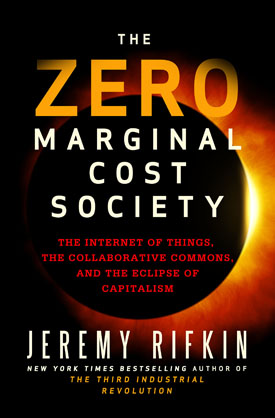
Who Will Pay for the Zero Marginal Cost Society?

Jeremy Rifkin's book, The Zero Marginal Cost Society, is at times thrilling, at times encyclopedic, and at times possibly hyperbolic. It is very well-written, it touches on an incredibly wide variety of modern topics, it builds on an exhaustive set of references, and most importantly it makes you think seriously about the future. You cannot possibly read this book without pausing at least a half a dozen times to ponder. There were parts of the book that presented me with completely new facts, claims, technologies, and predictions. For example, I hadn't considered the prospect of nearly zero marginal cost energy production. I don't know that I have as much confidence as Rifkin in that prospect coming true in the near future. But to contemplate the possibility and its implications alone was exhilarating. Similarly, I found fascinating his claim that "what makes the great infrastructure revolutions transformational is the convergence of new communications media with new energy regimes." I will be thinking a lot about this in my own work.


2014-03-31-FinalZMCSCoverArt.jpg

Due to space constraints, I'll focus on one difficulty I had with Rifkin's analysis. I strongly support the notion of building systems and developing public policies that enable and take advantage of zero marginal costs, for example in the context of various infrastructure and knowledge commons, but the first concern that arose in my mind as I began reading the book was simple and likely one that most people will raise: What about the fixed costs? Who is going to supply the infrastructures necessary for the various near zero marginal cost systems to function? Whether we are talking about knowledge or electricity or education or physical production systems, there are critical infrastructures that support, structure, and sustain the systems for participants (users, producers, consumers, prosumers). Who will bear the fixed costs and supply these infrastructures? If the supplier is a private company that owns the infrastructure, how will the supplier manage it? (To lay bare my concerns: Rent extraction and control by private, for-profit infrastructure owners may very well undermine most of Rifkin's dreams.) If the government supplies the infrastructure, how will it raise the funds and how will it decide which infrastructures to build and when to build them? These are familiar questions because I faced them often when discussing my own recent book, Infrastructure: The Social Value of Shared Resources (OUP 2012) , which Rifkin kindly quotes. To be fair, Rifkin does address some supply side issues.


He opens chapter nine with a discussion of the Marginal Cost Controversy (MCC), which was a debate among economists that took place in the 1930s and 1940s. The debate was about Hotelling's argument that government should subsidize the fixed cost of infrastructure so that marginal cost pricing would prevail. Hotelling lost the academic debate. In my book, I also discussed the importance of the MCC. In fact, Christiaan Hogendorn and I soon will publish a retrospective article, Revisiting the Marginal Cost Controversy, in the Journal of Economic Perspectives. We've been thinking that it was unfortunate that the MCC had been lost and that it needs to be revitalized. And along comes Rifkin! Fantastic! And he correctly states at the very beginning of his discussion: "At the time, [the MCC] was more of an abstract issue. Today, it's one of the most important political issues facing society." He goes on: "How we choose to finance a near zero marginal cost society will likely determine the way we organize economic, social, and political life for the remainder of the twenty-first century." And similarly, he says: "Whether the new potential inherent in the [Internet of Things] infrastructure can be realized will be determined by who finances the platform. The struggle for control is already underway ..."


Rifkin, however, makes a few minor mistakes in describing Hotelling's arguments --- Hotelling did not base his argument on the idea that infrastructure and public utilities are public goods or nonrivalrous; those economic concepts surfaced later in the 20th century. But those mistakes do not undercut the key argument for government subsidization of fixed costs. In fact, as I argue at length in my book, they strengthen the argument considerably, at least where infrastructure users produce public and social goods and generate spillovers. Nonetheless, the MCC remains a controversy, and one that must be examined, debated, and evaluated in context. There are various tradeoffs to reconcile. Unfortunately, Rifkin doesn't fully engage the controversy that he identifies as "one of the most important political issues facing society."


Rifkin abandons the MCC and government subsidization of fixed costs too soon (although he returns to it occasionally later in the book). He seems to believe that infrastructure financing will come from "hundreds of millions of consumers and taxpayers." But his arguments don't fully explain how this will happen. He discusses the Internet and emphasizes that is "owned by everyone and no one" because the Internet "is a system organized by an agreed-upon set of protocols that allows computer networks to communicate with each other." While this is true, the physical infrastructure networks are indeed owned by companies. He suggests that these "companies are merely providers and facilitators." But how can that possibly be correct? Ask Netflix whether Comcast is a mere provider or facilitator. The network neutrality debate highlights the fact that physical network owners are anything but passive providers. To the contrary, in their relentless pursuit of profits for their shareholders (a perfectly reasonable objective for for-profit companies, mind you), private companies that own physical infrastructure networks have and will continue to extract rents and exercise control over user activities (by which I mean all higher layer activities by private companies like Google and Netflix and users like you and me) when it is feasible to do so.


If Rifkin's predictions for the future are correct, the network neutrality fight will recur across a range of different infrastructures. As he says later, "the struggle over network neutrality is, at its core, a battle of paradigms." While this is correct, Rifkin adroitly sidesteps the difficult infrastructure supply issues and the difficult governance or management issues that follow. He discusses implementation of smart girds in Europe and the potential for super Wi-Fi networks and open spectrum commons to become the underlying communications infrastructure for the Internet of Things. But these possibilities involve such contentious political, economic, and technological battles! Infrastructure owners are in a position to exert control, extract rents, and price well above marginal cost, and their arguments in defense of such practices can be boiled down to the simple supply side issue of recovering fixed costs. This issue needs to be dealt with.


Rifkin attempts to do so in different parts of the book by appealing to the emergence of the Collaborative Commons. Part II of the book extensively discusses commons. As a scholar who's written quite a lot on commons, I'm happy to go there; I may have the "Commons affliction" he describes.


One telling example is his discussion of the Tennessee Valley Authority project. He returns to the MCC and explains how "Hotelling's contentions and best-case example turned out to be correct." The federal government played a major role in underwriting the rural electrification project and ultimately "threw its support to a distributed, collaborative, laterally scaled economic institution--the cooperative..." This "third approach," he suggests, provides a reasonable way to deal with the supply side questions while sustaining infrastructure commons. This is intriguing but incomplete. Much remains to be seen about how this would play out in various communities and contexts and with respect to various infrastructures. Nonetheless, it, like so much of Rifkin's book, forces you to stop and think about the possibilities for the future.


Brett Frischmann is the author of Infrastructure: The Social Value of Shared Resources. He is a professor at Cardozo Law School in New York City, an Affiliate Scholar of the Center for Internet and Society at Stanford Law School, an Affiliated Faculty Member of The Vincent and Elinor Ostrom Workshop in Political Theory and Policy Analysis, Indiana University, and a Trustee for the Nexa Center for Internet & Society in Torino, Italy. Professor Frischmann holds a B.A. in Astrophysics from Columbia University, an M.S. in Earth Resources Engineering from Columbia University, and a J.D. from the Georgetown University Law Center. More information is available on his website - www.brettfrischmann.com.

Friday, May 9, 2014

How To Manage The Explosive Marketing Technology Landscape

The line between marketing and IT is becoming blurred in many organizations. As digital transformation (workforce and consumer mobility, social collaboration, cloud computing, big data and applications) takes center stage, Mayur Gupta, Global Head of Marketing Technology & Innovation for Kimberly-Clark has spent the past few years removing the line all together. As the marketing technology leader for a 22 billion dollar manufacturer of paper products, Gupta sits at the intersection between marketing and technology.

2014-05-09-MayurGupta.jpg

Mayur Gupta, Chief Marketing Technologist, Kimberly-Clark

Gupta describes his role of marketing technologist as being part creative, part strategist and part technologist; someone who converges the conventionally silo worlds of marketing and technology.
Here, Gupta gives advice to marketers and technologists on dealing with the massive challenge of cutting through the noise of the marketing technology landscape that is "literally chaotic" to deliver a seamless, omni-channel user experience.


4 Ways to Manage the Marketing Technology Landscape


1. Drive some cadence around the chaos - Gupta finds the speed at which technology is going to be fascinating, but behind the fascination of various marketing technology maps (Gartner's technology transit map and IDC's technology market map) resides a massive amount of challenge for brands who are left to figure out how to drive some cadence around the chaos of the marketing technology landscape. The task of deciding which technology to choose in a landscape that boasts over 1,000 marketing technology companies offering different capabilities is like choosing a needle in a haystack. Is it any wonder that 81% of large companies now have a chief marketing technologist role? "Marketing technology management is a big task, it's not just about selecting relevant technology to your brand and consumer, but more importantly it's about how you read these technologies and the data that is getting unleashed from all these touch points with each of them," says Gupta.

His advice is to resist the temptation to adopt every single technology that is out there: "Don't be technology obsessed, but be consumer obsessed. At the end of the day it is about what problem are you solving for the consumer and what you really need as a brand to add value to their life," says Gupta. Gupta and his team created a framework to manage the chaos that allows them to break down their technology needs into three buckets - enterprise, tactical and innovation. Because the need, impact, investment and speed across that landscape vary tremendously, this framework helps them to define the right capabilities for their brands to engage with consumers, which capabilities are really relevant to their brand, which are the right partners to enable those capabilities and how these capabilities work together.

2. Create a seamless experience for the consumer - In order to create a seamless experience for the consumer, it's important to not look at technologies in isolation, but to use data and technology to weave these capabilities into each other. When looking at the marketing technology landscape you need to first identify the role and responsibility of each one of those capabilities and stick with those that complement the different technologies you already have in your landscape and make sure they are talking to each other. "Technology and data have to be the links that connect these capability areas so you can fully drive a seamless, omni-channel experience to your customer," says Gupta.

Gupta says that brands and marketers today are multi-channel, while consumers are omni-channel. Brands are trying to put a tick mark on each of these channels where they exist, but lack the ability to create a seamless experience for the consumer who is seamlessly jumping from one channel to another and expecting to see a very connected experience. "I look at multi-channel as a very mechanical approach to being present across all channels, touch points and devices. Omni-channel is where you are strategically present and connecting the dots and leveraging data and insights to make sure it's a journey and not a broken pathway for the consumer," says Gupta.

3. Invest in digital innovation - According to a recent IDC marketing survey, in the next two years marketing technology will account for half of the marketing budget. "Marketing is now all about consumer engagement and doing everything we can to be there with the consumer and predict what the consumer wants before they need it," says Gupta. Kimberly-Clark has invested in a Digital Innovation Lab to find and pilot new ideas for brands, learn how to work with start-ups and learn how to be more agile in marketing. The lab is a multi-collaborative, thought-leadership initiative that sits at the intersection of marketing, product innovation and channel innovation. "Our focus is to be the orchestrators and the facilitators of innovation by tapping into the outside world, we want the world to be our innovation lab and tap into all the energy in the outside community," says Gupta.

In order to stay ahead of innovation, Gupta has also started to ear mark a special budget for emerging technologies, which he defines as solutions that already exist but have not yet been tapped into by their brands. His team has an ongoing way of evaluating new capabilities on a weekly basis, as a proactive way of keeping on top of what is happening in the world. At the same time, they are building new partnerships with agencies that are helping them to connect with everything that is going on in Silicon Valley. A core goal and function of the Digital Innovation Lab is new technology and idea scouting to allow Kimberly-Clark to build a strong network of start-ups and incubators who are giving them insight into their pipeline, allowing them to test and try out new technologies.

4. Eliminate the line between marketing and IT - According to Gupta, "The IT organization is right at the center of everything we are doing, there is no line. We have put in the effort to kill the line and drop the silos because otherwise we would not be successful." At the end of the day, both marketing and IT are in service of the brand with the common objective to enable their local brands to win across the globe. Gupta says that the Information Technology transformation is no different than the transformation that marketing is going through. Regardless of where you sit, everyone needs to move to the point of convergence, because that is where the consumer sits. He quotes one of his favorite books, Converge by Razorfish CEO and CTO: "In today's world the biggest challenge is that the consumer experiences are a reflection of how the companies are organized." Because companies are fragmented in the way they operate, they cannot drive that connected and seamless experience for the consumer.

In order to work seamlessly with IT to create that seamless experience for the consumer, Gupta's team has created a marketing technology group that is at the intersection of the marketing and the IT organization. "The way we kill the silos is by making the silos complement each other. We have created a model where we agree that there are core skills and competencies that marketing brings to the table, while at the same time recognizing the must-have capabilities that an IT organization brings," says Gupta. The group is made up of marketing technologists and IT professionals that understand the nuances of marketing. He describes the partnership as a two-headed monster - while marketing technology and IT are connected hip-to-hip they are both looking in two different directions. One is looking at brands, agencies, marketing capabilities, speed, agility, analytics and data to drive consumer experience. The other is looking at technology parts, architecture, scale, security and performance.

Calling all start-ups - I just love that fact that a 22 billion dollar company is investing in an innovation lab and has huge respect for start-ups and every unique idea. If you are a start-up, Gupta says that they are like a sponge right now, and if you have an idea, they have a channel and a pipe for you to share that idea with them. Gupta closes with this advice for how start-ups should engage with him: "If anyone is telling me about a technology, I am already disappointed. If you tell me about the problem you are trying to solve for the consumer, I will listen." Sounds like a great opportunity to me!

You can watch the full interview with Mayur Gupta here. Please join me and Michael Krigsman every Friday at 3PM EST as we host CXOTalk - connecting with thought leaders and innovative executives who are pushing the boundaries within their companies and their fields.